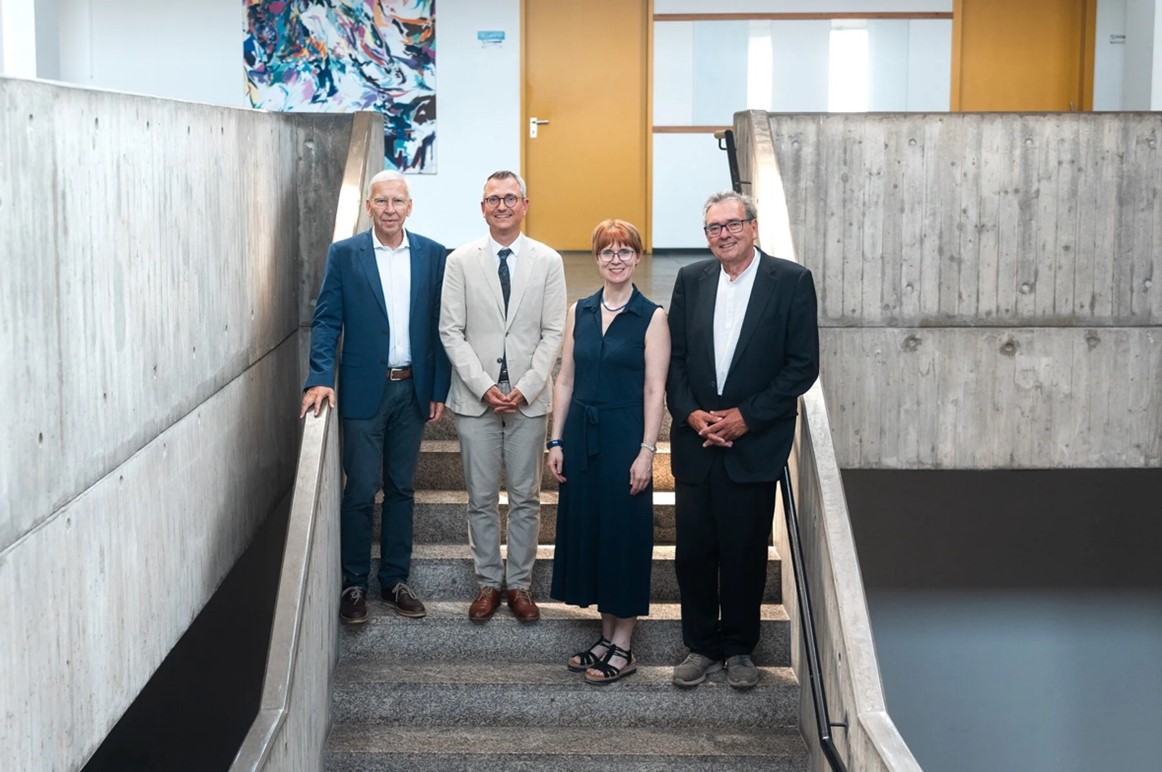
Astrid Ensslin is a Professor for Dynamics of Virtual Communication Spaces here in the Department of Interdisciplinary and Multiscalar Area Studies (DIMAS) and previously served as the University of Regensburg’s (UR) Commissioner for Gender Equality in Science and the Arts (external link, opens in a new window).
Commenting on her election, she said: “Digitalization, particularly in the field of AI, as well as public outreach, open up a wide range of opportunities for the University of Regensburg in research, teaching, knowledge transfer, and academic administration. I would like to strategically develop and connect these opportunities together with all staff and student groups.”
The entire DIMAS team congratulates Astrid Ensslin on her election and looks forward to working with her as a member of the university leadership.
In connection with her election as vice president, we asked Astrid Ensslin a few questions about her new role:
1. With the planned amendment to the Bavarian Higher Education Innovation Act, the Free State of Bavaria aims to enshrine in law that universities may no longer prohibit the use of AI in exams through their examination regulations, in conjunction with a new disclosure requirement. The UR has already established its own framework for the sustainable and ethical use of AI through its AI guidelines. How do you view this initiative from Munich in relation to the UR’s existing approach?
The responsible and competent use of AI is already a key pillar of media literacy—a skill our graduates must possess, regardless of their personal career paths. Whether we approve of it or not, AI will play an increasingly important role in our daily lives, and academically trained professionals must master various ways of interacting with it so fluently that they can act autonomously and continue their education in this area in the future. In my opinion, this is only possible through a critical, sustainable, informed, and pedagogically guided approach to different language models and prompting methods. Therefore, the Free State’s initiative is to be welcomed. However, the “ban on bans” has already been firmly institutionalized at the UR since the publication of its AI guidelines (external link, opens in a new window), and all UR user groups can read there how they are permitted to use generative AI, how they can use it, and how they should not use it. Data protection (external link, opens in a new window), copyright (external link, opens in a new window), and sustainability (external link, opens in a new window)play a particularly significant role in this regard.
2. You’ve been conducting research on digital communication spaces for years and have published on topics such as AI-assisted authorship. How does this research perspective influence your view of how AI is currently being used in teaching and learning?
My research focuses on a relatively small aspect of the field of language modeling, specifically within the realm of digital literary and communication studies. I am interested in models of authorship and new forms of scientific communication, in which chatbots can certainly play a central, narrative role—for example, as interlocutors, sparring partners, or narrative voices in dialogic forms of publication. Chatbots are, in a sense, co-authors, but at the same time they synthetically reproduce the voices of millions of other authors, and thus the co-creation of texts and images becomes a closely interwoven blend of transformer models, a human data collective, and the author. This exchange should be analyzed not only in terms of the textual products that result from it, but also in the performative sense of a posthumanist, performative art of language—a dramaturgy between human and machine.
But I also explore generative AI in my teaching and experiment with new, formative, and collaborative approaches to university pedagogy and assessment. Instead of individually written assignments, which often lead many students to use AI irresponsibly, students in my courses are explicitly allowed to use language models to illustrate their design concepts—for example, in creative-scientific game design—with concept art or to “vibe-code” mini-prototypes. However, this always includes a reflective text component in which the working groups document their approaches, their critical engagement with prompt design, and the relative successes of incorporating generative AI, and link these to reports on project management. An academic essay on the theoretical and intellectual sources is also part of such a portfolio, but it must be directly aligned with the co-creative components, which makes the thoughtless use of AI more difficult and promotes independent academic writing.
But all of this is still a work in progress for me, and I look forward to exchanging ideas with all UR members who work with language models and would like to share their experiences.