

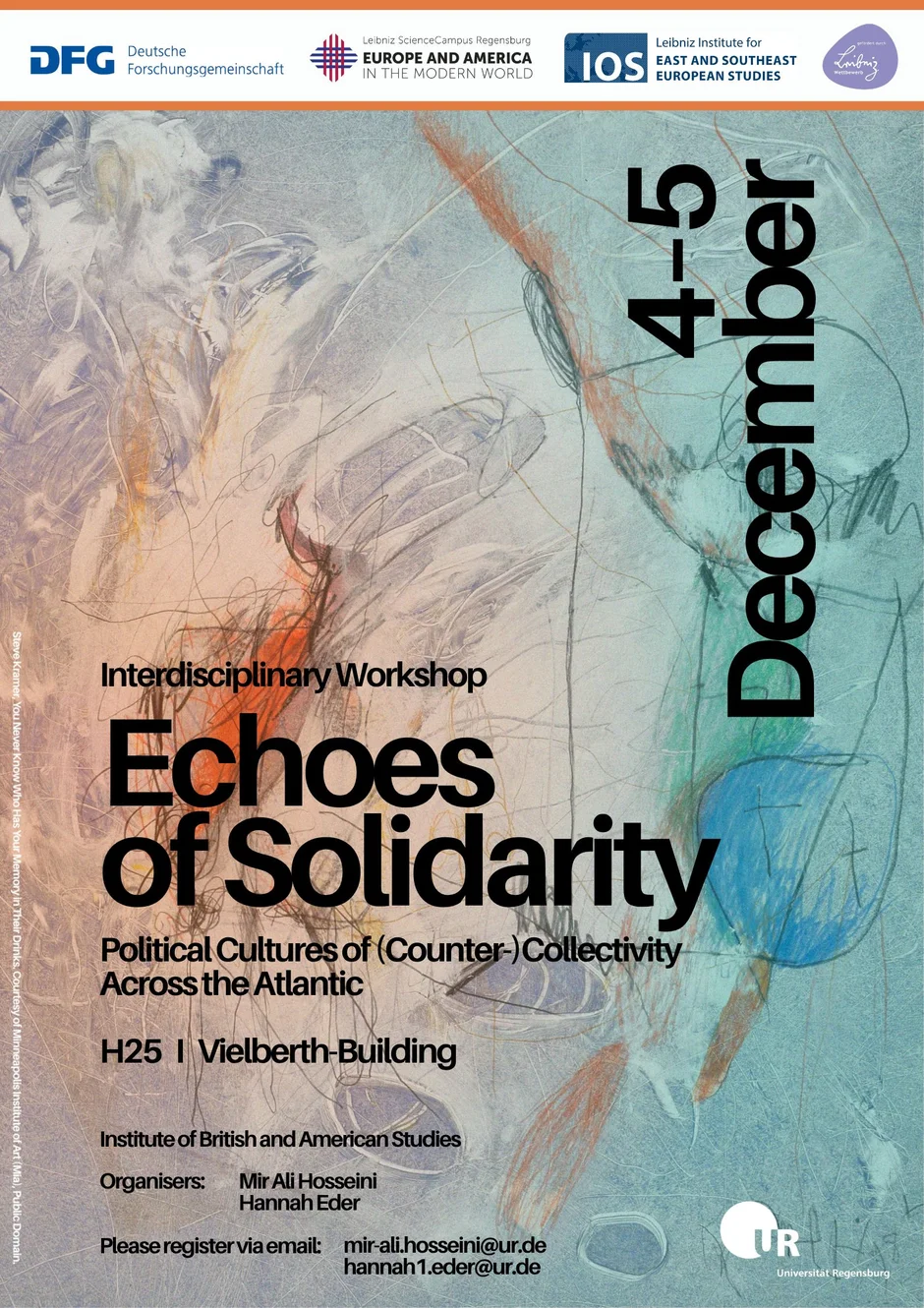
Event: Echoes of Solidarity: Political Cultures of (Counter-)Collectivity
Location: H25
- Speakers:
- Keynotes: Johannes Voelz (Goethe University Frankfurt), Laura Bieger (Ruhr-University Bochum), Mark Schmitt (Humboldt-University of Berlin), Anne Brüske (UR), Jan Marschelke (UR); Organisers: Mir Ali Hosseini & Hannah Eder (UR)
- Event type:
- Workshop
- Target groups:
- public, university-wide
- Event language:
- English
After the Second World War, political thought in Western liberal democracies was increasingly marked by a sense of exhaustion, as articulated, for instance, in Daniel Bell’s The End of Ideology (1960) and Judith Shklar’s After Utopia (1957). In the twenty-first century, that exhaustion has not disappeared so much as taken on new forms. As philosopher Rodrigo Nunes argues, contemporary political cultures are marked by a persistent ‘fear of organisation’ rooted in the failed collectivist experiments of the twentieth century, which ‘have imprinted in our collective memory and imagination’. Established modes of political organisation and collective identification have been weakened to the point where political imagination appears stalled.
At the same time, this exhaustion unfolds amid a period of intensifying crises. Ecological catastrophe, neoliberal austerity, fragmented public spheres, political polarisation, the rise of authoritarianism, and declining trust in media and institutions simultaneously drain and overstimulate political life. ‘We live on the precipice of infrastructure collapse’, cultural theorist Lauren Berlant diagnosed, sketching existence in the twenty-first century as an unsettling state where ‘what used to be called alienation [...] is experienced at once as sensual saturation and physical exhaustion’. For Berlant, now more than ever, new forms of coming together and new terms for infrastructural transformation have to be forged.
Our workshop responds to this conjunction of impasse and turbulence by focusing on how collectivity is remembered or reconfigured, how alternative ways of being with others are imagined and worked out, and how practices of coming together are re-politicised within, alongside, or against hegemonic institutions. We are interested in how people come to envision themselves as part of a shared world, and how such attachments have been fractured, reworked, and transformed over the past century. We ask how artistic and cultural production critically engages with past, present, and future modes of collectivity, and how conditions such as precarity, authoritarianism, perpetual crisis, war, and migration enable and constrain collective formations. More broadly, we attend to both the erosion of dominant forms of collectivity and the emergence of alternative solidarities, collectivities, and political cultures of being together across the Atlantic. Overall, we approach collectivity not as a fixed concept or category, but as a contested field of social, political, cultural, affective and embodied relations through which commonality and belonging are produced, negotiated, and disrupted.
During our workshop we aim to spark conversations and establish synergies within an interdisciplinary group of senior and early-career researchers whose projects explore the meaning, form, and formation of (counter-)collectivities in theory, literature, art, film, and performance throughout the twentieth and twenty-first century.
Venue
H25
Universitätsstraße 31
93053 Regensburg
Your cookie settings have blocked this map.
Organiser
Dr Paul Vickers
Coordinator - Leibniz ScienceCampus
Universität Regensburg
Room 051, Sedanstr. 1
93055 Regensburg
0941 943 5964
campus@europeamerica.de