

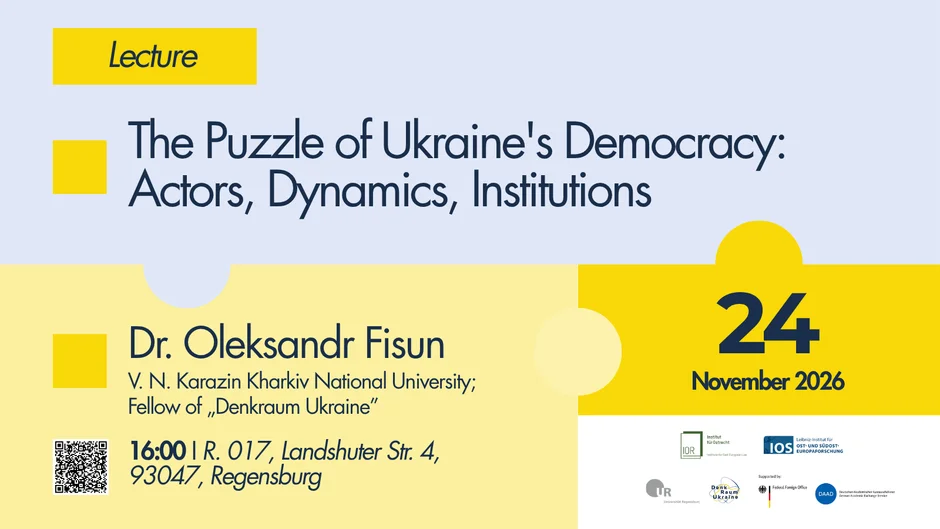
Event: The Puzzle of Ukraine's Democracy: Actors, Dynamics, Institutions
Time: 16:00
Location: IOS
- Speakers:
- Oleksandr Fisun (V. N. Karazin Kharkiv National University, Ukraine; Fellow of „Denkraum Ukraine”)
- Event type:
- Lecture
- Target groups:
- public, university-wide
- Event language:
- English
Abstract
The lecture aims to outline the pathways of Ukrainian democratic development from the country's independence in the early 1990s to the current full-scale Russian invasion of Ukraine and propose an alternative hypothesis about its origins. In contrast to many other post-Soviet countries, Ukraine's political system, despite all odds, has always demonstrated strong democratic bias, political pluralism, and competitive politics. The speaker argues that the unexpected dynamics of informal institutions, patronal politics, and practical republicanism may provide the key to understanding this puzzle.
Oleksandr Fisun
Dr. Oleksandr Fisun is a professor and the head of the Political Science Department at V.N. Karazin Kharkiv National University in Ukraine. His research primarily focuses on Ukrainian politics and post-Soviet transformations, as well as the formal and informal political institutions in comparative, regional, and global contexts.
Over the past decade, Dr. Fisun has held visiting fellowships at various academic institutions, including the Kennan Institute at the Wilson Center, the Polish Institute of Advanced Studies, the Ukrainian Research Institute at Harvard University, the Institute for European, Russian, and Eurasian Studies (IERES) at George Washington University, and the Institute for Advanced Study at Central European University.
Dr. Fisun's publications include the book "Democracy, Neopatrimonialism, and Global Transformations" (Kharkiv, 2006) as well as numerous chapters and articles on comparative democratization, informal politics, neopatrimonialism, and regime change in Ukraine and post-Soviet Eurasia.
His current research interests focus on Ukraine’s political regime trajectories since independence, with a special emphasis on the interplay between formal and informal political institutions at both national and regional levels. As a DU Fellow, he plans to examine subnational politics and local governance in Ukraine after the decentralization reform, which has significantly strengthened the societal resilience of Ukraine’s regions during the full-scale Russian invasion.
Venue
IOS
Landshuter Str. 4
R. 017