

We explore quantum science on its shortest relevant length and time scales. With newly developed slow-motion cameras we videotape and control the intrinsic quantum motion of the elementary building blocks of matter – electrons, atoms and molecules – directly in space and time. Together with our partners at the Regensburg Center for Ultrashort Nanoscopy (RUN) (external link, opens in a new window), we combine atomic spatial resolution with a temporal resolution better than a single light cycle. Our research provides key insights into the complex many-body physics of novel quantum materials, and lays the foundations for quantum technologies of tomorrow.
Main research areas
  • Lightwave electronics

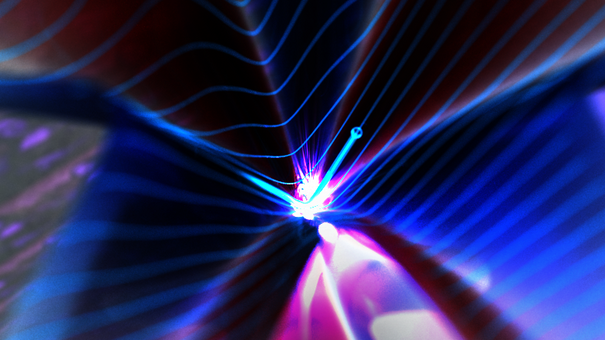
    We use the carrier wave of light as an ultrafast bias to accelerate electrons at optical clock rates and to create new phases of matter.

    Image: © Brad Baxley, PtW

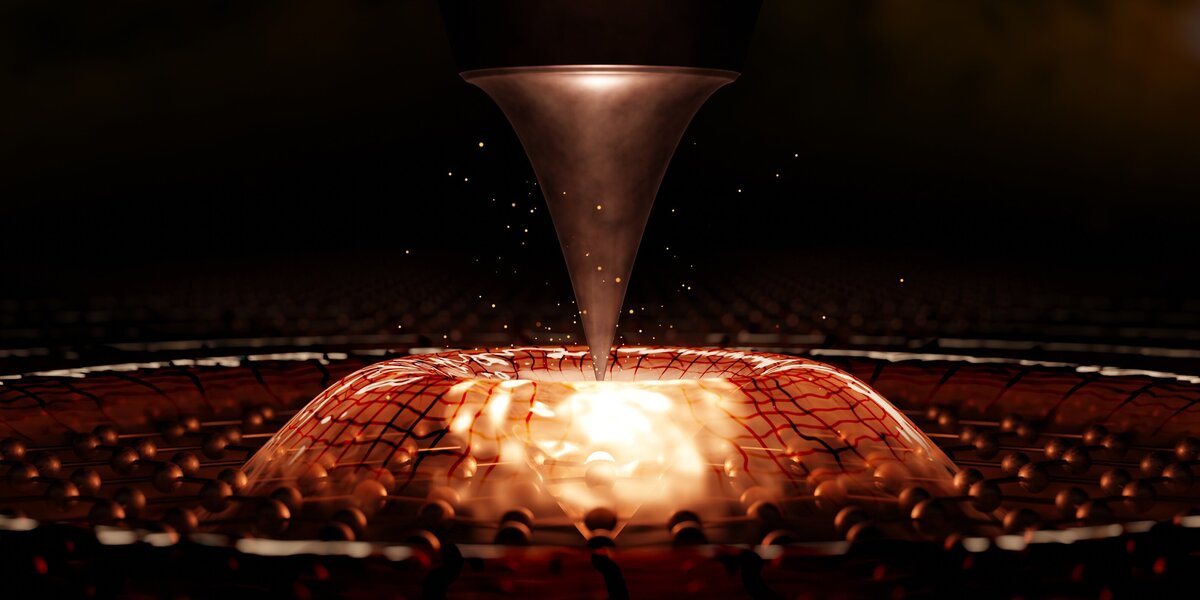
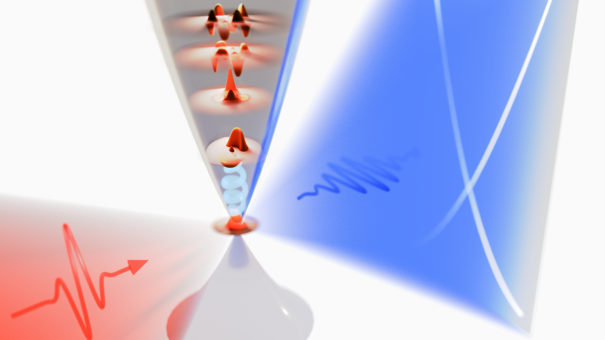
  • Subcycle nanoscopy

    We visualize and control the ultrafast quantum motion of electrons and atoms directly in space with a time resolution better than a cycle of light.

    Image: © Brad Baxley, PtW

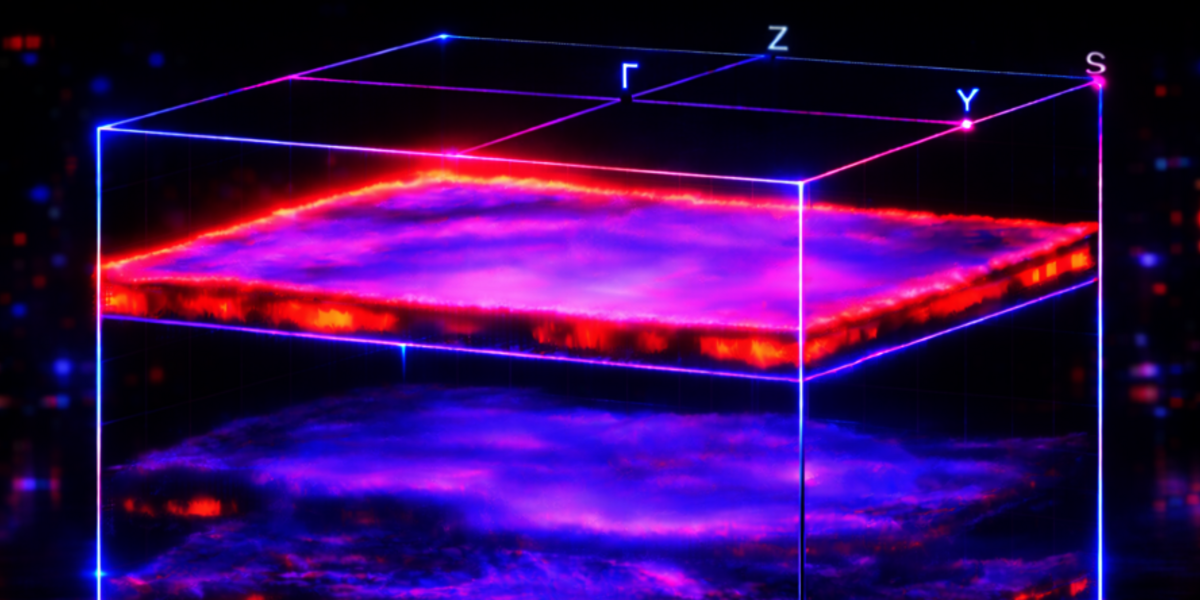
  • Subcycle momentum videography

    We watch electrons moving through the band structure of quantum materials and videotape their orbital quantum motion inside molecules.

    Image: © Brad Baxley, PtW

Lightwave electronics

We use the carrier wave of light as an ultrafast bias to accelerate electrons at optical clock rates and to create new phases of matter.

Image: © Brad Baxley, PtW

Subcycle nanoscopy

We visualize and control the ultrafast quantum motion of electrons and atoms directly in space with a time resolution better than a cycle of light.

Image: © Brad Baxley, PtW

Subcycle momentum videography

We watch electrons moving through the band structure of quantum materials and videotape their orbital quantum motion inside molecules.

Image: © Brad Baxley, PtW

Selected publications

Quantum leap microscopy (external link, opens in a new window)

We demonstrate Ångström-scale optical modulation using a standard mid-infrared tabletop laser. The effect arises from light emission driven by laser-induced tunneling currents between a metallic tip and a surface – even under weak continuous-wave excitation. This discovery opens the door to ultra-high-resolution optical imaging with conventional setups.

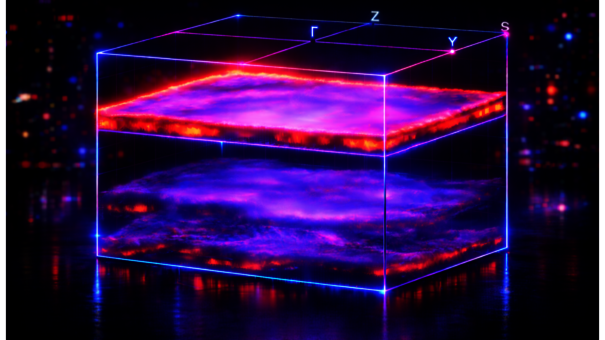
Observation of an isolated flat band in the van der Waals crystal NbOCl₂ (external link, opens in a new window)

Using photoelectron momentum microscopy, we have mapped the complete two-dimensional band structure of the van der Waals crystal NbOCl₂. Our measurements reveal an almost perfectly flat band that spans the entire momentum space and is well separated from all other, dispersive bands. This uniquely isolated flat band establishes NbOCl₂ as an ideal platform for investigating correlation-driven phenomena, as well as for exploring the role of dispersionless quasiparticles in lightwave electronics and light-induced band engineering.

Terahertz spacetime film in graphene (external link, opens in a new window)

RUN researchers utilized a novel near-field method to directly image and control the spacetime dynamics of terahertz surface plasmon polaritons in graphene. This provides a direct determination of their group and phase velocities and damping.

News

Events

Our work is supported by
The German Science Foundation (external link, opens in a new window)

with funding for SFB 1277, GRK 2905, EXC 3122, as well as individual grants and major instrumentation grants

The European Research Council (external link, opens in a new window)

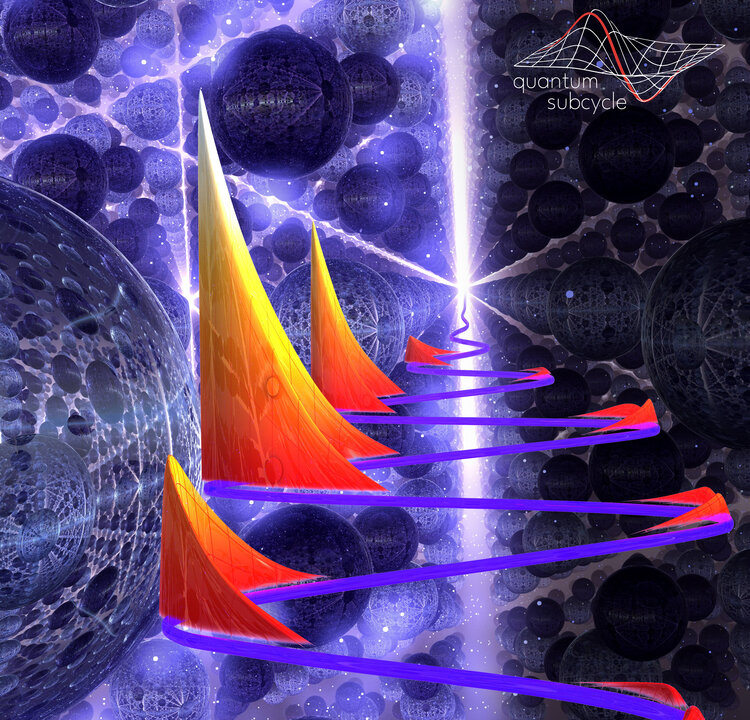
through several grants, including ERC grant 101071259 (Orbital Cinema), and ERC grant 305003 (QUANTUMsubCYCLE)

The Alexander von Humboldt Foundation (external link, opens in a new window)

with numerous past and current postdoctoral fellowships

The State of Bavaria and the Federal Republic of Germany (external link, opens in a new window)

funding the Regensburg Center for Ultrafast Nanoscopy according to Art. 91b Abs. 1 Satz 1 GG

Further links

To top