

Drittmittel

Der von der DFG geförderte Exzellenzcluster „Center for Chiral Electronics (externer Link, öffnet neues Fenster)“ (CCE) bringt führende Forschende aus Physik und Chemie in Halle (Saale), Berlin und Regensburg zusammen.
Das CCE wird das einzigartige Potenzial der Chiralität in Festkörper- und molekularen Systemen erforschen, um elektronische Technologien der nächsten Generation zu entwickeln – leistungsstark und energieeffizient – und damit der wachsenden Nachfrage nach einer nachhaltigeren digitalen Infrastruktur gerecht zu werden.

Zusammen mit Leo Gross (externer Link, öffnet neues Fenster) (IBM Zurich) und Diego Peña (externer Link, öffnet neues Fenster) (University Santiago de Compostela) erhielten wir einen ERC Synergy Grant für unser Projekt “Molecular Devices by Atom Manipulation” (MolDAM).
Mehr Informationen über ERC Synergy Grants. (externer Link, öffnet neues Fenster)

SFB 1277 (externer Link, öffnet neues Fenster): “Emergent Relativistic Effects in Condensed Matter"
RTG 2905: “Ultrafast Nanoscopy” (externer Link, öffnet neues Fenster)
Einzelprojektförderungen
| Dauer | Projektname |
|---|---|
| 2020 – 2023 | “Ultrafast single molecule videography with sub-Ångström resolution” #432343901 |
| 2017 – 2020 | “On-surface synthesis of covalently bonded molecular structures on insulators” #391347986 |
| 2017 – 2023 | “Single-Electron Alternate-Charging Scanning Tunneling Microscopy on Insulating Surfaces” RE #391277787 |
| 2007 – 2015 | Lichtenberg Professur der Volkswagen- Stiftung |
Verbundprojekte
| Dauer | Projektname |
|---|---|
| 2026 - 2032 | EXC 3112 Cluster of Excellence Center for Chiral Electronics |
| 2025 - 2030 | GRK 2906 “Ultrafast Nanoscopy: From single particle dynamics to cooperative processes” |
| 2021 - 2027 | ERC-Synergy grant “Single Molecular Devices by Atomic Manipulation" |
| 2017 – 2029 | SFB 1277 “Emergent Relativistic Effects in Condensed Matter: From Fundamental Aspects to Electronic Functionality” |
| 2014 – 2017 | Partner des EU-ITN-Projekts “MOLESCO” |
| 2014 – 2017 | SFB 689 “Spin phenomena in reduced dimensions” |
| 2014 – 2017 | GRK 1570 “Electronic Properties of Carbon–Based Nanostructures” |
| 2014 – 2017 | Bilaterales DFG-GAČR-Projekt mit Pavel Jelínek |
| 2010 – 2013 | SFB 689 “Spin phenomena in reduced dimensions” |
| 2009 – 2012 | GRK 1570 “Electronic Properties of Carbon–Based Nanostructures” |
| 2008 – 2013 | DFG-Schwerpunktprogramm 1243 |
Research Topics
Thick-film studies
Alternate-Charging STM (AC-STM): (externer Link, öffnet neues Fenster)
AC-STM combines tunnelling-based electron transfer with atomic force microscopy to probe single molecules on insulating substrates. By synchronizing voltage pulses with an oscillating AFM tip, controlled single-electron charging and discharging is induced via tunnelling—similar in principle to STM, but without requiring a conductive substrate. The resulting charge transfer is detected with single-electron sensitivity through the AFM signal. This enables measurements of electronic structure as a function of charge state, going beyond STM-based orbital mapping to reveal redox-dependent transitions and charge-induced changes in molecular properties.
Excited State Spectroscopy (AC-STS): (externer Link, öffnet neues Fenster)
Building on the above working principle, Excited State Spectroscopy is a single-molecule technique that provides direct access to a wide range of quantum states. Through controlled attachment and removal of single electrons, the method probes radiative, non-radiative, and charge-related transitions within one unified experiment. This enables precise determination of energies and lifetimes of excited states, and even the preparation of molecules in defined excited configurations—offering a comprehensive view of molecular electronic dynamics beyond the reach of conventional spectroscopy.
Electron Spin Resonance - Atomic Force Microscopy (ESR-AFM): (externer Link, öffnet neues Fenster)
ESR-AFM combines the atomic precision of atomic force microscopy with electron spin resonance to detect spin transitions in individual molecules. A major challenge in current-based sensing, such as ESR-STM, is the inherent interaction between the tunneling current and the spin, which significantly limits coherence times. By utilizing a pump-probe AFM detection scheme, we enable coherent spin manipulation over tens of microseconds. This approach allows us to characterize quantum states with sub-nanoelectronvolt resolution, paving the way for investigating the atomistic origins of decoherence and conducting fundamental quantum-sensing experiments.
Lightwave-driven STM
With state-of-the-art experimental setups combining low-temperature STM in an ultra-high vacuum environment with ultrashort laser pulses, we have developed techniques to resolve ultrafast dynamics of single-atom and single-molecule quantum systems on their intrinsic length, time and energy scales. In a collaboration with the group around Rupert Huber (externer Link, öffnet neues Fenster), we employ pulsed light sources of different frequencies to cover a range of time scales to observe dynamics ranging from attosecond charge transfer in atomic-resolution STM to motion of individual molecules on a surface or shifting electronic energy levels of atomic vacancies due to phononic motion.
Terahertz STM (externer Link, öffnet neues Fenster)
Ultrashort terahertz pulses in the tunneling junction of an STM act as an ultrafast bias voltage. We have developed both lightwave-driven STM and lightwave-driven scanning tunneling spectroscopy to selectively address specific energy levels on timescales of the order of hundreds of femtoseconds. Thereby, we can take snapshots of molecular orbital densities in space allowing for molecular movies as well as snapshots of spatially confined states in energy to follow the temporal evolution of the local density of states. Investigated systems range from single molecules to atomic defects in transition metal dichalcogenides.
In our lightwave-driven STM setup employing a magnetic field as an additional turning knob, we envision disentangling ultrafast dynamics on atomic scales with additional access to the spin degree of freedom.
Near- and mid-infrared STM
By utilizing near- and mid-infrared light pulses, we push the boundaries of the time resolution of lightwave-driven STM to the single-femtosecond and ultimately attosecond regime. This approach enables the observation of electron dynamics with combined sub-cycle temporal and atomic spatial resolution. We envision directly accessing dynamics such as electron propagation in nanostructures or chemical reactions on their intrinsic timescales.
On-Surface Chemistry
Organic synthesis under UHV conditions confined to well-defined surfaces provides a powerful platform for the synthesis of by other means inaccessible compounds hosting fascinating properties like tailored edge states, exotic band structures, emergent π-magnetism and electron correlation. Our goal is the synthesis of novel compounds exhibiting such properties, which, among other challenges, requires the exploration of new reaction schemes.
In addition, chemical reactions of organic molecules can be induced and controlled by applying voltage pulses with the STM tip. Well-known examples include the tautomerization of porphyrinoids or carbon-ring rearrangements. We aim to expand the range of tip-induced reactions while also deepening the understanding of the reaction mechanisms. Beyond STM and nc-AFM for structural characterization we employ Kelvin probe force spectroscopy (KPFS) to access charge states while lightwave-driven STM may provide temporal resolution.
Labs
Our microscopes are operated under ultra-high vacuum (UHV) and cryogenic temperature (10K and below) conditions. This allows examining single molecules under clean and stable conditions.
Combined Scanning Tunneling/Atomic Force Microscopes

These two equivalent setups are based on a qPlus sensor design, which allows us to perform scanning tunneling microscopy (STM) and atomic force microscopy (AFM) measurements simultaneously. Functionalizing the tip with additional atoms or molecules enables the AFM study of intramolecular phenomena with sub-ångstrom precision. These microscopes are also capable of employing the newly developed AC-STM technique, which allows the investigation of molecular orbitals on insulating surfaces.
Room PHY 2.01.06 / Phone Number -6051
Lightwave Scanning Tunneling Microscope
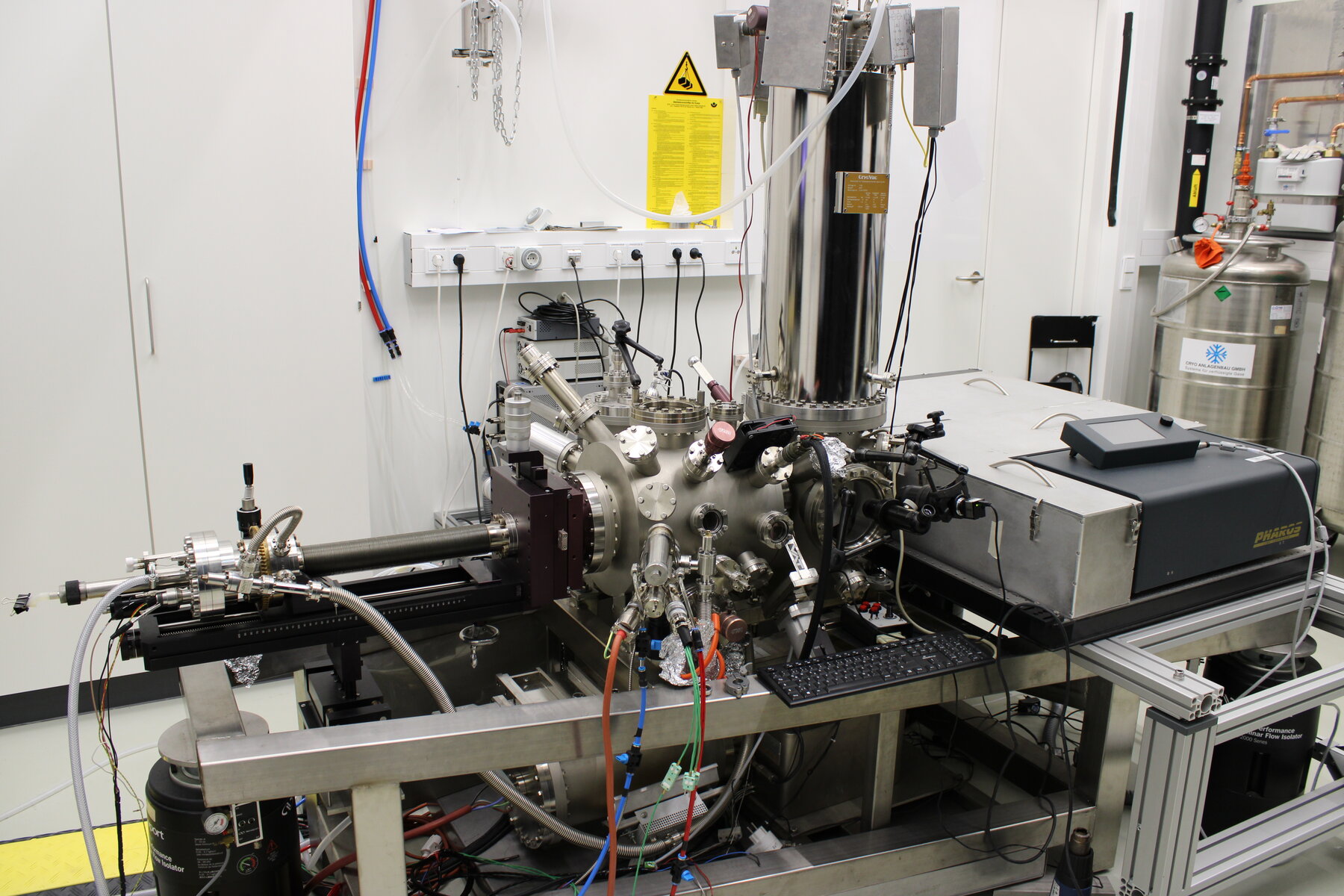
One of the most recent developments in a collaboration with the group of Prof. Rupert Huber at the University of Regensburg culminated in the establishment of lightwave scanning tunneling microscopy (LW-STM). Here, phase-stable laser pulses in the terahertz regime are coupled into the tunneling junction, which act as a transient bias voltage. This permits the manipulation of single electrons on a femtosecond time scale and can be used to track the motion of individual molecules with sub-molecular precision.
Room RUN U.2.34 / Phone Number -69721
2K/9T Scanning Tunneling Microscope
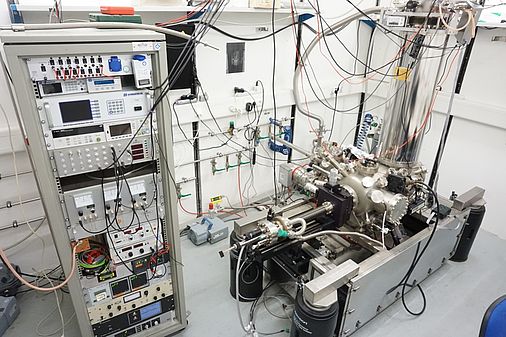
The cryostat of this microscope is equipped with a so-called 1K-pot allowing for a sample temperature of slightly below 2 K, while a solenoid magnet can provide magnetic fields of up to 9 T. This combination of temperature and field allows for inelastic spin-flip excitations to be detected in scanning tunneling spectroscopy, such that this microscope is dedicated to spin-related studies.
Room PHY 2.01.08 / Phone Number -6051
mK/10T Scanning Tunneling Microscope
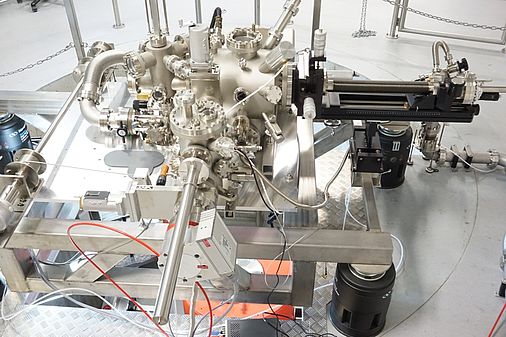
Furthermore, we are setting up a scanning tunneling microscope dedicated to reach lowest temperature in a dilution cryostat, while facilitating sample preparation under ultra-high-vacuum conditions. In scanning tunneling spectroscopy, the temperature determines the energy resolution. Hence, the goal of setting up this apparatus is reaching highest resolution and being able to study very-low energy excitations. We aim at reaching temperatures of 50 mK.
Room PHY 2.01.12A / Phone Number -6051
Infrared Lightwave Scanning Tunneling Microscope

With this next-generation lightwave-driven scanning tunneling microscope we reach low-femtosecond time scales by driving the tunneling process with sub-cycle mid- and near-infrared laser pulses. The novel microscope head facilitates an integrated optical mirror and a dedicated optical pathway to couple the laser into the cryostat. This development is pursued in a collaboration with the group of Prof. Rupert Huber.
Room PHY 8.01.04A / Phone Number -1904
Towards lightwave-driven scanning tunneling microscopy in a magnetic field
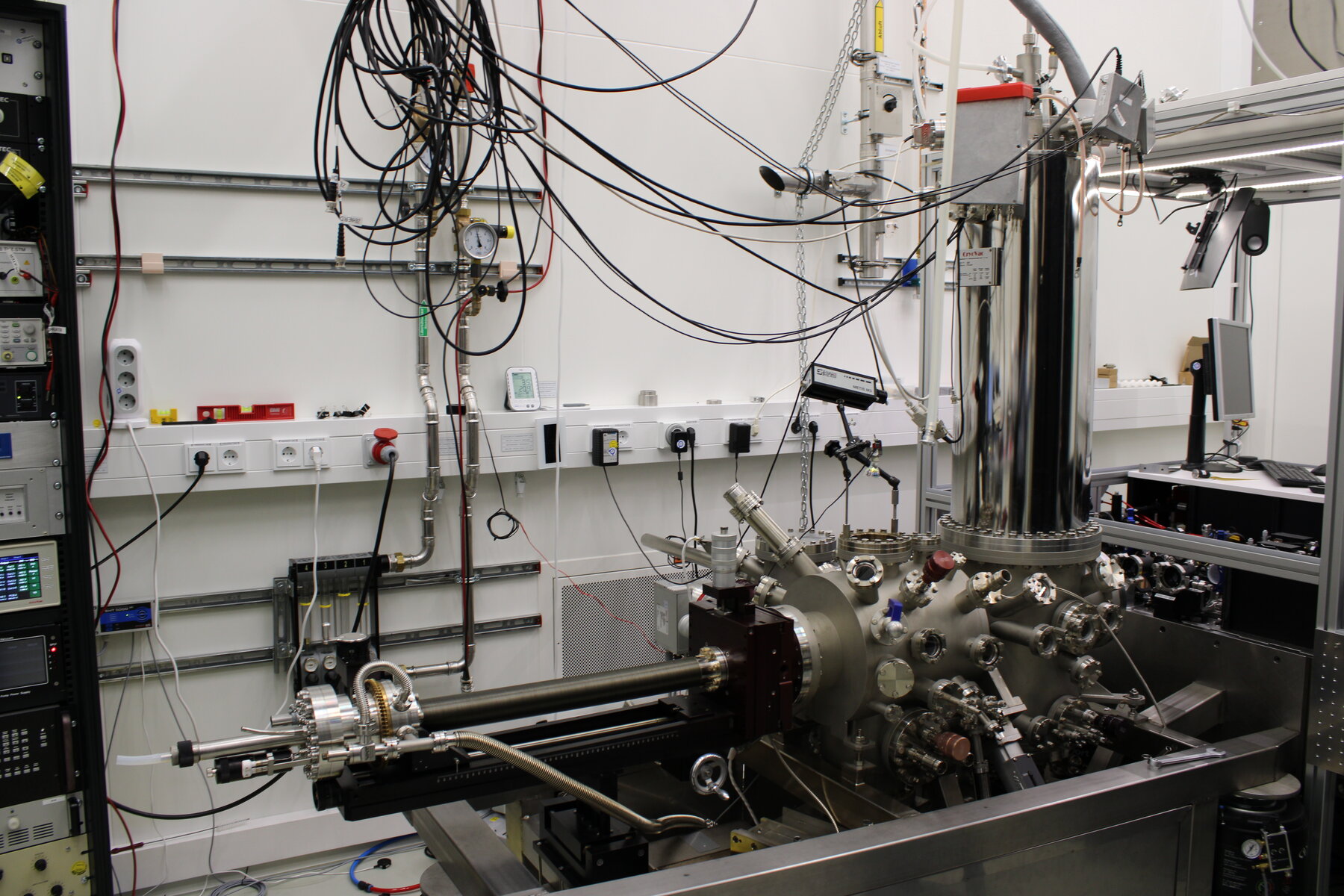
Currently, next-generation lightwave-driven scanning tunneling microscopes are being build, in collaboration with the group of Prof. Rupert Huber. In the framework of the collaborative research center 1277 we are establishing lightwave-driven scanning tunneling microscopy in a magnetic field (3T) to study single-spin precession and related phenomena directly in the time domain at the atomic scale.
Room RUN U.2.34 / Phone Number -69721