

Customised enzyme activity, stability and quaternary structure
The generation of enzymes with a desired combination of structure, activity and stability is the central goal of protein engineering.
To achieve this goal, we utilise both directed evolution (the combination of random mutagenesis and selection or screening) and rational design (the introduction of specific amino acid replacements based on structural or mechanistic considerations).
For example, through directed evolution we were able to significantly increase the low catalytic activity of a dimeric metabolic enzyme, while through rational design we were able to generate a fully active monomeric variant of this enzyme.
Based on these achievements, we are now performing sophisticated computational rational design to modify the interaction specificities between the protein subunits of different enzyme complexes.
Light control of enzymes
The targeted control of enzyme activity by light is a rapidly growing field of protein design and synthetic biology.
One such approach, which is being pursued in collaboration with the group of Prof Burkhard König (organic chemistry, University of Regensburg), is based on the use of photoswitchable small molecules that act as competitive enzyme inhibitors. The conformation of these photoswitches is altered by irradiation, which leads to a different affinity for the active centre and thus enables us to fine-tune the catalytic activity by light.
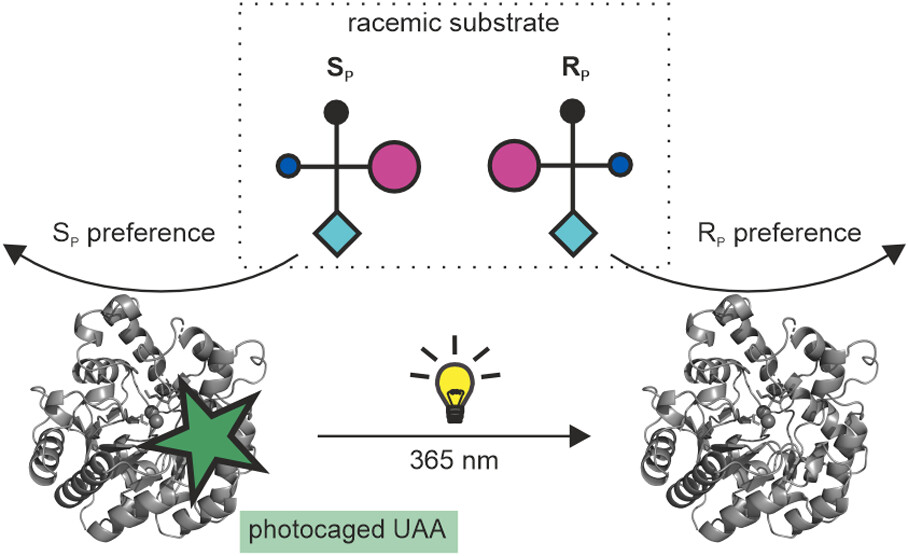
Furthermore, we have used caged photosensitive unnatural amino acids to regulate the enantioselectivity of an enzyme by light.
Finally, we have used photoswitchable unnatural amino acids to reversibly light-control the propagation of an allosteric signal within a hetero-dimeric enzyme complex.