

Reconstruction of the predecessor sequence
We carry out molecular palaeontology in order to determine the amino acid sequences of proteins of extinct species by computation.
Following such an ancestral sequence reconstruction (ASR), the corresponding ancestral enzymes are produced and experimentally characterised.
In collaboration with the group of Prof. Rainer Merkl (Biochemistry II, University of Regensburg), we applied ASR to characterise a single enzyme and an enzyme complex from the last universal common ancestor of all organisms (LUCA) or the last universal common ancestor of all bacteria (LBCA).
These precursor proteins were highly thermostable and catalytically active, suggesting that highly evolved enzymes and enzyme complexes already existed 3.5 billion years ago.
We have also used ASR to identify residues that are crucial for the functional properties of various enzymes.
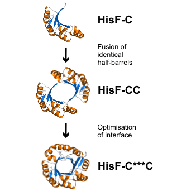
Evolutionary relationship between primary and secondary metabolism
It is generally assumed that enzymes of secondary metabolism have evolved from enzymes of primary metabolism.
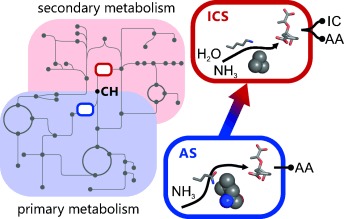
We have tested this hypothesis using the chorismate-utilising enzymes anthranilate synthase (AS) from primary metabolism and isochorismate synthase (ICS) from secondary metabolism.
Both enzymes catalyse mechanistically related reactions using ammonia and water as nucleophile, respectively.
We found that the nucleophile specificity of AS can be extended from ammonia to water by exchanging only two amino acids in a channel leading to the active site.
The observed ICS/AS bifunctionality demonstrates that a secondary metabolic enzyme can readily evolve from a primary metabolic enzyme without the need for initial gene duplication.
We have used a similar approach to reconstruct the evolution of an atrazine-degrading enzyme from a precursor with (dimethyl-)guaninedeaminase activity.