

M.A. European-American Studies
Navigation
Are you curious about European dimensions within US-American culture? Are you interested in histories of entangled spaces, forms of cultural exchange beyond and across borders, and political debate and responsibilities? Are you looking for inspiring intellectual exchange? Then apply for this master's program at the University of Regensburg! Benefit from the special combination of scholarly expertise, cutting-edge research, and practical experience in this master's program and become a part of the international research community offered at the University of Regensburg!
Gallery



Objectives
- Pursuing transnational approaches to American Studies, students acquire extensive and in-depth knowledge of the politically and culturally diverse relations and entanglements between Europe and America from the Early Modern period to the present. They are enabled to read, interpret, and contextualize a wide variety of textual, visual, and audiovisual material as well as material objects, they learn how to relate these materials to the major topics, developments, and problems of European-American relations and entanglements in past and present, and they are able to explain the relevance of the topics taught and researched in the master's program for our own present.
- Students learn to read, compare, and reflect the theories, concepts, and methods currently circulating in the field of American Studies and European-American Studies. The program enables them to critically assess and explore the value and the reach of the theories, concepts, and methods for their own analytical work with the materials for the study of European-American relations and entanglements. These competencies and skills are especially trained in the fields of “spaces, regions, spheres,” “mobilities and cultural transfers,” and "politics and responsibilities".
- Students learn how to find sources and research literature, how to use the resources and tools of academic research specific to the field, and how to read, evaluate, and process the relevant research literature. This enables them to conduct their own research and work independently on topics and issues in the field of European-American Studies.
- Students learn how to independently develop, research, and write academic papers of different size and scope that are based on evidence and draw on current theories, concepts, and methods to analyze the materials. Students are able to demonstrate that they can conduct theory-driven and method-based investigations of topics relevant to the field of European-American Studies, and that they can critically apply the theories, concepts, and methods to these investigations. In writing their scholarly papers, preparing oral presentations, and navigating diverse academic communicational situations, students learn how to organize themselves and their workload, they enhance their media skills and information competencies, and they are trained to present the results of their research in adequate forms and formats catering to different and specific audiences. As a result, students learn how to express themselves with precision in terms of content and form, and they develop a broad range of communicative skills.
- During the program, students develop a high degree of intercultural and interdisciplinary competence that transcends their expertise in the field of European-American Studies by far. All courses are taught in English, and they teach students how to read and interpret texts and diverse cultural materials emerging from a broad diversity of cultural contexts. Courses systematically explore the dynamics of cultural encounters and transnational knowledge negotiation and transfer. At the end of the program, graduates are able to apply their expertise and competencies in the field of cultural studies and cultural history to other world regions and cultures.
What to Expect
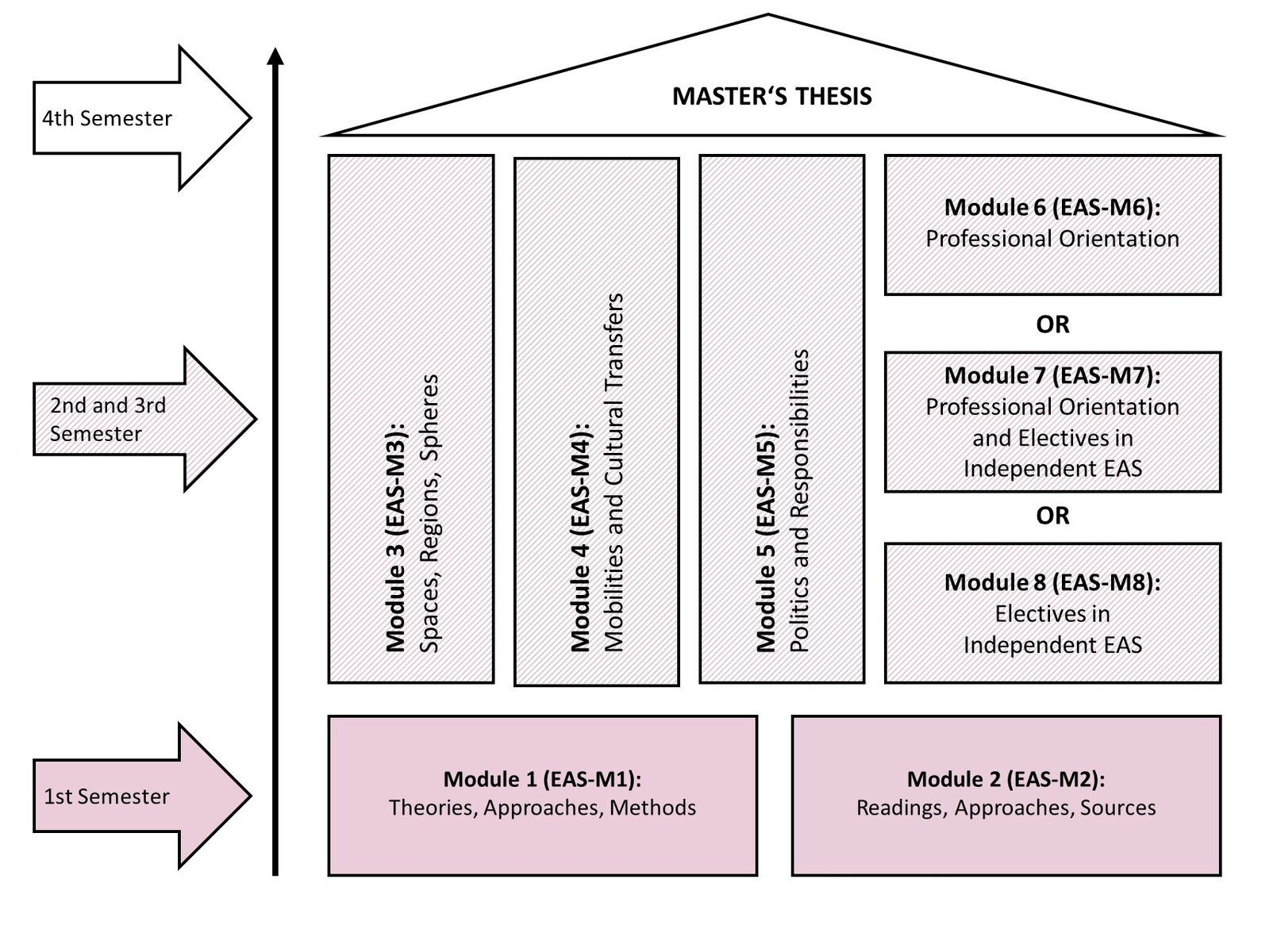
After an introduction to fundamentals of transnational American Studies (modules 1 and 2), you will have the chance to participate in courses from our three main pillars (modules 3-5):
- "spaces, regions, spheres"
- "mobilities and cultural transfers"
- "politics and responsibilities"
Finally, you can deepen your understanding by focusing on an area of your choice (modules 6, 7, or 8).
Application
- Deadline June 1 (to start your studies in the following winter semester)
Application need to be submitted via our application platform: Campusportal (SPUR). Applications sent via email will not be considered.
Requirements
- Applicants are required to hold an above-average first academic degree completed in a program with components related to the study of North America and Europe-usually a B.A., state exam, or equivalent, or a higher academic degree.
- Applicants must also demonstrate their aptitude for the American Studies graduate program. See the application documents and procedures below.
- The M.A. program in European-American Studies is an English-language program. Applicants must possess an excellent command of English at level C1 of the Common European Framework of Reference for Languages or higher (or equivalent). (UR students please note: successful completion of the General Language Course C certifies English skills on level C1).
Application Documents
Please send the following documents via SPUR :
- CV (including the exact titles + grades of your qualifications as well as the full name of the university you received your B.A./academic degree from, documentation of relevant stays abroad, documentation of relevant academic and extra-curricular activities such as internships, projects, etc.)
- a cover letter in English (approx. two pages)
- B.A. certificate (or equivalent): if the B.A. certificate is not yet available, please include an official transcript amounting to at least 150 credit points or 5/6 of the required courses and exams of your program.
- certified translation of B.A./academic degree certificate (only if certificate is NOT in German or English)
- a transcript of academic records, that lists the attended courses and documents hitherto achieved credit points (at least 150 credit points) as well as your grade average
- certified translation of transcript (only if transcript is NOT in German or English)
- a thesis-driven academic essay (including works cited) in English of 12,000-15,000 characters (including blanks). The essay topic for the winter semester 2026/27 is this:
“In a recent opinion piece in the New York Times, Stephen March argues that under the second presidency of Donald Trump, the United States has experienced a dramatic erosion of its cultural power, to the extent that it is no longer widely perceived as “a paragon of cool,” particularly among younger generations. Drawing on examples from literature, film, music or other media, pick two case studies from different periods and analyze the changing status of the U.S. cultural power in European-American relations.” The article is available for download: America is Losing the Fight for the Teenagers of the World (Stephen March) (opens in a new window). (This PDF is not accessible).
- English-language certificate (level C1 or equiv.): this is an obligatory document in order to apply (even if your BA was in English!). Exception: Only if you have obtained a study degree at a secondary or post-secondary American institution, you do not need to submit an English language certificate. (UR students please note: successful completion of the General Language Course C certifies English skills on level C1).
- Certificate of your secondary school degree (high school or equiv.), even if you have already obtained your B.A. or an M.A. degree
- certified translation of certificate of your secondary school degree (only if it is NOT in German or English)
- certificate of university entrance exam (if applicable in your country)
- international applicants: copy of passport
- applicants from China, Vietnam, and India: APS Certificate
- any other relevant certificates
Please note:
- All high school and university documents must be submitted in the original language and in either English or German. Simple copies of certificates and certified translations are sufficient for the application. However, all original documents must be shown at the Registrar's Office for enrollment.
- The M.A. program in European-American Studies is an English-language program. It is recommended to hold or acquire basic German language skills (level A1 or equiv.) in order to benefit fully from the interdisciplinary range of the program and attend classes in related disciplines.
Links
Please visit the International Office's website for further information for international students.
Orientation Program "Startklar" for International Students
Contact
Structure
- 4 semesters / 120 credit points (including M.A. thesis)
- 10 courses + M.A. thesis + freely selectable project or practical component (internship)
Regulations
Please use the following links to get to the examination regulations (called “Prüfungsordnung” in German) and detailed module descriptions (called “Modulkatalog” in German):
- Studien-/Prüfungsordnung ab WS 2012/2013
- Studien-/Prüfungsordnung ab WS 2018/2019
- Module catalog M.A. European-American Studies (valid for study begin in or after winter semester 2018/19; in German)
English versions
- Examination regulations (translation updated on 25th November 2025)
- Module catalog valid for study begin in or after winter semester 2018/19 (translation updated on 25th November 2025)
Please note that these translations are for informational purposes only and not legally binding!
Curriculum
Curriculum (for students starting in 2018 or later)
The current course catalog for MEAS will help you find courses for the respective modules. Please note that in modules 3-5 you will be able to choose among several courses offered in the respective area each semester, e.g., there will be different thematic courses on European-American spaces, regions, and spheres for module 3.
The module handbook (Modulbeschreibung (opens in a new window). (This PDF is not accessible)) (external link, opens in a new window) / English version (opens in a new window). (This PDF is not accessible)) provides detailed information concerning credit points (ECTS), workload, course requirements etc.
Disclaimer:
This document is provided for informational purposes only. It Is not legally binding. You can find the official (German) version of the module description (Modulkatalog) here

Internship
This master's program allows you to include electives in independent EAS, i.e. seminars and courses of your choice, within your studies and/or do an internship at an institution of your choice (modules 6, 7, or 8). You can complete the internship in the semester breaks between your 2nd and 4th semesters or, if the internship takes more than 3 months, during the semester.
To find a suitable position and get an overview where students have done their internships in the past, you can have a look at the Grad Student Forum.
In addition, the following links might be helpful to find an internship position:
- For a list of possible internship offers abroad, please visit the website of the International Office.
- Funding options for internships in Europe with ERASMUS+ and outside of Europe with PROMOS
- Internship Links to search engines and placement agencies worldwide
It is possible, but not obligatory, to take an "Urlaubssemester" (semester off) for an internship or stay abroad. For more information, please visit the website of the Studierendenkanzlei.
Thesis
At the end of your course of study you are required to write a master's thesis in order to illustrate your academic skills.
Preparation
- Talk to your chosen thesis advisor (approximately around the end of your 3rd semester).
Registration
- To register your M.A. thesis at the Prüfungsamt (not in FlexNow), please fill in the registration form "Antrag auf Zulassung zur Masterarbeit." The thesis can be registered at any time during the semester; there are no specific registration dates for each semester. Once your thesis is registered, you have four months to write it. Students have to be enrolled the entire time it takes for them to write and hand in the thesis.
Formalities
- Length: 60-80 pages
- Submit 3 copies: 2 printed copies, 1 digital copy (pdf)
- Title page: see "Anlage 2" of the "Studien-/Prüfungsordnung"
- To verify that your work (= ideas, structure, words) is wholly your own and that material from the work or works of others has been cited, you need to submit a signed plagiarism declaration with every piece of written work.
Results
- You can look at the written assessment of your M.A. thesis in the Prüfungsamt within one month after having received your M.A. grade (but not afterward).
More Information
See §21 and §22 of the “Studien-/Prüfungsordnung” for detailed information on writing and registering your M.A. thesis.
Certificate
The M.A. certificate is issued in German and English.
Final Grade
- Final grade (for students who started in 2018 or later): the overall grades of modules 1 and 2 count 5% each, of modules 3-5 20% each, and of the M.A. thesis 30% towards your final grade.
Getting Your Certificate
- Once you have completed all modules including your M.A. thesis (at the end of your sixth semester at the very latest), fill in the "Antrag auf Ausstellung des Abschlusszeugnisses" and take it to the Prüfungsamt. You can either pick your certificate up in person (you will be informed via e-mail when you can do so) or have it sent to a postal address of your choice.
Academic Advisors
In addition to the degree program coordinators, the academic advisors at the Department of English and American Studies can help you with questions regarding your studies (especially content-related questions):
M.A. European-American Studies:
Contact
Degree Program Coordination
- E-mail address: studienorg.iaa(at)sprachlit.uni-regensburg.de (opens your email program)
- Tel: 0941 943-3667 (starts a telephone call, if your device allows this)
- Location: PT, 3.2.62
-
Important information:
Susanne Gürtner, M.A. (Tuesday–Friday)
Gabriele Mödl, M.A. (Monday–Thursday)
Melissa Deiß, M.A., student assistant
**************
We offer in-person office hours in PT 3.2.62. There is no need to make an appointment in advance.
Monday: 10 am–12 pm (no office hours on Monday, November 9)
Tuesday: 10 am–12 pm
Wednesday: 10:30 am–12:30 pm
Thursday: 10 am–12 pm
**************
For questions concerning your M.A. application, please contact Application.MasterDEAS@ur.de.