

Winter term 2026/2027
Courses
Lectures
- Administrative Law II
- Infrastructure Law (Energy Law), SP3
Seminar
- Learning to Write – Language and Style in Law Studies and the Dissertation
Seminars / Colloquium
- Seminar on Public Economic Law
- PhD Seminar
Please refer to the notice on GRIPS (external link, opens in a new window) for dates and room allocations.
Summer term 2026
Courses
Lectures
- Administrative Law III (Construction and Local Government Law)
- Public Commercial and Business Law
- Real estate law (Public Real Estate Law)
Seminars / Colloquium
- Seminar on the Legal Framework for Sustainable Transformation
- PhD Seminar
Please refer to the notice on GRIPS (external link, opens in a new window) for dates and room allocations.
Winter term 2025/2026
Courses
Research leave
- Seminar (Legal Framework for Sustainable Transformations – Current Challenges in Public Commercial, Property and Regulatory Law)
Specialisation in Political Economy and Social Policy
A warm welcome to the homepage of Research Area 12 – Public Commercial and Business Law
Are you
- interested in the important area of life that is the economy?
- Do you have a passion for public law and fancy a specialisation programme with high academic standards?
- value an overlap with the compulsory course content?
- Are you looking for a specialisation with excellent career prospects?
Then the Public Economic Law specialisation is the perfect choice for you! We examine public law as it relates to the economy. Using this area of life as an example, we also revisit key aspects of the compulsory curriculum: we revisit european law and constitutional law, general and specific administrative law, and security and public order law. All key forms of legal action are covered: parliamentary acts and statutory regulations, administrative acts and real acts, as well as contracts under public and civil law. The career prospects in commercial and business law could scarcely be better. You can establish your first professional contacts directly whilst studying this specialisation. On the one hand, experienced practitioners from a wide variety of fields enrich teaching in Regensburg, whether in lectures or in discussion sessions. On the other hand, we are able to offer attractive field trips. For example, we visit law firms and trade associations, federal ministries and federal courts.
Courses
1. Public Commercial and Business Law (2 SWS)
Public commercial and business law governs the economic activities of private individuals as well as those of the public sector. The lecture examines the instruments, forms and regulations through which the state seeks to facilitate and regulate economic activity. Topics covered include trade and hospitality law, craft trades law, as well as modern regulatory law and the law on subsidies.
Professor Hartmann regularly teaches public and commercial and business law in the summer semester.
2. Planning Law (1 SWS)
Planning law governs the procedures and principles according to which public contracts are awarded. It covers the procurement of services, construction works or the supply of goods. Following the major waves of privatisation in the 1990s and the requirement under EU law to introduce legal review mechanisms, at least in the above-threshold sector, the importance of planning law has continued to grow.
The course focuses primarily on the area of above-threshold procurement, as set out in Sections 97 et seq. of the German Act against Restraints of Competition (GWB). This ranges from the conditions for the application of planning law, through the establishment of criteria for the selection of goods, services or construction works as well as contractors, to the award criteria and evaluation, right through to the conduct of tendering procedures and the monitoring of compliance with regulations. In addition, we will examine sustainable procurement. Together with me, you will work through this new area of law using case studies and academic articles. In this way, you will not only familiarise yourselves with a new area of law – planning law – but also deepen your understanding of administration and general administrative law.
Professor Krämer-Hoppe regularly teaches planning law in the summer semester.
3. Telecommunication law (2 SWS)
Telecommunication law is a modern, multifaceted and interdisciplinary field of law with technical and economic implications. It can primarily be classified under specialised (economic) administrative law. At the same time, the telecommunications regulatory framework forms the basis of the entire information economy, which explains its dual placement within both specialisation area 7, ‘law of the information society’, and the former specialisation area 9, ‘commercial and business law’, as well as the new specialisation area 12, ‘public law’. The (new) legal issues that regularly arise as a result of the constant technical development of telecommunications and the significant reshaping of telecommunications regulation under EU law, most recently through the GIA (Gigabit Infrastructure Act) – or, in German, the Gigabit Infrastructure Ordinance – make this area of law particularly interesting for law students and those studying for the LL.B. in Digital Law. Against this background, following a brief explanation of the technical and economic background essential to understanding telecommunication law, as well as its links to EU law and constitutional law, the lecture provides an overview of the systematic structure and main features of the Telecommunications Act (TKG). In doing so, it also addresses current debates (e.g. ‘legally guaranteed right to high-speed internet’, ‘amendment of the TKG’, ‘frequency allocation’, etc.) and situates them within the legal framework. With regard to aspects of economic administrative law, the lecture explores general issues of public law, such as constitutional rights or the performance and allocation of tasks within a federal state and within the European Union, but also administrative law issues such as the scope of the Administration’s discretion and margin of appreciation. A compilation of the relevant statutory texts, a timetable and an outline of the lecture content will be made available on the University of Regensburg’s e-learning platform (‘G.R.I.P.S.’) before the start of the course. The supporting materials for the lectures (e.g. PowerPoint slides) will also be available there before the start of each lecture session. The lecture will be held as a face-to-face session.
Professor Kühling regularly teaches telecommunication law in the winter semester.
4. Colloquium on Public Commercial and Business Law
The colloquium offers an excellent opportunity to engage in discussion on public commercial and business law. It takes place either as a separate course in Regensburg or as a field trip (see below, under ‘Other courses and additional offerings’).
Professor Hartmann regularly offers the Colloquium on Commercial and Business Law in the summer term.
5. Law on Restrictions on Competition (2 SWS)
Antitrust law, or the ‘law on restrictions on competition’ (in EU law: ‘law of competition’), safeguards competition against restrictions imposed by companies operating in the markets. It is of considerable importance to the economy as a whole, as its purpose is to preserve competition as an institution. To this end, it prohibits any impairment of competition through agreements between undertakings and similar measures. For example, it prohibits price-fixing and territorial agreements, or, within certain limits, price wars in the retail sector, as well as excessively high electricity and gas prices. It also serves to regulate corporate mergers.
Competition law is a complex legal subject: it cannot be clearly classified under civil law, administration law or the law on administrative offences. This is because breaches of the provisions of competition law are subject to sanctions from all three areas of law; in other words, they are enforced by means of administration, administrative offences law and civil law. The substantive legal provisions consist largely of general clauses designed to ensure that undertakings behave independently in the markets and that competition is maintained. There are largely uniform European provisions (Articles 101 and 102 TFEU, Merger Regulation) and German regulations (Act against Restraints of Competition, GWB). – There are links to planning law, which is also partly regulated by the Act against Restraints of Competition, and to the state aid provisions of the TFEU, to specific regulations for the energy and telecommunications markets, and to the more recent legal acts on platform regulation.
Professor Bauermeister regularly teaches antitrust law in the summer semester.
6. Academic Decision-Making Workshop (2 SWS)
This course is aimed at all students who have attended the two constitutional law lectures and are interested in an in-depth discussion of current constitutional court decisions and contentious issues. It forms part of the specialisation programme in specialisation areas 2, 3 (new), 4, 7, 8, 10, 12 (new) and 13.
We depart from the lecture-based teaching method customary in Germany and structure the course in line with teaching practices in the Anglo-American world, based on discussion with you (‘Socratic method’). This allows us, above all, to address your specific needs and the difficulties you encounter when dealing with legal affairs.
We will announce the case law to be discussed in advance so that everyone can work through it (‘reading assignment’) and discuss it before the session begins. This is also intended to practise the approach required for preparatory seminar papers. The marking of seminar papers and term papers shows that independently identifying recent developments in case law – for example, through current judgements – and subsequently contextualising them within existing frameworks repeatedly poses problems. Furthermore, students often lack the courage to engage in critical evaluation. This course aims to deliberately break away from the often predominant approach to legal problems via secondary literature (‘reading commentaries’ rather than ‘reading judgements’) and to encourage critical discourse, which is often neglected in ‘traditional’ lectures. As Kant put it: ‘Have the courage to use your own understanding!’
We will introduce the course at the start and then take turns discussing relevant case law with you. The material will be made available before each lecture session.
Professors Kingreen and Kühling offer the Academic Decision-Making Laboratory regularly in both the winter and summer semesters.
7. Seminars (2 SWS each)
Summer Semester 2025
Urban Planning Law in Times of Housing Shortages, Climate Change and the Energy Transition
Professor Dr Bernd J. Hartmann
Dr Maximilian Dombert, Solicitor
We will discuss current and fundamental legal affairs relating to urban planning law in times of housing shortages, climate change and the energy transition. Students from the former SP 3 (real estate law), the new SP 3 (Regulatory Law of Sustainability – RRN) and the new SP 12 (public commercial and business law – ÖWiR) are invited to attend. The seminar may also be attended outside a specific specialisation area. It is open to both term papers and seminar papers. The student who achieves the best performance in the seminar will receive a certificate and a book of their choice from the Nomos publishing house’s academic catalogue as a reward. You can find out more about the Best Paper Award online (www.go.ur.de/bestpaperaward (external link, opens in a new window)).
Dates: 14, 21 and 28 May, 4, 11 and 18 June 2025
Further links: GRIPS (external link, opens in a new window), EXA (external link, opens in a new window)
8. Other events and additional offerings
SUMMER SEMESTER 2025
Excursion to Leipzig
During the summer semester 2025, the Chair of Public Law, commercial and business law and administrative sciences is organising an excursion to Leipzig from 7 July to 10 July 2025. We have two main aims: Firstly, we wish to provide an insight into the career paths in public law that are open to lawyers. Secondly, we will focus particularly on climate protection law, urban planning and its implementation, both at local authority level and beyond. To this end, we will visit the Federal Administrative Court, attend an oral hearing and explore the architecture of the building. We will learn about the EEX electricity exchange, hear from the City of Leipzig about urban planning following the reunification in 1990 and today, and visit the law firms Luther and Maslaton. Thanks to the generous support of the Faculty of Law at the University of Regensburg, we are able to provide a substantial subsidy for the trip. Please apply by 9 May, as detailed in our invitation.
SUMMER SEMESTER 2024
Excursion to Berlin
During the summer semester of 2024, the Chair of Public Law, Commercial and Business Law and Administrative Sciences organised an excursion to Potsdam and Berlin. We gained an insight into career opportunities in public law. We also addressed issues relating to sustainability law. We were able to visit the Federal Ministry of Justice (BMJ), the Federation of German Industries (BDI) and the law firm Dombert Rechtsanwälte. You can find the details in our travel report (external link, opens in a new window).
Exams
1. Seminar paper in the preparatory seminar
You will complete the seminar paper as part of a seminar. You will submit a written paper and present it to your fellow students and the seminar tutor – i.e. your professor – in an oral presentation. You can either choose the topic of your academic work from a list of suggestions or it will be assigned to you (similar to the term paper). The exact procedure depends on the seminar tutor and will be communicated to you in the run-up to the respective seminar. If you wish to write your term paper in SP 12 – ÖWiR, we recommend that you also enrol on the preparatory seminar with us: the seminar paper is the best preparation for the term paper in the ÖWiR specialisation.
2. Student research project
Once you have completed your preparatory seminar, you will write your term paper in a further seminar. The term paper is similar to the seminar paper: as part of a seminar, you will produce an academic paper and present your findings orally. Unlike the seminar paper, however, the topic will be allocated to you: the Faculty Examinations Office will draw it at random from the proposals submitted by the lecturers of SP 12 – ÖWiR. You will then have four weeks to work on the assignment, during which you can choose between different submission dates. By selecting a specific seminar led by a particular member of the teaching staff, you can exert some influence over the field from which the topic of your student research paper is drawn.
3. Oral specialisation examination
The oral examination covers the content of the various specialisation lectures. We focus primarily on testing your grasp of the fundamentals. If you have attended the lectures, engaged with the material and participated actively, and have revised the subject matter using the lecture notes, you will be well prepared for the oral examination.
Teaching staff: the ‘we’ in ÖWiR
The courses in this specialisation are supervised by
- Professor Dr Tabea Bauermeister
- Professor Dr Bernd J. Hartmann, LL.M. (Virginia) – Spokesperson
- Professor Dr Thorsten Kingreen
- Professor Dr Rike Krämer-Hoppe
- Professor Dr Jürgen Kühling, LL.M.
In addition, contributions from practitioners enrich this focus area
Seminars
2 May 2025
Seminar: ‘Urban Planning Law in Times of Housing Shortages, Climate Change and the Energy Transition’ in the summer term 2025
In the summer semester 2025, Professor Hartmann, together with Dr Dombert (Dombert Rechtsanwälte), will be offering a seminar on urban planning law. We will discuss current and fundamental legal affairs relating to urban planning law in times of housing shortages, climate change and the energy transition. Students from the former SP 3 (real estate law), the new SP 3 (Regulatory Law of Sustainability – RRN) and the new SP 12 (public commercial and business law – ÖWiR) are invited to attend. The seminar may also be attended by students outside a specific specialisation area. It is open to both term papers and seminar papers. The student who achieves the best performance in the seminar will receive a certificate and a book of their choice from the Nomos publishing house’s academic catalogue as a token of recognition.
12 April 2024
Seminar on Parliamentary Law in the 2024/25 winter semester
In the winter semester 2024/25, Professor Hartmann will be offering a seminar on parliamentary law. The seminar is open to students in all years who have successfully completed the lecture course on constitutional law. Details on potential seminar paper topics and the preliminary meeting can be found here (external link, opens in a new window). Please register (external link, opens in a new window)via Flexnow (external link, opens in a new window). As always, the student who achieves the best performance in the seminar will receive a certificate and a book of their choice from the Nomos publishing house’s academic catalogue as a token of recognition.
17 November 2023
‘Climate Protection’ Seminar in the 2024 Summer Semester
In the summer semester 2024, Professor Hartmann will be offering a seminar on climate protection law. We will discuss current and fundamental legal affairs relating to climate protection. The seminar is based on both (preparatory) seminar papers and term papers in Focus Area 3 (real estate law).
Specific topic suggestions for the seminar papers and further information on the formal requirements can be found here (external link, opens in a new window).
Topics will be allocated during a preliminary meeting on Wednesday, 17 January 2024, at 4.00 pm (c.t.) in Room H24 (Vielberth Building). The number of participating students is limited. The seminar will take place every Wednesday at 6.00 pm (sharp) during the summer semester 2024; the room is yet to be announced.
Excursions
2 March 2025
Excursion to Leipzig to visit the Federal Administrative Court and other sites – applications are now open!
During the summer semester of 2025, the Chair of Public Law, Commercial and Business Law and Administrative Sciences is organising an excursion to Leipzig from 7 July to 10 July 2025. We have two main objectives: Firstly, we aim to provide an insight into the career opportunities in public law available to lawyers. Secondly, we will be paying particular attention to climate protection law, urban planning and its implementation, both at local authority level and beyond. To this end, we will visit the Federal Administrative Court, attend an oral hearing and explore the architecture of the building. We will learn about the EEX electricity exchange, hear from the City of Leipzig about urban planning following the political changes of 1990 and today, and visit the law firms Luther and Maslaton.
11 July 2024
“Berlin, Berlin, we’re off to Berlin” – and to Potsdam!
In the summer term of 2024, Professor Hartmann’s Chair of Public Law, commercial and business law and administrative sciences, in cooperation with the public-law firm DOMBERT Rechtsanwälte, organised an excursion to Potsdam and Berlin. The trip on 20–21 June 2024 had two main aims: firstly, we gained an insight into career paths in public law that are open to lawyers. Secondly, we focused particularly on climate protection law and its enforcement, both at local authority level and beyond. We visited the Federal Ministry of Justice (BMJ), the law firm and the Federation of German Industries (BDI).
Best Paper Award

Book prize for the best written exams and seminar papers
There is something to be won for all written exams set by Professor Hartmann and in all the seminars he teaches: whoever writes the best written exam or seminar paper will not only be awarded a certificate, but will also be allowed to choose their favourite book from the legal study literature (external link, opens in a new window) published by Nomos. The ‘Best Paper Award’ has been presented since the summer term of 2017. You can find out more about the award – which has been covered by NDR radio and, most recently, the *Neue Juristische Wochenschrift* (NJW, issue 50/2017, p. 18 of the main section) – in a press release from epd (external link, opens in a new window) and in the *Neue Osnabrücker Zeitung (external link, opens in a new window)*.
Teaching projects
JURA – Legal Education
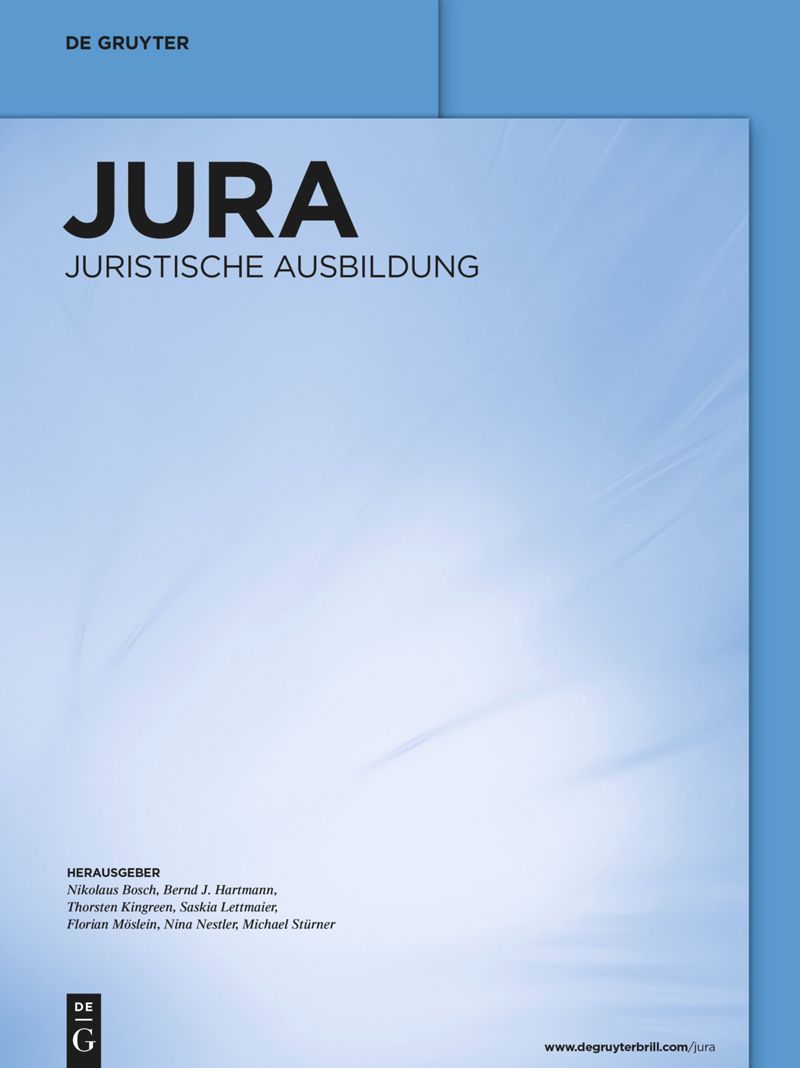
Professor Hartmann is co-editor of the monthly legal education journal JURA (external link, opens in a new window) (external link, opens in a new window).
In addition to essays and case law analyses, Hartmann also regularly publishes index cards containing case solutions for law students.