

Training objective
In any legal profession, confident and effective communication is essential. Even during legal training, trainees are required to conduct interviews and counselling sessions, as well as deliver oral arguments. For this reason, the German Judges Act (Section 5a(3), first sentence, DRiG) stipulates that key practical communication skills must be incorporated into law degree programmes. However, this statutory training mandate and the high practical relevance of the topic of ‘communication skills’ are reflected only to a limited extent, if at all, in the course offerings of most German law faculties. The situation is quite different at the Faculty of Law at the University of Regensburg: Here, the REGINA Training Centre offers a practice-oriented programme in the field of communication within legal practice. The curriculum covers a broad spectrum of subject-specific courses and extends to preparation for legal competitions. The programme is aimed at Regensburg law students in all semesters.
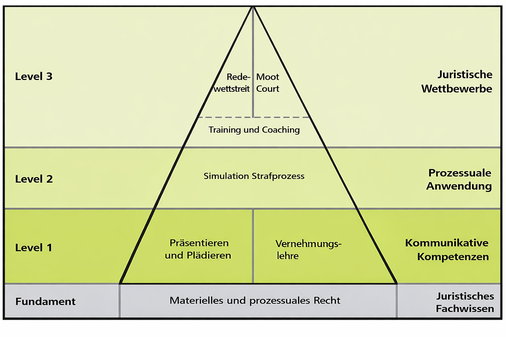
Pyramidal structure
At the first level, students are taught and practise the fundamental skills required for typical legal communication situations. Building on this, in the second level, students have the opportunity, under supervision, to further practise the skills they have learnt in trial simulations (currently limited to criminal law) using realistic cases from legal practice. Finally, in the third level, following individual REGINA training, students can test their skills against fellow students from their own university and other law faculties in moot courts or the Regensburg ‘Linklaters Public Speaking Competition’. The levels build on one another in terms of difficulty – however, it is possible to join directly at Level 2 or 3.