

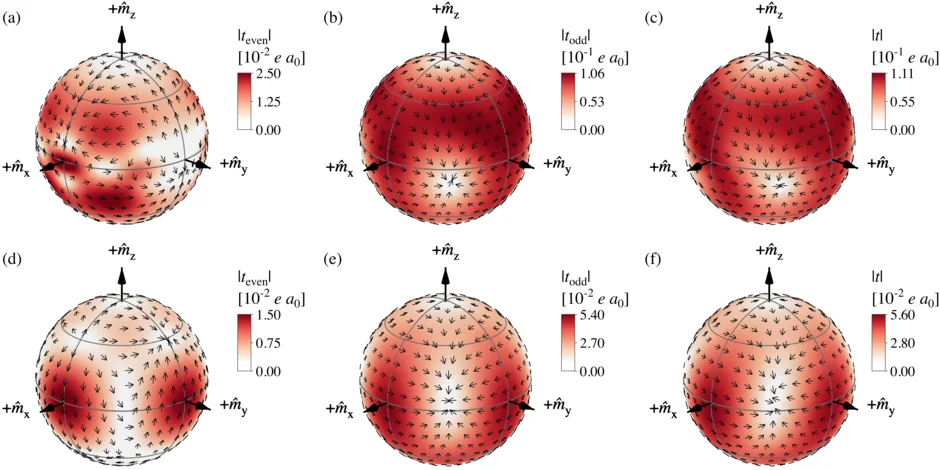
Our article “Anatomy of spin-orbit torques in monolayer Fe₃GeTe₂ and Fe₃GaTe₂” published as Editors’ Suggestion
(October 2026)
In this collaboration with colleagues from Lausanne, we explored from first principles the spin-orbit torques in the two-dimensional ferromagnets FGT and FGaT, and related the torque characteristics to marked differences in the bandstructures of these materials.
Our results have been published in Physical Review B as Editors’ Suggestion (external link, opens in a new window).
Our preprint “Unconventional spin momentum locking and topological domains in twisted slabs of topological insulator Bi₂Te₃” published on arXiv
(October 2026)
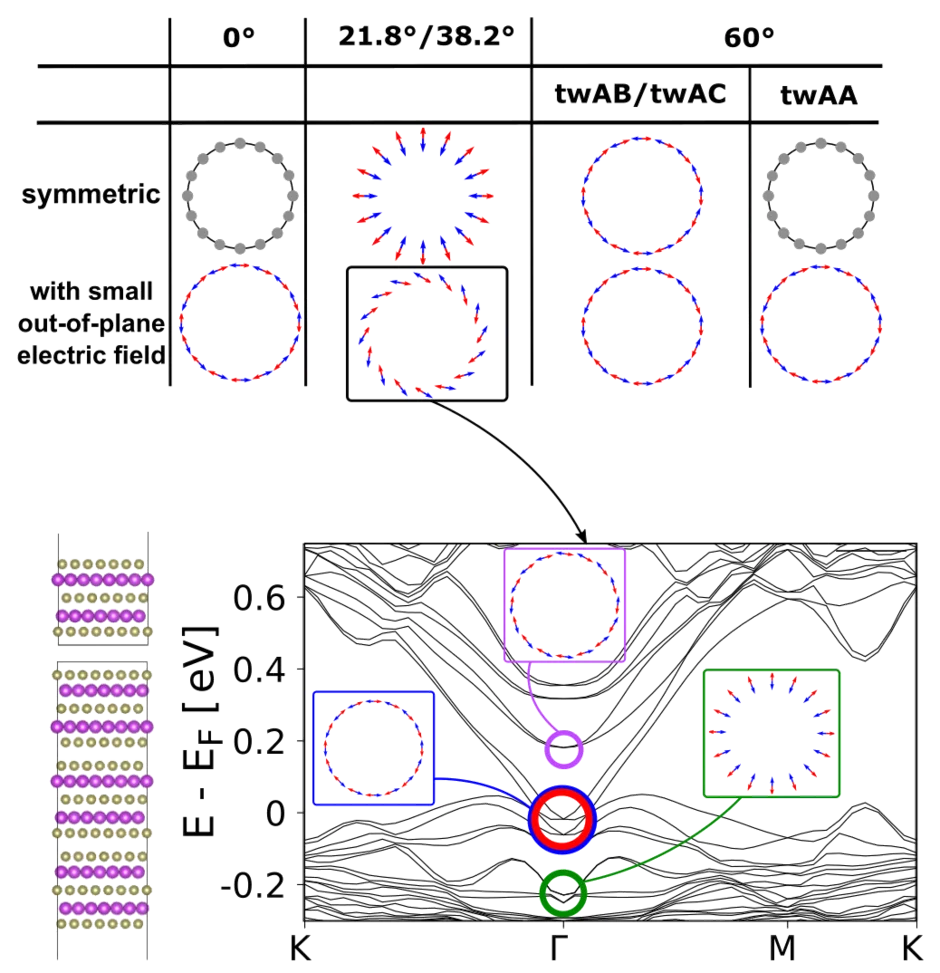
The Dirac surface states of the three-dimensional topological insulator Bi2Te3 show a spin-momentum locking that usually implies a tangential Rashba-like spin texture. The properties of these Dirac states can be tuned by dividing a slab of such a material into two thinner halves and modifying the interface by twisting, shifting, and changing the interlayer distance. Using first-principles calculations, we explored the characteristics of such modified Bi2Te3 slabs, with a particular focus on the twisting degree of freedom. We investigated different stacking configurations and found a non-trivial topology only for some stackings, leading to topological domains on the Moiré scale. Moreover, we calculated the properties of commensurate twisted supercells. The latter reveals not only flat bands, which are tunable by external pressure, but also radial spin textures with unconventional spin-momentum locking.
Our preprint can be found at arXiv:2610.25190 (external link, opens in a new window).
Our article “Ferroelectric-controllable spin-orbit torque in two-dimensional multiferroic heterostructure” published
(October 2026)
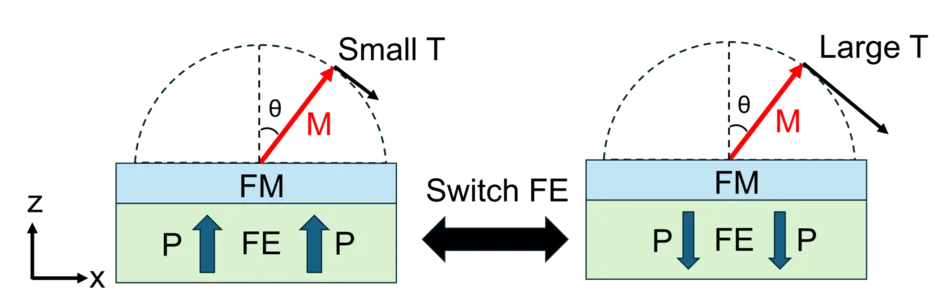
Applying first-principles techniques, we demonstrated that switching the ferroelectric polarization of an In2Se3 layer (FE) proximitizing the 2D ferromagnet (FM) Fe3GeTe2 will lead to a pronounced modification of the magnetization-dependent distribution of the spin-orbit torkances, establishing a viable strategy to achieve a fully electric control of spin-orbit torques.
Our results have been published in Physical Review B (external link, opens in a new window).
Our article “Predicting moiré physics from local proximity effects in van der Waals heterostructures” published
(September 2026)
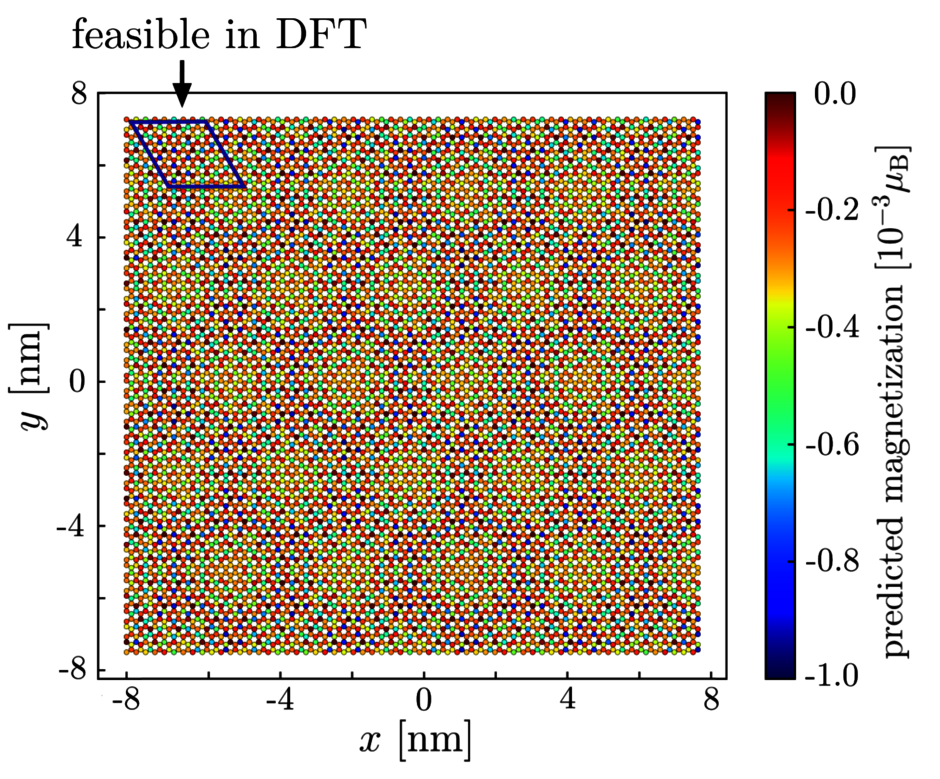
We developed a machine-learning framework to efficiently predict proximity-induced magnetism in van der Waals heterostructures at large scales that are inaccessible to state-of-the-art first-principles calculations. As an example, our approach was applied to graphene/Cr2Ge2Te6 heterostructures pointing towards rich magnetic Moiré textures in this structure. Our method can be broadly applied to orbital and spin proximity effects.
Our results have been published in npj Computational Materials (external link, opens in a new window).
Our preprint “Superconducting spin valve as a sensitive probe of spin-orbit coupling anisotropy” published on arXiv
(September 2026)
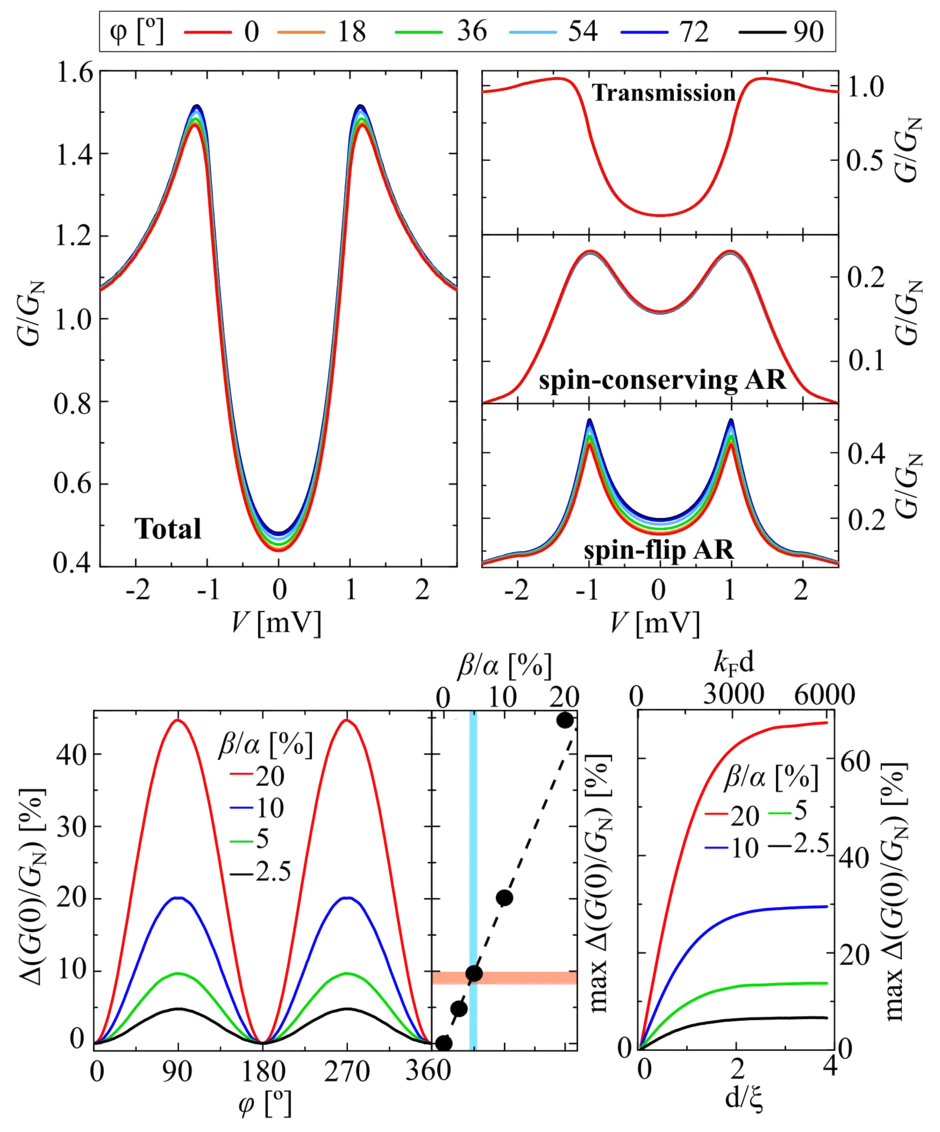
Spin-orbit coupling (SOC) – in particular, the interplay of Rashba and Dresselhaus spin-orbit fields – plays a central role in modern condensed matter physics and is crucial for the development of spin-based devices and quantum technologies. In this joint experiment–theory collaboration with colleagues from Madrid, we explored the tunneling conductance of epitaxial Fe/MgO/V/MgO/Fe/Co spin-valve junctions. Mapping the observed conductance data to a theoretical model accounting for the interference of Rashba and Dresselhaus SOCs, we identified a weak Dresselhaus SOC contribution with an amplitude that is about 5% of the Rashba field. Scanning transmission electron microscopy (STEM) suggests that it is the presence of periodic interfacial lattice mismatch defects around the MgO interfaces that reduces the actually expected – and with Dresselhaus SOC incompatible – C4v symmetry to C2v and thereby microscopically induces interfacial Dresselhaus SOC in these junctions.
Our preprint can be found at arXiv:2609.29244 (external link, opens in a new window).
Our article “Gate-Tunable Remnant Anomalous Hall Effect in Dual-Proximity Graphene Heterostructures” published
(September 2026)
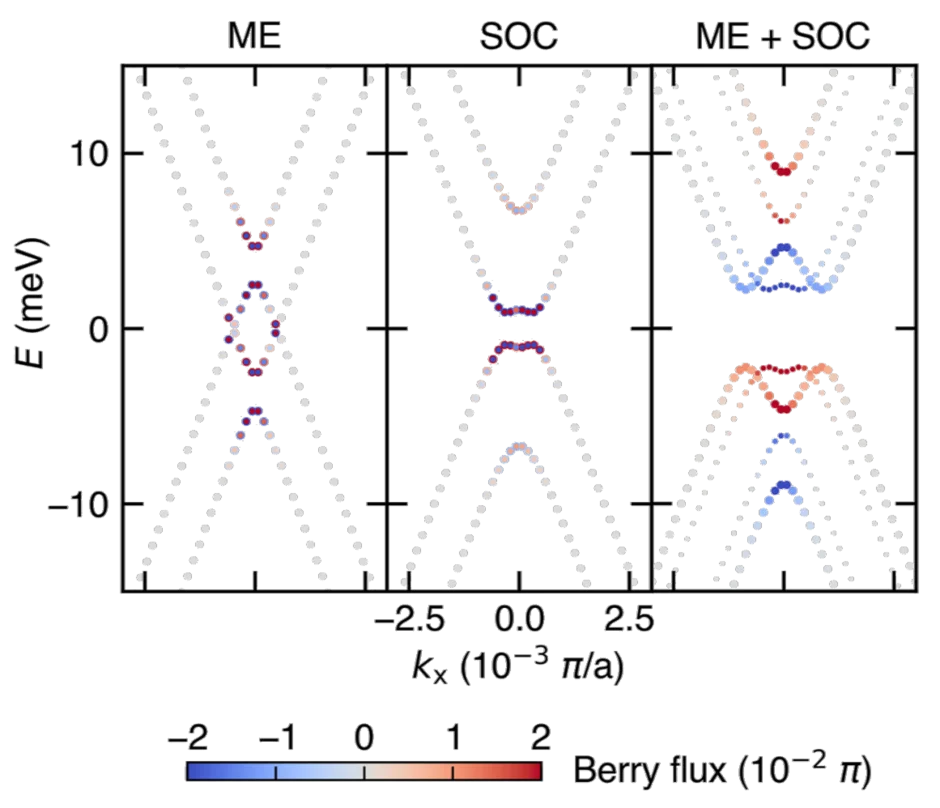
Monolayer graphene offers long spin coherence but lacks intrinsic spin-orbit coupling (SOC) and magnetic exchange required to access anomalous Hall and topological transport. In this joint experiment–theory collaboration, we demonstrated a gate‐tunable, remnant anomalous Hall effect (AHE) in dual‐proximity Cr2Ge2Te6/graphene/WSe2 van der Waals heterostructures and explored its physical origin. While a scaling analysis of the AHE conductance rules out extrinsic skew-scattering and side-jump mechanisms near the Dirac point, low‐energy model calculations reproduce the observed sign structure through Berry‐curvature hot spots that emerge only when exchange and SOC act together.
Our results have been published in Small Science (external link, opens in a new window).
Our preprint “Gate-tunable magnetic damping in van der Waals Heterostructures” published on arXiv
(September 2026)
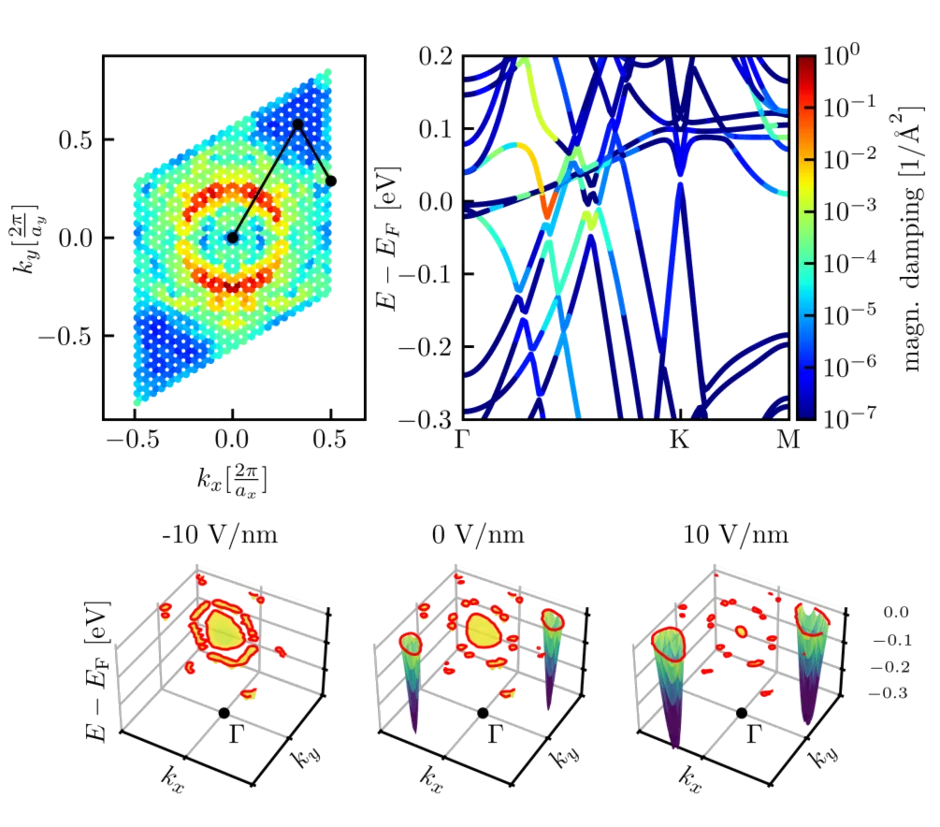
Active control of magnetic damping is crucial for the development of low-power, tunable spintronic devices. In this work, we applied first-principles techniques to elucidate that the intrinsic magnetic damping of 2D materials is highly sensitive to the position of the Fermi level relative to spin-orbit-driven anticrossings (“spin hot spots”). To give a concrete example, we studied Fe3GeTe2/graphene van der Waals heterostructures and showed that electrostatic gating with an out-of-plane field selectively shifts the relevant energy bands, leading to a tunability of the heterostructure’s magnetic damping over several orders of magnitude.
Our preprint can be found at arXiv:2609.15551 (external link, opens in a new window).
Our preprint “Ferroelectric-controllable spin-orbit torque in two-dimensional multiferroic heterostructure” published on arXiv
(August 2026)
Applying first-principles techniques, we demonstrated that switching the ferroelectric polarization of an In2Se3 layer (FE) proximitizing the 2D ferromagnet (FM) Fe3GeTe2 will lead to a pronounced modification of the magnetization-dependent distribution of the spin-orbit torkances, establishing a viable strategy to achieve a fully electric control of spin-orbit torques.
Our preprint can be found at arXiv:2608.07731 (external link, opens in a new window).
Our preprint “Anatomy of Spin–Orbit Torques in Monolayer Fe₃GeTe₂ and Fe₃GaTe₂” published on arXiv
(August 2026)
In this collaboration with colleagues from Lausanne, we explored from first principles the spin-orbit torques in the two-dimensional ferromagnets FGT and FGaT, and related the torque characteristics to marked differences in the bandstructures of these materials.
Our preprint can be found at arXiv:2608.05788 (external link, opens in a new window).
Our article “Resonant magnetic proximity hot spots in Co/hBN/graphene” published
(June 2026)
In this collaborative project with experimental colleagues from TU Munich, we explored magnetic proximity effects in Co/hBN/graphene heterostructures and demonstrated a pronounced localized spatial variation of the induced spin polarization of graphene’s Dirac states.
Our results have been published in Physical Review B (external link, opens in a new window).

Our preprint “Multistate Manipulation of Charge–Spin Conversion in Two-Dimensional Ferroelectric Bilayers” published on arXiv
(June 2026)
In a follow-up work to our previous publication (see below), we applied first-principles calculations to propose a mechanism for simultaneously controlling the Edelstein and spin Hall effects in bilayer metallic ferroelectric PtBi₂.
Our preprint can be found at arXiv:2606.14378 (external link, opens in a new window).

Our consortium’s QuantERA proposal recommended for funding
(May 2026)
We are thrilled that our proposal for the project “2DQUEST – Quantum Engineering in Superconducting Graphene for Topological Qubits” has been recommended for funding within the QuantERA initiative (external link, opens in a new window).
We are looking forward to collaborating with our partners in Sweden, Germany, and Spain within this excellent consortium to advance new research together!

Our preprint “Magnetization-dependent and stacking-tunable Edelstein effect in two-dimensional magnet 2H-VTe₂” published on arXiv
(May 2026)
In a follow-up work to our previous article, we employed again first-principles methods and symmetry analyses to explore the intrinsically emerging Edelstein effect in the two-dimensional ferromagnetic semiconductor 2H-VTe₂, predicting a strong dependence of the effect on the ortientation of the magnetizaton.
Our preprint can be found at arXiv:2605.13763 (external link, opens in a new window).

Our article “Tunable Edelstein effect in the intrinsic two-dimensional ferroelectric metal PtBi₂” published
(April 2026)
Using first-principles calculations, we demonstrated that competing contributions of inner Rashba-like electron pockets and outer hole pockets with opposite sign tuned by strain can induce a pronounced Edelstein effect in the recently proposed intrinsic two-dimensional ferromagnetic metal PtBi₂.
Our results have been published in Physical Review B (external link, opens in a new window).
Our group at the DPG Spring Meeting in Dresden
(March 2026)
Our group has shown a comprehensive presence at the DPG Spring Meeting in Dresden (external link, opens in a new window) (March 2026) delivering poster presentations and talks to showcase our work on radial Rashba spin-orbit coupling in twisted TMDCs, spin-orbit torques, and spin-orbit effects in ferromagnet/superconductor/ferromagnet hybrids.
The schedule with our group’s contributions can be looked up here (opens in a new window). (This PDF is not accessible).
Dr. Adam Škrlec joins our group
(February 2026)
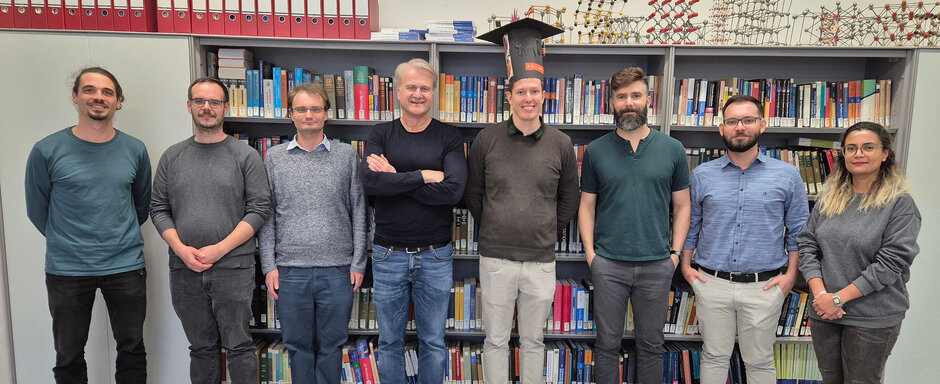
Dr. Adam Škrlec joins our group as a Postdoc. Adam will be working on developing models to describe quantum transport in proximitized superconducting systems.
Welcome, Adam!

Our preprint “Giant anomalous Josephson effect as a probe of spin texture in topological insulators” published on arXiv
(January 2026)
In collaboration with the Strunk/Paradiso group in Regensburg, we explored the anomalous φ0-phase shift in the Josephson current-phase relations of junctions based on the topological insulator HgTe. We demonstrated that the effect is giant when compared to, e.g., SOC-induced phase shifts in parabolic-dispersion Al/InAs junctions, which we attributed to the fact that HgTe surface states feature a single Fermi contour. Moreover, we found that the spin of the surface states is not exactly perpendicular to their momentum, but shows a significant deviation of 19°.
Our preprint can be found at arXiv:2601.20410 (external link, opens in a new window).

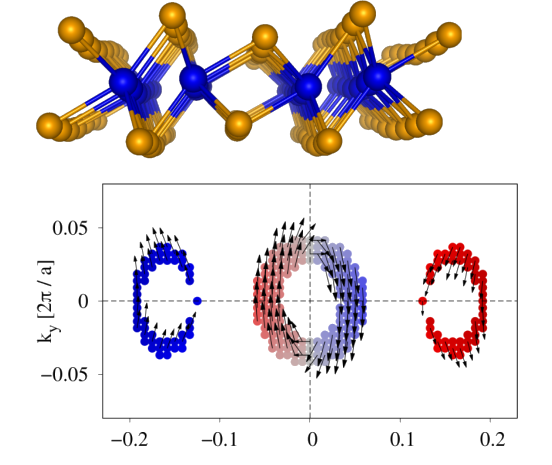
Our article “Radial Rashba spin-orbit fields in commensurate twisted transition metal dichalcogenide bilayers” published as Editors’ Suggestion
(January 2026)
We studied the ab initio band structures of commensurate twisted transition metal dichalcogenide bilayers unraveling that their in-plane spin textures mostly feature radial Rashba spin-orbit fields. Fitting the first-principles results to established model Hamiltonians, we obtained all relevant parameters such as the spin-orbit and exchange couplings.
Our results have been published as Editors’ Suggestion in Physical Review B (external link, opens in a new window).
Our preprint “Resonant magnetic proximity hot spots in Co/hBN/graphene” published on arXiv
(January 2026)
In this collaborative project with experimental colleagues from TU Munich, we explored magnetic proximity effects in Co/hBN/graphene heterostructures and demonstrated a pronounced localized spatial variation of the induced spin polarization of graphene’s Dirac states.
Our preprint can be found at arXiv:2601.07781 (external link, opens in a new window).