

Development of large-scale electronic structure methods
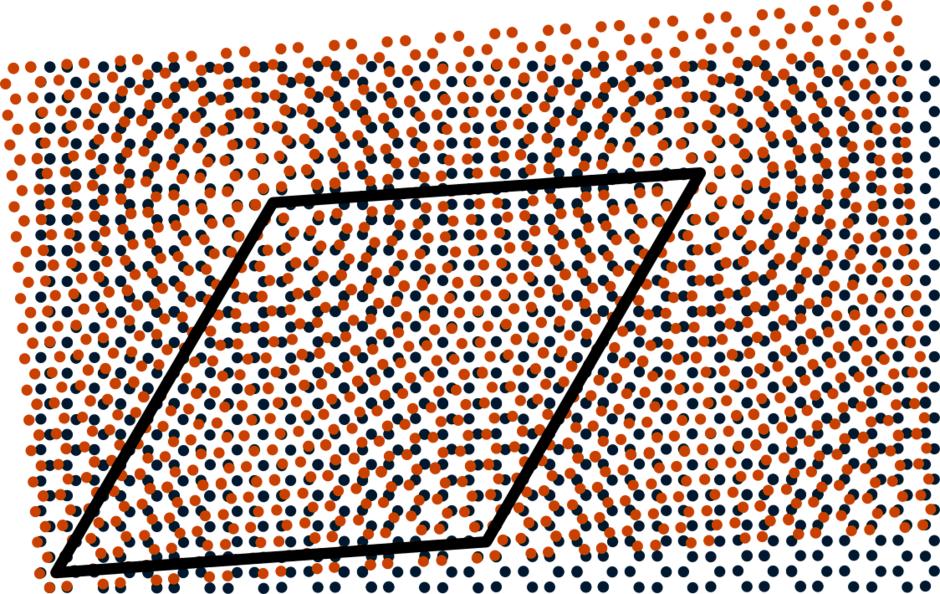
The main focus of the group is to develop large-scale electronic structure methods that are capable of dealing with hundreds to thousands of atoms in the simulation. Such large-scale electronic structure problems routinely arise when modeling liquids, disordered materials or interfaces. As an example, you see below a moiré structure of two hexagonal layers (blue and orange). Moiré structures feature very interesting physical properties, from superconductivity [3] to strong band gap variations [4]. The unit cell of moiré structures is large, see below the black box as an example which contains roughly 500 atoms. Treating such a large unit cell is already a challenge for standard electronic structure methods.
We implement electronic structure methods in the open-source CP2K package [1,2]. CP2K uses Gaussian basis functions and can describe molecules as well as periodic systems. CP2K is optimized for massively parallel execution on the latest supercomputers and has a quickly growing user community in physics, chemistry and materials science.
References:
[1] See https://github.com/cp2k/cp2k (external link, opens in a new window) and https://cp2k.org (external link, opens in a new window)
[2] T. D. Kühne et al., CP2K: An electronic structure and molecular dynamics software package - Quickstep: Efficient and accurate electronic structure calculations, J. Chem. Phys. 152, 194103 (2020). (external link, opens in a new window)
[3] Y. Cao et al., Unconventional superconductivity in magic-angle graphene superlattices, Nature 556, 43-50 (2018) (external link, opens in a new window).
[4] Shabani et al., Deep moiré potentials in twisted transition metal dichalcogenide bilayers, Nat. Phys. 17, 720-725 (2021) (external link, opens in a new window).