

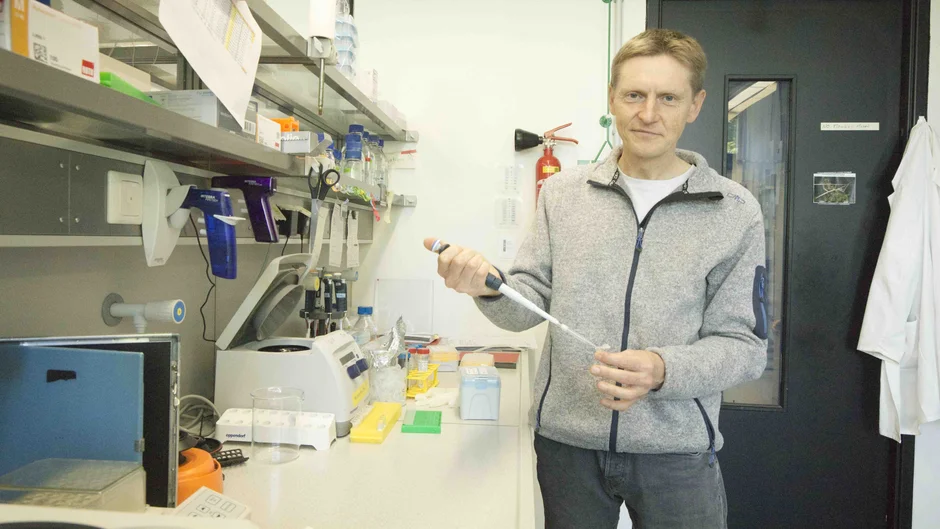
 UR / Karoline Stürmer
© Karoline Stürmer UR, 2026
When Thomas Tuschl offered him a position as a postdoctoral researcher in his lab during a coffee break at a conference at the Harnack House — the Max Planck Society’s educational center in Berlin — Gunter Meister had no idea what consequences this encounter would have. In retrospect, it marked the beginning of an extraordinary career. Tuschl was considered one of the rising stars of molecular biology at the time; in 2004, *Der Spiegel* even saw him on the path to a Nobel Prize for his work on RNA interference.
For Gunter Meister, the offer was a ticket to the front row of a research field that was still in its infancy at the time, but whose significance was already becoming apparent. Tuschl had just accepted a position as a professor and lab director at Rockefeller University in New York. Gunter Meister had just earned his Ph.D.
Questioning Scientific Assumptions
Meister doesn’t recount this episode as the beginning of a great success story. Rather, he sees it as one of the many crossroads that arise by chance in science. In fact, he initially turned down the offer—or at least didn’t accept it right away. His first child had just been born, and a move to New York required careful consideration. It was only after discussions with his family that he made the decision.
This blend of scientific excellence and approachable down-to-earthness runs through the entire career of the Regensburg-based biochemist. Gunter Meister is not the kind of scientist who makes a big deal out of his successes, awards, or positions. Rather, anyone who speaks with him gets the impression of meeting a person who, to this day, is driven above all by the question of what hidden mechanisms lie behind the phenomena of life.
This is also evident in what he doesn’t talk about. During the conversation, the topics range from research and ideas to higher education policy—covering many subjects but hardly mentioning any big names. He doesn’t even mention that Meister is now in direct contact with researchers such as Victor Ambros, the discoverer of microRNAs—small RNA molecules that regulate genes—and the 2024 Nobel Prize laureate in Medicine.
Beyond “Junk DNA”
Meister earned his Ph.D. in 2002, immediately following the completion of the Human Genome Project, the large-scale international initiative that fully sequenced the human genome (DNA—deoxyribonucleic acid) for the first time. The project’s findings fundamentally changed our understanding of the genome—the totality of an organism’s genetic information. For a long time, it had been assumed that only the small portion of DNA that serves as a blueprint for proteins was significant. Large sections of the rest of the genome, on the other hand, were considered “junk DNA”—genetic ballast with no discernible function.
For Meister, this notion was implausible.
Why would evolution preserve large amounts of genetic material over millions of years if it served no purpose whatsoever? As early as 1999, he therefore began studying those regions of the genome that were dismissed at the time as “junk DNA.” To him, it seemed obvious that many of these mysterious DNA segments must have functions—even if those functions were not yet understood at the time. It was only with the Human Genome Project that it became increasingly clear: Many regions of this supposed DNA “junk” contain important control centers of the cell.
Meister was particularly interested in the new world of questions that suddenly opened up. How do cells communicate with one another? How do they decide which genes to activate and which to leave inactive? And who actually controls these processes? These were precisely the questions Thomas Tuschl was working on in New York. For Meister, who had just earned his Ph.D., this was a stroke of luck.
At the Heart of the RNA Revolution
Over the next few years, an unexpected key player emerged: RNA (ribonucleic acid). For a long time, it was regarded merely as a carrier of genetic information. But around the turn of the millennium, it became clear that it could do much more: the discovery that small RNA molecules can specifically silence genes caused a particular stir. This came as a surprise to the field of molecular biology. At the time, no one knew exactly how this process worked or which other molecules were involved.
These mechanisms were elucidated only gradually. And Meister was right in the thick of it.
The significance of these discoveries became apparent in the years that followed. The work on RNA interference gave rise to one of the most dynamic fields of research in modern molecular biology. In 2006, Andrew Fire and Craig Mello were awarded the Nobel Prize in Medicine for their discovery of the mechanism.
Meister was ultimately able to identify the molecules involved. But for him, the topic was by no means closed. On the contrary: the more they understood, the more new questions arose. “Since then, there’s really been no reason for me to move on from this topic,” he says. Meister describes his years in New York with the same matter-of-fact tone that others might use to recount a weekend getaway. Yet they were scientifically formative. At the same time, the family’s second child was born there. Conveniently, the daycare center was located directly below the lab—science and family were literally next door to each other, the biochemist explains.
Despite their fascination with Manhattan, the family was drawn back to Germany.
After a little over two years, Meister was offered the chance to establish a junior research group at the Max Planck Society—that is, to lead an independent research team for the first time—under conditions that he still describes today as nearly ideal: excellent funding, considerable scientific freedom, and the rare opportunity to pursue his own ideas independently.
Looking back, it’s striking how quickly Meister progressed through the various stages of his career. It’s a pattern that repeats itself time and again: No sooner had he reached a position that many researchers consider a career goal than the next opportunity presented itself. After a little more than two years, he left the scientifically vibrant city of New York; just four years later, he traded the well-resourced junior research group at the Max Planck Society for a professorship in Regensburg. Today, he looks back on this with a certain sense of wonder. “Perhaps I should have savored some of those phases a little longer,” he says. In fact, his curiosity about what lay ahead in his career often seems to have outweighed the temptation to linger on his past achievements.
Driven by the Next Question
Today, Gunter Meister is one of the world’s leading researchers in the field of RNA biology. Yet he remains fascinated not by definitive answers, but by unresolved questions.
He is currently grappling with a problem that, at first glance, seems astonishingly simple: How do RNA molecules actually manage to survive inside the cell?
Enzymes—specialized protein molecules—lurk everywhere, seeking to destroy it. Only through protective mechanisms, chemical modifications, and the support of other molecules does it manage to survive in this hostile environment. At the same time, the cell uses precisely these degradation processes to regulate RNA in a targeted manner. He calls this concept “The life of RNA in the ribonuclease environment”—the world of RNA in an environment teeming with RNA-degrading enzymes. This is not just about individual molecules, but about the general question of how RNA can survive at all in a complex environment that specializes in its degradation.
Perhaps this perspective also applies to him personally. After all, Meister is rarely interested in isolated individual phenomena. He is fascinated by interconnections, networks, and the dynamics of complex systems. New ideas often don’t arise at his desk, but rather out in the woods.
Two to three times a week, he runs about ten kilometers. He says he’s no marathon runner. Competitions don’t interest him. For him, exercise serves above all as a form of mental balance. At some point, he loses awareness of the run itself, and his mind begins to clear. Thoughts fall into place, problems resolve themselves, and sometimes ideas for experiments suddenly pop into his head.
In fact, physical activity seems to be a fundamental principle of his life. He rides his bike to work, prefers taking the stairs to the elevator, and explores new cities on business trips by walking rather than by taxi. “I just can’t sit still for long,” he says.
Perhaps this also explains his view of science. He takes a critical view of stagnation—as well as of structures that aren’t regularly questioned. External evaluations, but also self-reflection, dialogue, and a constant sense of curiosity are what define science for him.
It’s an attitude that has also shaped his own career—from a doctoral student who challenged the concept of “junk DNA,” to a postdoc at the heart of the RNA revolution, to the Regensburg professor who is now working on the next big questions in molecular biology. He doesn’t need big words to describe it. The story is impressive enough on its own.