


Course: Biochemistry M.Sc.
- Biology and Pre-Clinical Medicine
Ready to take the next step in biochemical research?
The Master's degree programme in Biochemistry offers you the opportunity to deepen your knowledge of molecular life processes and develop your own scientific profile. The programme focuses on modern methods and intensive experimental laboratory practice in the context of current research projects. The programme will equip you with the skills to solve tomorrow's scientific problems confidently and creatively, particularly in the fields of medicine, the environment and technology.
The most important facts at a glance
Program Profile - Biochemistry in Regensburg
Proven, modern, practical: the degree program in Biochemistry at the University of Regensburg was established as a diploma programme back in 1989 and converted into a modern Bachelor's/Master's program in 2006, supported by the Faculties of Biology and Preclinical Medicine as well as Chemistry and Pharmacy. The course in Regensburg offers you a very research-oriented, practical and interdisciplinary education with a wide range of opportunities for individual specialisation and the development of your own scientific profile.
What makes this program special?
On the Master's degree programme in Biochemistry, you will benefit directly from the excellent research environment at the Regensburg Center for Biochemistry (RCB) (external link, opens in a new window). There, established and young research groups work together on central questions of biochemistry - from RNA biology and structural biology to enzymology and genetics. The RCB offers you access to modern infrastructure such as cryo-electron microscopy, mass spectrometry, NMR and single-molecule techniques as well as a wide range of opportunities for interdisciplinary exchange in seminars, workshops and graduate programmes such as RIGEL or the Graduate Research Academy RNA Biology.
Another important location is the Regensburg Centre for Ultrafast Nanoscopy (RUN) (external link, opens in a new window), where molecular movements are visualised in real time and with atomic resolution. The RUN opens up exciting prospects for students with an interest in ultrafast imaging, biophysical methods and nanotechnology.
You will also benefit from the proximity to clinical research at the University Hospital Regensburg (UKR) (external link, opens in a new window) and the connection to the renowned Leibniz Institute for Immunotherapy (LIT) (external link, opens in a new window). These institutions will give you an insight into projects at the interface of biochemistry, medicine and translational research.
During your studies, you will work on current research projects in various working groups and can deepen your interests in a targeted manner. This creates a solid foundation for your further scientific development and the start of independent research work.
An external internship, which you can complete either in industry or abroad, is also an integral part of the Master's degree programme. You will gain valuable experience in an international or application-orientated environment and make contacts for your future career at an early stage. In addition, regular excursions allow you to gain direct insights into biotechnological and pharmaceutical companies.
What can I do with this degree?
A Master's degree programme in Biochemistry at the University of Regensburg opens up a wide range of career prospects in research, industry and related fields. The demand for qualified biochemists is high, as analytical thinking, experimental skills and the use of modern methods are central to many fields of activity. After graduating, you can pursue a doctorate or enter directly into the biotechnological or pharmaceutical industry, for example.

Our graduates work in a wide range of fields, including
- Medical research and diagnostics (e.g. atuniversity hospitalsor in infection and cancer research)
- Pharmaceutical and biotechnology industry (e.g. in drug development, diagnostics, personalised medicine)
- Research institutes and laboratories (e.g. in biochemistry, molecular biology, microbiology, immunology)
- Environmental technology, food analysis and synthetic biology
The degree program's long-standing tradition, its close links to research institutions and the internationally visible reputation that has grown from this - together with the practical, research-oriented training and individual support - form the best requirements for your successful career start, both in science and in industry.


Structure of the Program
The Master's degree programme in Biochemistry is strongly research-oriented and offers you a wide range of special topics lectures, seminars as well as course and research internships. You have a great deal of freedom to choose your own specialisation.
Program Structure
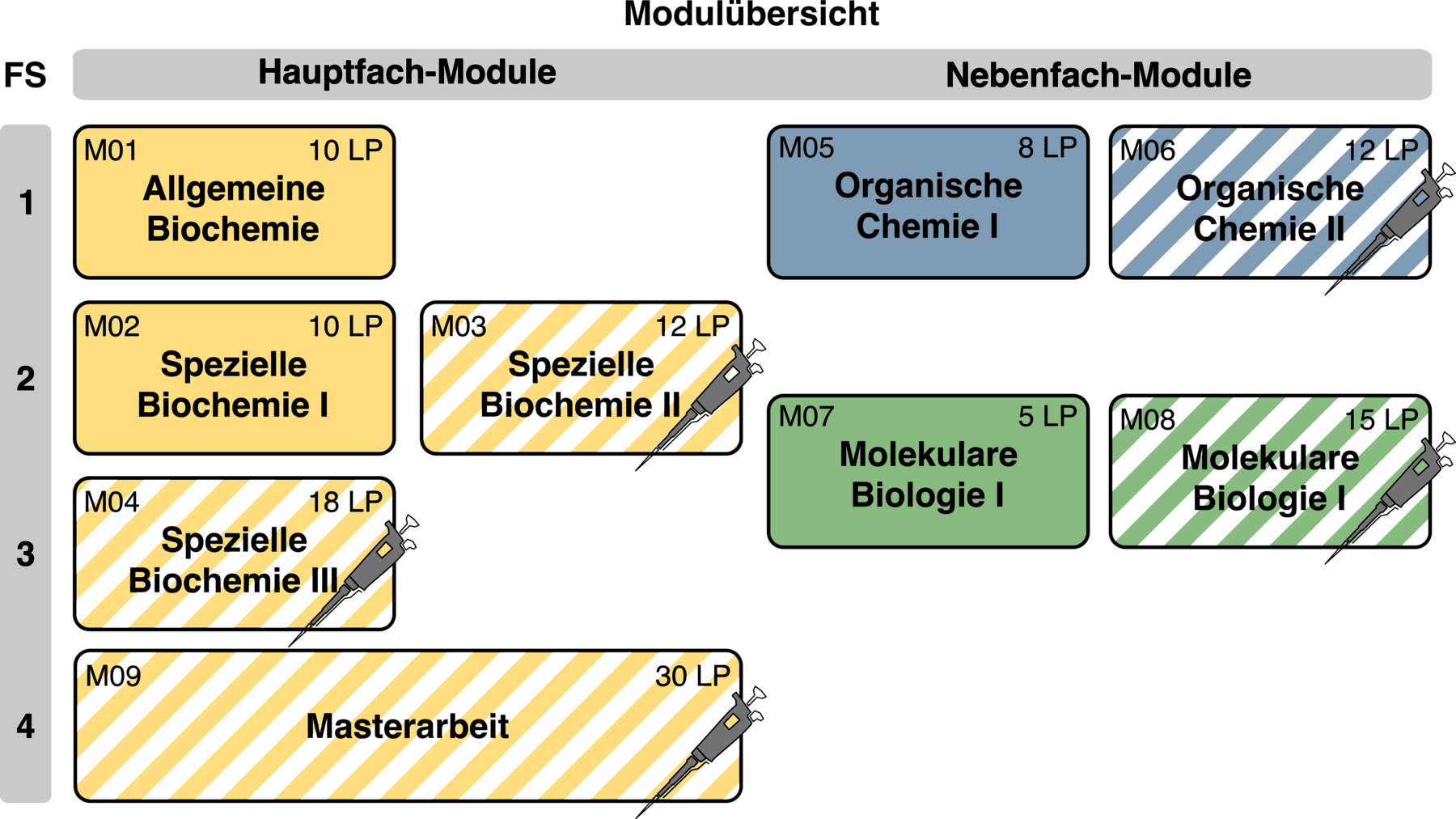
The programme is divided into five major subject modules (biochemistry) and four minor subject modules (chemistry and molecular biology).
Further information on the courses can be found on the Master's degree program in Biochemistry website.
External research laboratory
The Master's in Biochemistry includes an external research laboratory placement, which you can complete flexibly in industry or at a research institution in Germany or abroad. This allows you to gain valuable practical experience and expand your network.
The exchange programme with the University of Colorado Boulder (USA) (external link, opens in a new window) is particularly popular. Every year, three Master's students in biochemistry are given the opportunity to complete an Internship in one of the renowned research groups there - including a scholarship.
Student Life & Services
 Foto: UR / Julia Dragan
Requirements
| Admission Restrictions / Selection Procedure | no |
| Pre-registration procedure | no |
| Eligibility Test / Aptitude Test | yes |
| Placement Test | no |
| Subject-Specific Language Requirements | yes |
| German Language Certificate for Students with Foreign University Entrance Qualification | yes |
| Other Requirements | no |
Binding information and current information can be found in the brief overview (German version) (opens in a new window). (This PDF is not accessible) of the Registrar's Office or in the examination regulations applicable to you Examination Regulations.
Details Requirements
Subject-specific requirements
The following requirements apply for admission to the Master's degree programme in Biochemistry in accordance with §4 of the Examination Regulations:
- Degree
A completed university degree (at least 6 semesters Standard Period of Study, 180 ECTS) in Biochemistry or a related subject with an average grade of at least 2.5. In the case of foreign degrees, the grade is converted according to the modified Bavarian formula. - Related degree programs
A related subject exists in particular if the content and methodological requirements correspond to those of the Bachelor's degree programme in Biochemistry at the University of Regensburg. - Language skills
Applicants who have not obtained their degree or university entrance qualification at a German-speaking institution must provide proof of German language skills at DSH-2 level and English language skills at the same level. - Provisional admission
If the degree certificate is not yet available at the time of application, provisional admission may be granted. Requirements for this are at least 150 ECTS and an average grade of at least 2.5.
Eligibility Test / Aptitude Test
An Eligibility Test is required if the average grade after 150 ECTS is worse than 2.5 or the degree was obtained in an unrelated subject.
Application procedure
Applications for the Master's programme in Biochemistry are made exclusively online via the SPUR campus portal (external link, opens in a new window). This applies to both domestic and international prospective students.
If you have any questions about your application, please send us an e-mail to
bewerbung.biochemie@ur.de
Application documents
Please prepare the following documents or scans for uploading to the SPUR campus portal:
All applicants:
- Degree certificate of the first university degree (if this is not yet available, certified proof of previous study and examination achievements totalling at least 150 LP, showing the provisional Bachelor's (overall) grade).
- Transcript of Records
- Curriculum vitae
- Letter of motivation
Optional: Proof of relevant internships completed outside your first degree or letters of reference
Applicants who have not obtained their university entrance qualification or their first degree in Germany, additionally:
- School leaving certificate
- Copy of passport
- Proof of German language proficiency at DSH-2 level
Note for international applicants: Proof of sufficient German language skills(DSH-2) is mandatory for enrolment. A visa may also be required. Further information can be obtained from the International Office of the University of Regensburg.
Application deadlines
- 15. June for the following winter semester
- 15. January for the following summer semester
The notification of admission or rejection will be made available via the SPUR campus portal (external link, opens in a new window) by the end of July (winter semester) or the end of January (summer semester).
Enrollment
Admission, Application and Enrollment
 Foto ©iStock.com/mixetto
Academic Advising
Course-related information and advice
If you have any questions about the programme content, the subject-specific requirements, the application procedure and the specific structure of the programme, please contact the
General Student Advisory Service
The General Student Advisory Service (ZSB) supports you with all questions relating to your studies - from the decision to study, to the course of studies, to successful graduation.
If necessary, the ZSB will refer you to the appropriate contact person.