


Course: Criminology and Violence Studies M.A.
- Law
The interdisciplinary Master's degree programme deals with the causes, manifestations and consequences of criminal offences, violence and aggression. To this end, criminological theory and multidisciplinary perspectives and findings from current research into violence and aggression are brought together to form an interdisciplinary degree program.
The most important facts at a glance
Program Profile
The Master's degree programme is basically open to any undergraduate degree in cultural studies, social sciences, humanities, natural sciences or law, preferably from the subject groups involved in the Master's degree programme.
Is this the right program for me?
Yes, if..
...you are interested in dealing with crime-related phenomena and violence research topics at an academic level
...you are willing to engage with new disciplines and methods in an interdisciplinary degree program
...you have the opportunity to study Full-time and on site
...you have understood that an independent way of working is a prerequisite for a university Master's degree programme
No, if..
...you hope to deal with a sensational criminal case in every lecture
...you would like to work as a profiler/ with the police afterwards
...you are dependent on part-time study or distance/online learning
What makes this program special?
The degree program is designed to be interdisciplinary. The Violence Studies extension enables students not only to specialise in strictly criminological fields of research, but also to investigate phenomena of violence beyond their connection to criminal law.
What can I do with this degree?
Graduates of the M.A. in Criminology and Violence Studies primarily work in science and research or in the social prevention sector. The subsequent professional orientation is often linked to the previous Bachelor's degree programme. Work in the education sector or in journalism is also possible. Work in the police force is only possible with the training and continuing education programmes offered there.

Structure of the Program
Program Structure
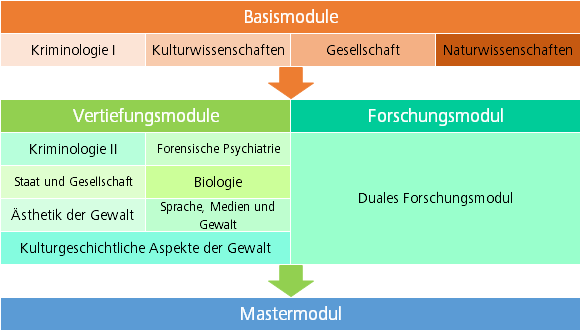
Full-time and on-campus study programme. Modular structure: 4 core modules, 2 specialisation modules, research module and Master's module. Always starts in the winter semester.
Study Plans
Internationalization
There are no co-operations with foreign partner universities. Prospective students from abroad can apply for the Master's programme in the usual way. Please note the information on the homepage for international applications!
A voluntary semester abroad is possible.
Internship
A compulsory internship is not part of the degree program, but it is possible to combine a self-organised research module with an internship.
Student Life & Services
 Foto: UR / Julia Dragan
Requirements
| Admission Restrictions / Selection Procedure | no |
| Pre-registration procedure | no |
| Eligibility Test / Aptitude Test | yes |
| Placement Test | no |
| Subject-Specific Language Requirements | no |
| German Language Certificate for Students with Foreign University Entrance Qualification | yes |
| Other Requirements | yes |
Binding information and current information can be found in the brief overview (German version) (opens in a new window). (This PDF is not accessible) of the Registrar's Office or in the examination regulations applicable to you Examination Regulations.
Details Requirements
For application documents to be submitted, the application deadline and information on the application procedure and the application process, please refer directly to the degree program homepage.
Application form (German version)
Eligibility Test / Aptitude Test
The Eligibility Test takes place in two phases: Examination of the application documents (phase 1), selection interview if necessary (phase 2). Please read the information on our homepage and in the PO, Annex 1 to the Selection Procedure.
Subject-Specific Language Requirements
Proof of English B2 is mandatory (can be submitted later).
Other Requirements
Bachelor's degree with a minimum grade of 2.5. The application documents must be submitted correctly, completely and in accordance with the requirements of the chair. Rejection due to formal errors is possible.
Admission for internationals
Proof of German at B2 level must be submitted with the application; students with a foreign university entrance qualification require the DSH or TestDaF for enrolment.
Admission, Application and Enrollment
 Foto ©iStock.com/mixetto
Academic Advising
Course-related information and advice
If you have any questions about the programme content, the subject-specific requirements and the application procedure, as well as the specific structure of the programme, please contact the
Course-related information and advice
General Student Advisory Service
The General Student Advisory Service (ZSB) supports you with all questions relating to your studies - from the decision to study, to the course of study, to successful graduation.
If necessary, the ZSB will refer you to the appropriate contact person.