
Concordia and Discordia
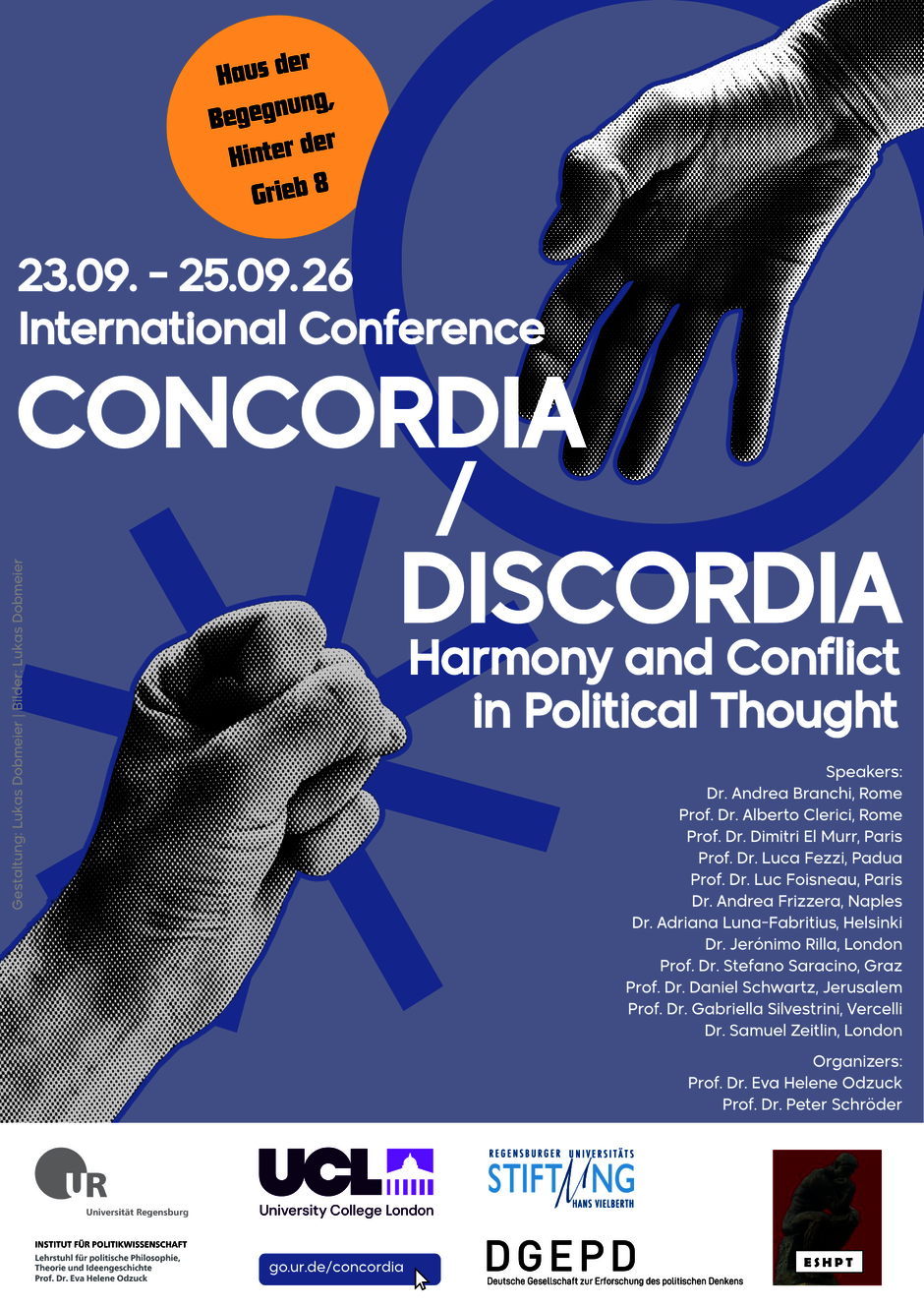
The idea of Concordia, of political cohesion in a fractured society, is as old as political thought itself. From the Greek polis through the Christian Middle Ages to the early modern period, thinkers such as Aristotle, Nicholas of Cusa, and Jean Bodin asked how communities can hold together despite competing interests, religious division, and the pursuit of private ambition.
While the contemporary political landscape, shaped by polarization, rising nationalism, and digital echo chambers, lends these questions new urgency, we seek to revive the rich tradition of political thinking on Concordia and Discordia. Our aim is to build a bridge between the recurring questions of the history of ideas and the pressing challenges of the present: how, by whom, and under what conditions can political concord still be conceived today?
Organizers: Prof. Dr. Eva Helene Odzuck; Prof. Dr. Peter Schröder
Location: Haus der Begegnung, Hinter der Grieb 8, 93047 Regensburg
If you would like to attend the conference, please register by sending an email to
lukas.dobmeier(at)ur.de (öffnet Ihr E-Mail-Programm)
[until 15/09/26]
Program
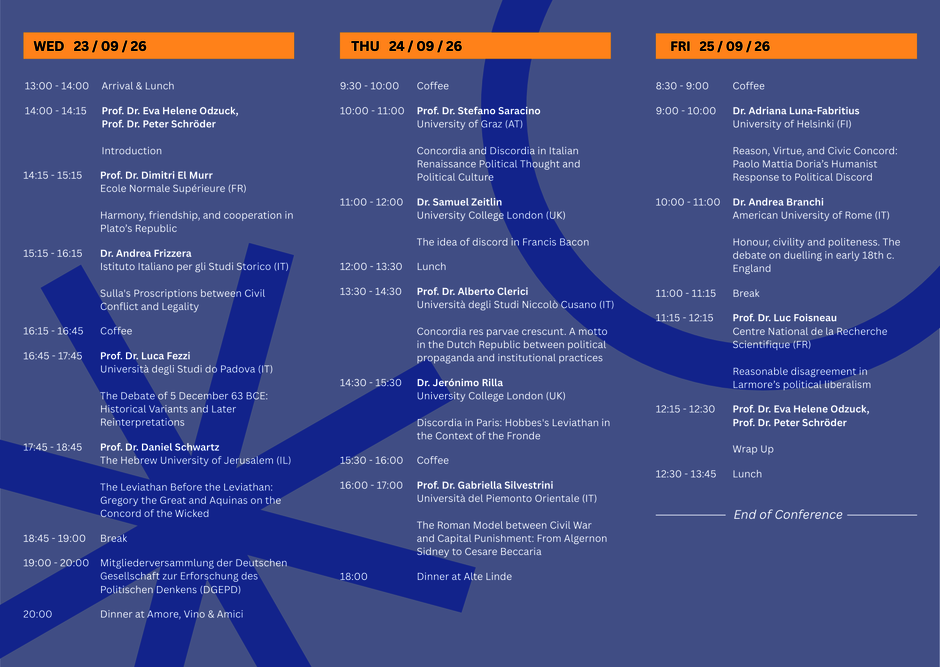
Wednesday 23.09.2026
13:00 – 14:00 Arrival & Lunch
14:00 – 14:15 Prof. Dr. Eva Helene Odzuck, Prof. Dr. Peter Schröder: Introduction
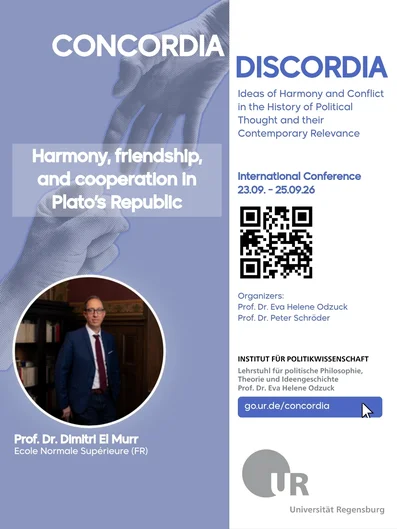
14:15 – 15:15 Prof. Dr. Dimitri El Murr: Harmony, friendship, and cooperation in Plato’s Republic
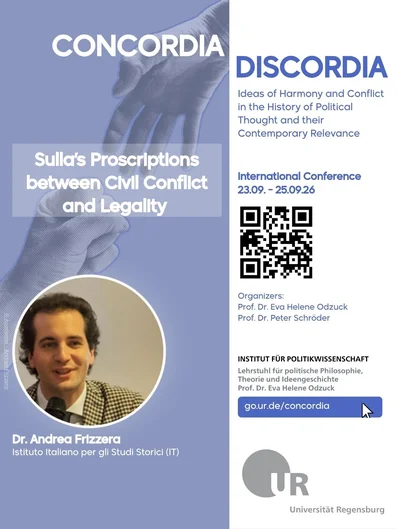
15:15 – 16:15 Dr. Andrea Frizzera: Sulla's Proscriptions between Civil Conflict and Legality
16:15 – 16:45 Coffee
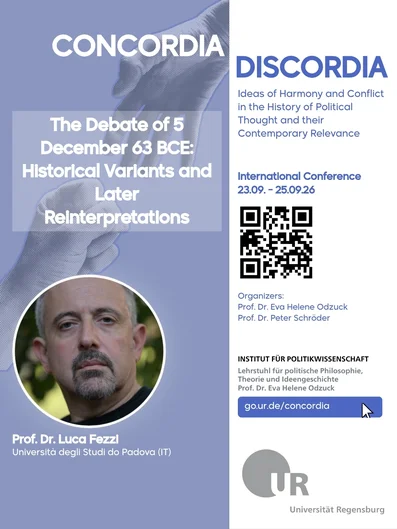
16:45 – 17:45 Prof. Dr. Luca Fezzi: The Debate of 5 December 63 BCE: Historical Variants and Later Reinterpretations
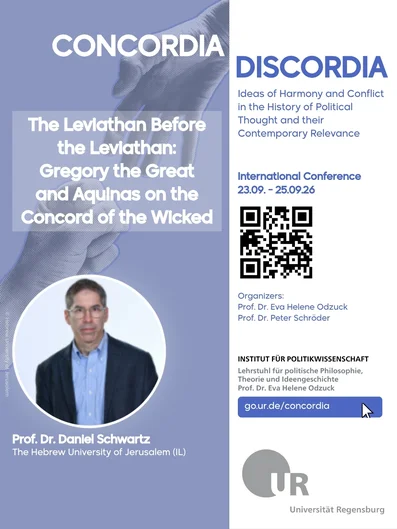
17:45 – 18:45 Prof. Dr. Daniel Schwartz: The Leviathan Before the Leviathan: Gregory the Great and Aquinas on the Concord of the Wicked
18:45 - 19:00 Break
19:00 – 20:00 Mitgliederversammlung der Deutschen Gesellschaft zur Erforschung des Politischen Denkens (DGEPD)
20:00 Dinner at Amore, Vino & Amici
Thursday 24.09.2026
9:30 – 10:00 Coffee
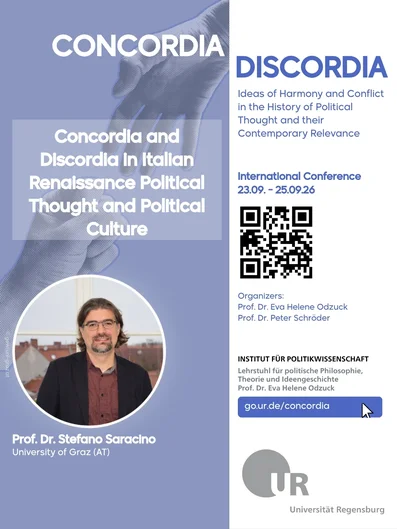
10:00 – 11:00 Prof. Dr. Stefano Saracino: Concordia and Discordia in Italian Renaissance Political Thought and Political Culture
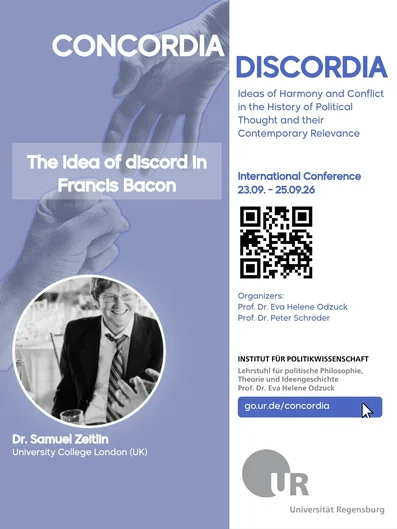
11:00 – 12:00 Dr. Samuel Zeitlin: The idea of discord in Francis Bacon
12:00 – 13:30 Lunch
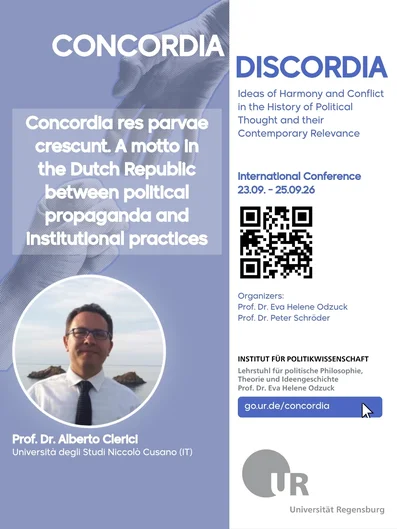
13:30 – 14:30 Prof. Dr. Alberto Clerici: Concordia res parvae crescunt. A motto in the Dutch Republic between political propaganda and institutional practices
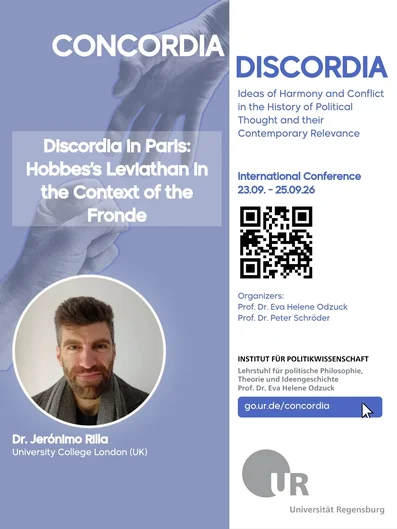
14:30 – 15:30 Dr. Jerónimo Rilla: Discordia in Paris: Hobbes's Leviathan in the Context of the Fronde
15:30 – 16:00 Coffee
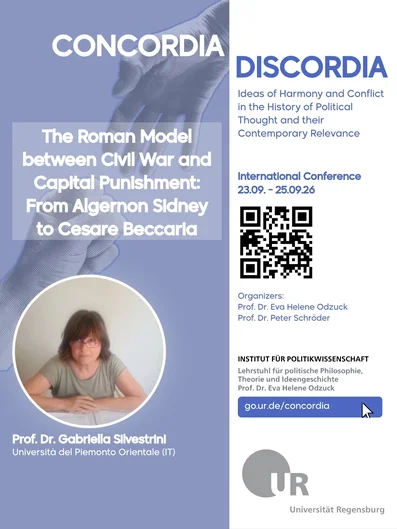
16:00 – 17:00 Prof. Dr. Gabriella Silvestrini: The Roman Model between Civil War and Capital Punishment: From Algernon Sidney to Cesare Beccaria
18:00 Dinner at Alte Linde
Friday 25.09.2026
8:30 – 9:00 Coffee
9:00 – 10:00 Dr. Adriana Luna-Fabritius: Reason, Virtue, and Civic Concord: Paolo Mattia Doria’s Humanist Response to Political Discord
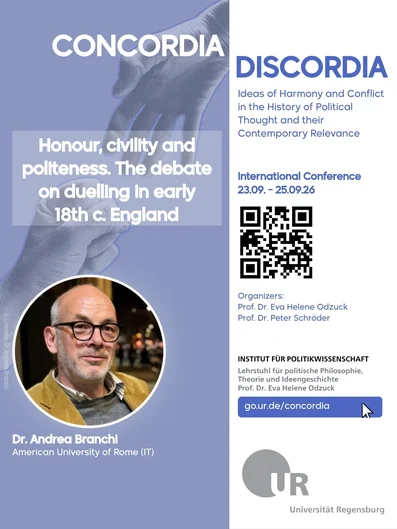
10:00 – 11:00 Dr. Andrea Branchi: Honour, civility and politeness. The debate on duelling in early 18th c. England
11:00 – 11:15 Break
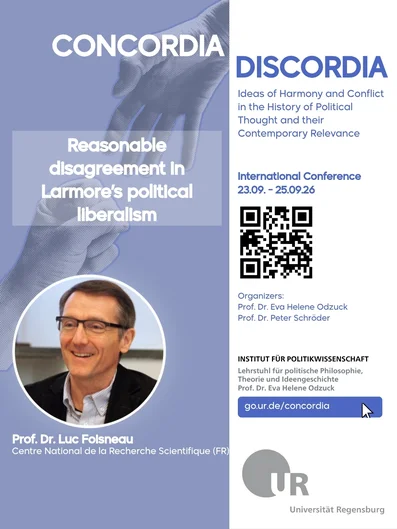
11:15 – 12:15 Prof. Dr. Luc Foisneau: Reasonable disagreement in Larmore’s political liberalism
12:15 – 12:30 Prof. Dr. Eva Helene Odzuck, Prof. Dr. Peter Schröder: Wrap Up
12:30 – 13:45 Lunch
Speakers
Dr. Andrea Branchi
American University of Rome (Rome, Italy)
Prof. Dr. Alberto Clerici
Professor of History of political thought - Università degli Studi Niccolò Cusano (Rome, Italy)
Prof. Dr. Dimitri El Murr
Professor of Ancient Philosophy - Ecole Normale Supérieure (Paris, France)
Prof. Dr. Luca Fezzi, Padua
Professor of Roman History - Università degli Studi do Padova (Padua, Italy)
Prof. Dr. Luc Foisneau
Director of research - Centre National de la Recherche Scientifique (Paris, France)
Dr. Andrea Frizzera
Doctor of Philosophy - Istituto Italiano per gli Studi Storico (Naples, Italy)
Dr. Adriana Luna-Fabritius
Docent in Intellecual History - University of Helsinki (Helsinki, Finland)
Dr. Jerónimo Rilla
Postdoctoral researcher - University College London (London, UK)
Prof. Dr. Stefano Saracino
Professor for Early Modern History - University of Graz (Graz, Austria)
Prof. Dr. Daniel Schwartz
Professor of Political Science and International Relations - The Hebrew University of Jerusalem (Jerusalem, Israel)
Prof. Dr. Gabriella Silvestrini
Associate Professor in History of Political Thought - Università del Piemonto Orientale (Vercelli, Italy)
Dr. Samuel Zeitlin
Lecturer in Modern Intellectual History - University College London (London, UK)
Travel Information
Regensburg is situated in the south-eastern part of Germany and easily accessible by train and plane.
With the Albrecht Dürer Airport in Nuremberg and the Franz Josef Strauß Airport in Munich, two of Germany’s biggest airports are only about a one hour-train ride away (the train ride from Frankfurt Airport is a little longer, approx. 3,5 hours in total.).
Regensburg train station is served by both ICE and local trains and located 1km from the conference venue.
Conference Venue
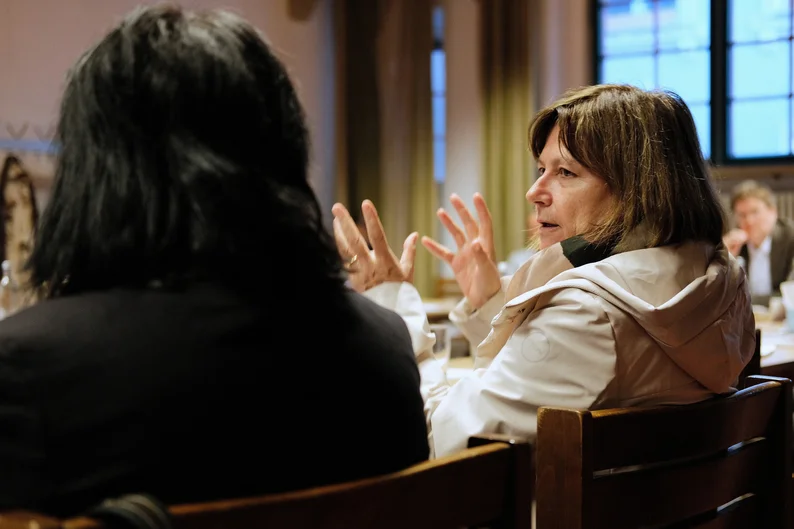
The conference will not take place on the university campus but in a beautiful old building of the 14th century called “Haus der Begegnung” which is closer to the hotels and the restaurants we plan to attend.
The address of the conference venue is: Hinter der Grieb 8, 93047 Regensburg.