
PhD project by Torsten Bendl
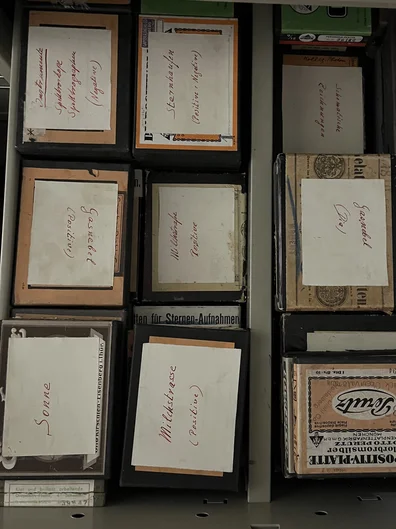
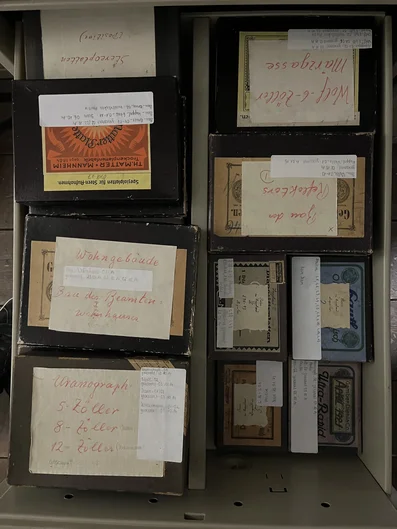
After the Langenheim brothers had invented the photographic glass plate slide in 1850, they signalled the start of a new form of knowledge dissemination. Now it was possible to demonstrate photographs to a larger audience at once, as they could now be projected onto a large screen. With the photographic slides, also the magic lantern underwent a change in meaning. While it had primarily been a means of entertainment since its invention in the 17th century, it was now used primarily as a teaching aid.
These changes led to the development of a new industry for the popularisation of science, i.e. the dissemination of scientific knowledge to a non-specialist audience. From the 1870s, companies in the photographic industry, such as the Berlin manufacturer of cameras Romain Talbot, projection technology, above all Liesegang, and publishers such as Benzinger and Seemann, recognised the potential of slides as teaching aids and produced and distributed their own series. In Liesegang's case, the company even went so far as to produce its own series of photographs, the so-called ‘Dodeka series’, and accompanied them with lecture texts so that the slides could be presented in a closed format and without the lecturers' prior knowledge.
The project examines the path a photograph took from being taken to being used as a slide in a popularising lecture. This is traced using the case study of astronomy. Astronomy is particularly suitable as it is a science in which the visual impression plays a particularly strong role. Planets, interstellar nebulae and galaxies can only be seen in their full splendour through a telescope. This means that you are dependent on having access to such an instrument. In addition, visual astronomy only works at night when the sky is clear. With photography, astronomical objects became accessible regardless of time and weather and could turn day into night when projected in the lecture theatre. The emergence of dozens of public observatories in German-speaking countries from the late 1880s also shows how much interest there was among the population.
On the other hand, astrophotography is a technique that could only be carried out by very few people until well after the Second World War. The equipment was expensive, the process was time-consuming and required a great deal of precision. For this reason, it is particularly easy to trace who the authors of the photographs are, so that the entire process from the photograph to its use can be followed. Overall, the project addresses the following questions: How does photography lead to a new infrastructure in the popularisation of science and astronomy? Which new actors were created in the process? What effect did photography have on the dissemination of knowledge? What path did the astrophotography take from the astronomer to the lecture theatre?
Sources for the project will be the holdings of Max Wolf at the University of Heidelberg, the estates of the companies involved (especially Liesegang in the depot of the Düsseldorf Film Museum) and the holdings of various public observatories and adult education centres in German-speaking countries. Karl Stöckl's estate at the University of Regensburg and his collection of glass plate slides, which are currently being digitised by the MMZ, also play an important role.