

Running projects
SFB 1277
Two subprojects both focused on imaging the antiferromagnetic order.
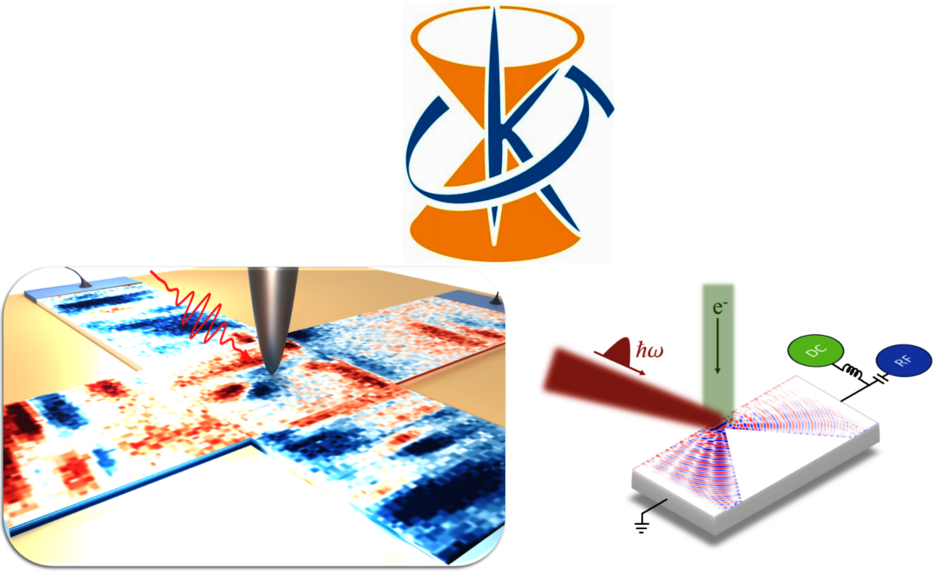
- The first subproject exploits an effect that arises from an electric field-induced Berry curvature in Pt-symmetric systems and it is linked to the Néel vector direction. The goal is then to map the magnetic order in the PT-symmetric CuMnAs via the nonlinear anomalous Hall effect, which manifests itself as a photocurrent.
- The second subproject aims at establishing an experimental platform for exploiting non-linear, spin-orbit-torque-driven dynamics in a synthetic antiferromagnet multilayer as a potential fundamental building block for future spintronic-based neuromorphic computing. We will combine high-frequency magnetotransport measurements with femtosecond nanoscale imaging approaches.
Cluster of Excellence “Center for Chiral Electronics” (CCE)
CCE will explore the unique potential of chirality in solid-state and molecular systems to develop next-generation electronic technologies.
Terahertz and DC nonlinear transport in twisted graphene and van der Waals hetero-structures
The project focus on nonlinear transport phenomena excited by terahertz radiation in twisted bilayer graphene and in 2D transition metal dichalcogenide / graphene bilayer heterostructures. Within this project, we will demonstrate that nonlinear transport can be used as a new and powerful method to access and characterize electronic and spin properties in 2D materials.
Our work is supported by

The German Science Foundation
funding projects SFB 1277, SPP 2558, Cluster of Excellence “Center for Chiral Electronics” and additional individual grants.

European Union’s Horizon 2020 research and innovation program
under the Marie Skłodowska-Curie Grant Agreement No. 861300 “Cold Opto-Magnetism for Random Access Devices”.

Czech Science Foundation
funding Project GACR 21-28876J.