

Micro- and nanoelectromechanical systems (MEMS/NEMS) are at the heart of technologies ranging from precision sensors to signal processing. Their performance often relies on nonlinear effects, ranging from amplitude-dependent frequency shifts, bistability, mode coupling and symmetry-breaking bifurcations such as period doubling. Understanding these dynamics at the nanoscale is essential for both fundamental physics and future device design. Yet conventional readout methods, whether electrical or optical, only indirectly capture the local structural motion behind these phenomena.
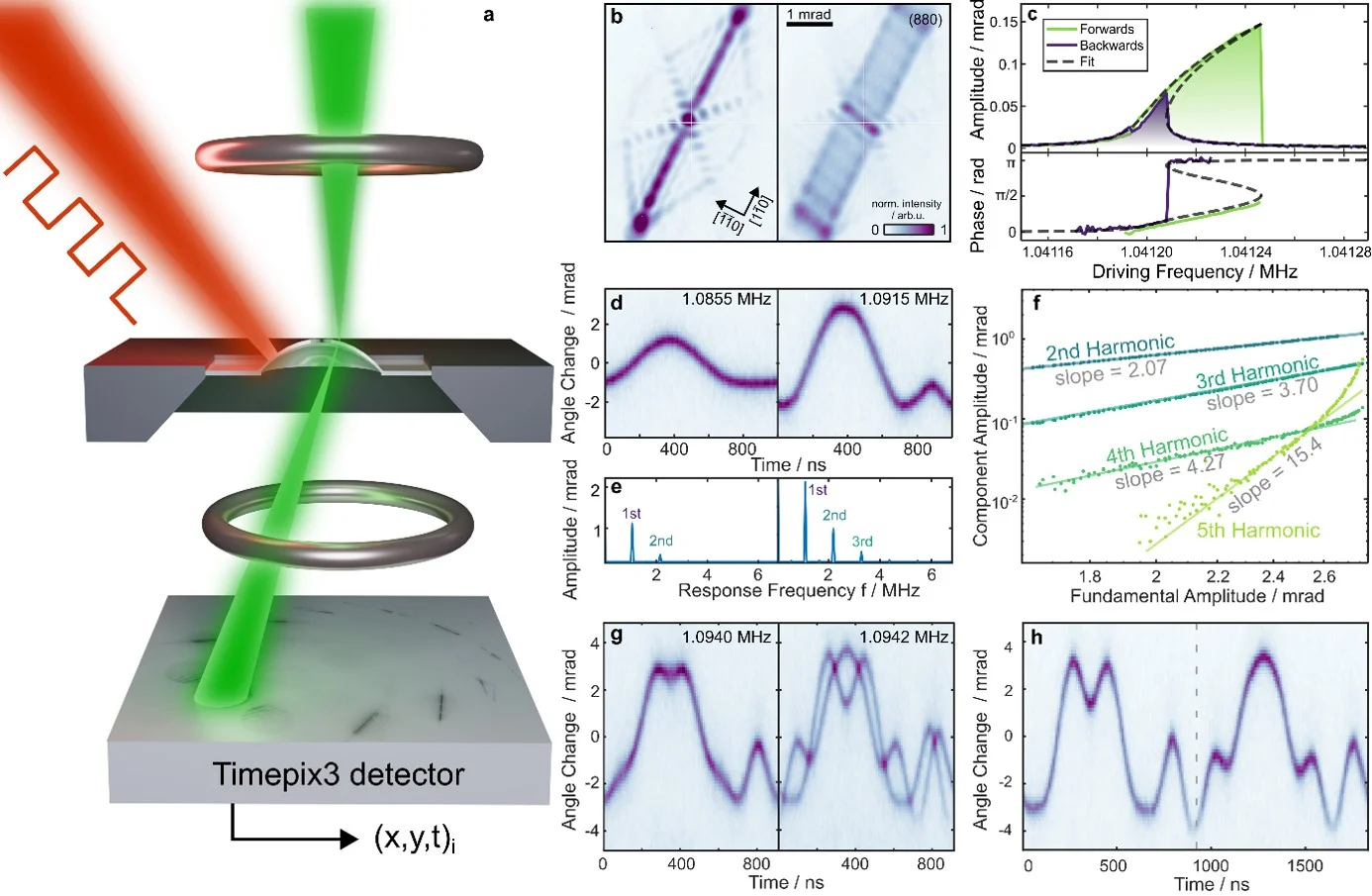
In our lab, we address this gap with a new approach: event-based, time-resolved convergent-beam electron diffraction (CBED) in an ultrafast transmission electron microscope (UTEM). By focusing a continuous electron beam on a vibrating, high-quality-factor sample and recording diffraction patterns with an event-based detector, we can reconstruct its motion with nanometer spatial precision and nanosecond time resolution, directly from the local Bragg-line dynamics. As a first sample system, we use a tensile-strained, single-crystalline silicon membrane resonator.
With this method, we have observed the full progression from Duffing-type nonlinear resonance to vibrational high-harmonic generation and, at the highest drive amplitudes, a clear period-doubling. This establishes electron diffraction as a powerful new tool for probing nonlinear nanomechanics, with potential to extend down to atomically thin resonators.
To extend our measurement capabilities, we are also building a Laser Doppler Vibrometer (LDV), which will complement our electron-diffraction approach with independent, high-precision optical vibration readout and therefore further broadening the range of nonlinear nanomechanical phenomena we can explore.