

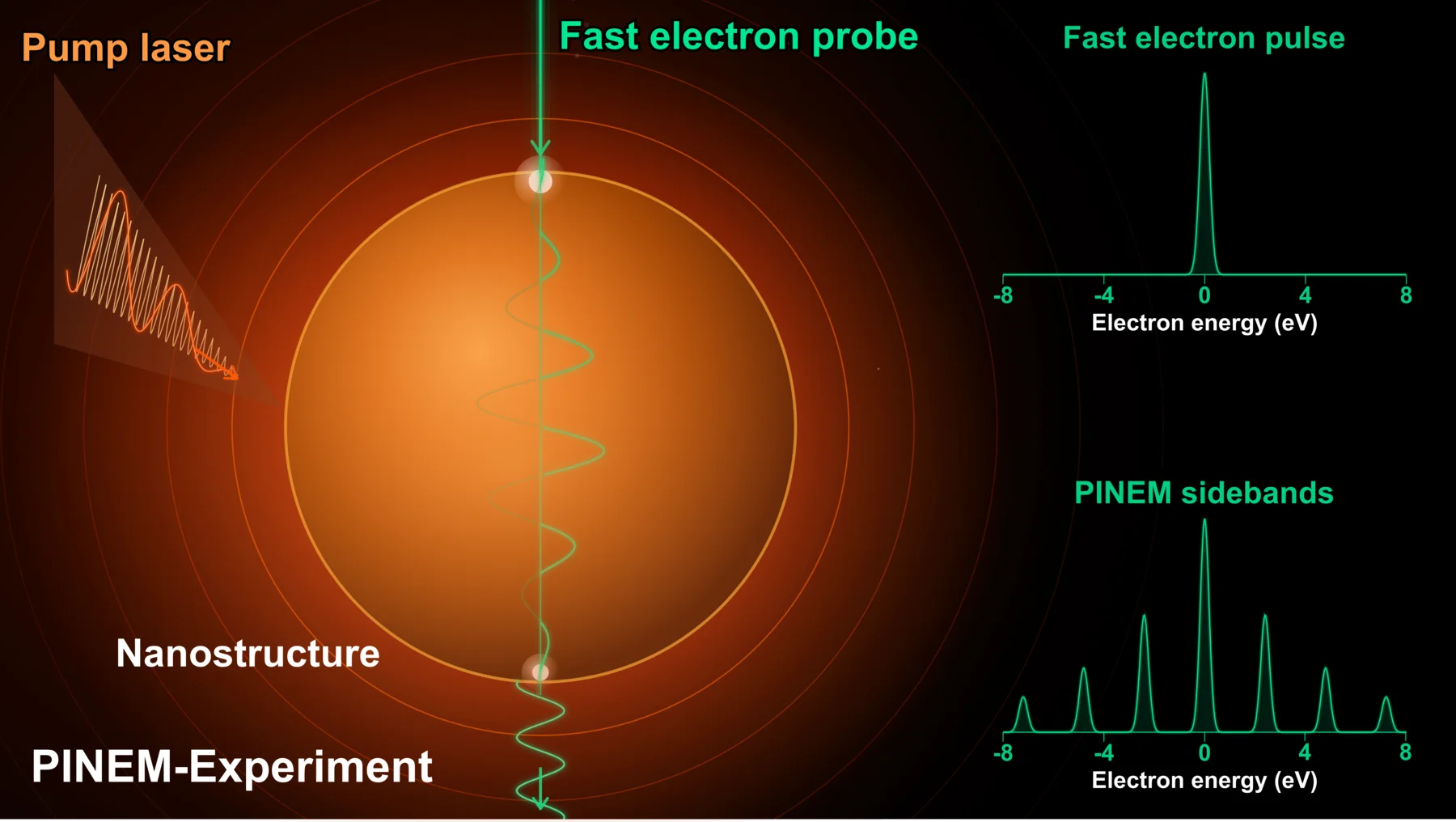
When light is squeezed to the nanoscale, conventional optics breaks down. Excitations hybridize, interfaces dominate, and light–matter coupling becomes strong enough to give rise to new quasiparticles and phenomena that are invisible to far-field measurements. To capture these effects, we use UTEM for probing transient optical near fields as they form and decay.
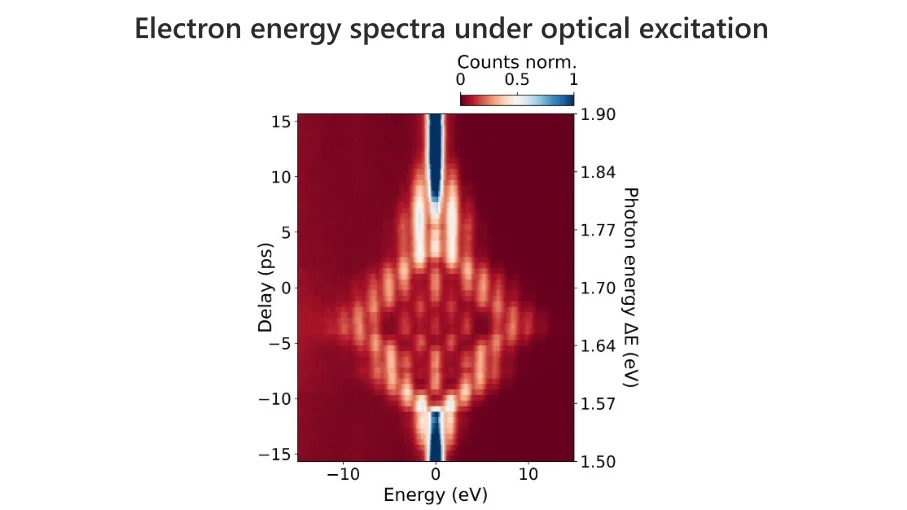
Using broadband optical excitation, we map the electron–light coupling strength and resolve how excitonic resonances, light scattering and guided optical modes interplay in space and energy, with a particular focus on exciton-polaritons in a wide range of material systems. By combining photon-induced near-field electron microscopy (PINEM) with electron energy-loss spectroscopy (EELS) in a pump-probe configuration, we follow how confinement geometry and material composition shape ultrafast polaritonic phenomena in real time.
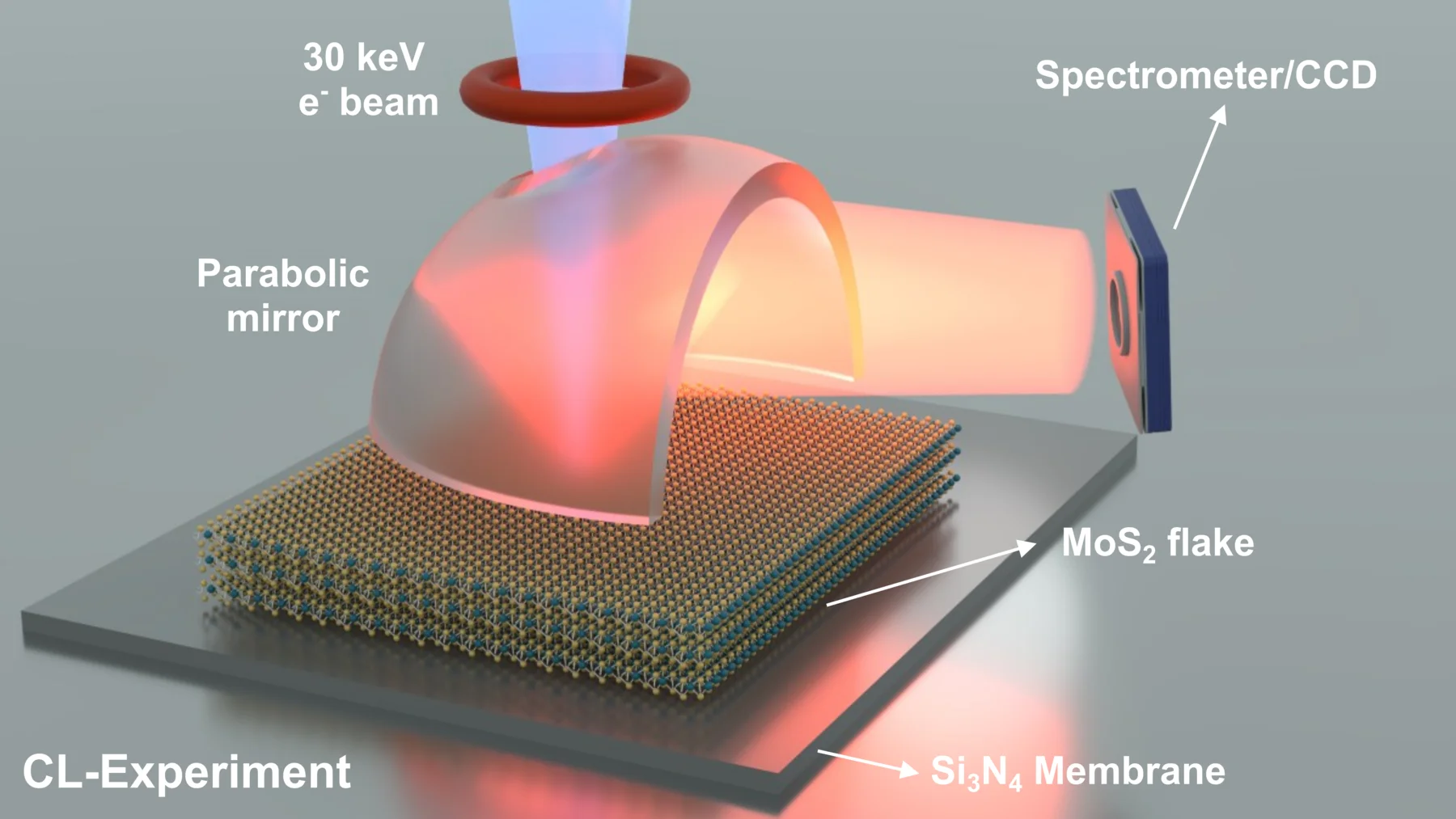
Alongside these measurements, cathodoluminescence (CL) spectroscopy offers a complementary view of the same systems by directly imaging their spontaneous optical emission and tracing the propagation of exciton-polaritons in space. Together, PINEM and CL provide a comprehensive picture: the former captures the ultrafast dynamics, the latter charts the steady-state optical landscape.
Selected Publications
N. Müller, S. El Kabil, G. Vosse, L. Hansen, C. Rathje, and S. Schäfer, Spectrally Resolved Free Electron-Light Coupling Strength in a Transition Metal Dichalcogenide, arXiv:2405.12017 (2024) (externer Link, öffnet neues Fenster).
N. Müller, G. Vosse, F. Evers, and S. Schäfer, Inelastic Electron-Light Scattering at Dielectric Thin Films, arXiv:2405.11495 (2024) (externer Link, öffnet neues Fenster).
N. Müller, V. Hock, C. Rathje, H. Koch, S. Schäfer, Broadband coupling of fast electrons to high-Q whispering gallery mode resonators, ACS Photonics 8 1569-1575 (2021) (externer Link, öffnet neues Fenster).