Bioanalysis & Biosensors
Our research encompasses modern bioanalytics methods for the investigation and detection of analytically relevant molecules and processes in complex real-world samples. The focus is on the development of innovative materials, separation and enrichment techniques, sensors and new instrumental concepts for sensitive and reliable analyses of concentration and effect. Our work addresses issues in medical diagnostics, personalised healthcare, food and environmental analysis, pharmaceutical research and biotechnology. In doing so, we combine chemical, physical and materials science approaches to develop analytical systems for the 21st century.
New materials, sensors and point-of-care testing
New functional materials form the basis of high-performance analytical systems. Our research utilises, amongst other things , liposomes, upconverting nanoparticles, electrospun nanofibres, as well as fluorescent and electroactive probes, to specifically amplify signals, improve detection limits and reduce reagent consumption in the interests of sustainable analytics.
Through labelling, enrichment and functionalisation strategies – for example, using electrospun nanofibres, micro- and nanoparticles, or reactive surfaces – even analytes at low concentrations can be detected with high sensitivity.
These approaches are integrated into modern bioanalytics platforms such as lateral-flow assays, microfluidic chips, plates with sensors, or lab-on-a-chip systems. The aim is to develop compact, automatable and user-friendly analytical systems for use directly at the patient’s bedside, in the doctor’s surgery (point-of-care testing) or in the field.
To detect biological and chemical target molecules, we utilise a wide range of optical, spectroscopic and electrochemical methods. This leads to the development of innovative sensor systems and wearables for rapid, portable and highly sensitive analyses in medicine, the environment and the life sciences.

Labelling-free functional analysis using living cells as sensors
Bioanalytical chemistry often focuses on determining the concentration of a chemical species in a complex biological sample. This requires the analytical method to be both selective and specific. If the biological effect (e.g. toxicity) of a real-world sample is the primary concern, then it is not initially crucial which of the components it contains triggers the effect, but merely whether the sample is toxic, carcinogenic or perhaps even beneficial or curative for a particular phenotype. This perspective takes account of the fact that it is often
It is impossible, or at the very least extremely labour-intensive, to analyse and evaluate all the components of a complex sample. Mechanism-of-action analysis is therefore necessarily based on living organisms, which are utilised in their functional entirety for detection purposes. For effect-based analytical studies, we therefore use living cells and tissues from a wide variety of species (humans, mice, rats, insects), which are selected according to the research question, and connect them to a physical signal transducer (electrode, optrode, piezo-resonator) in order to be able to read out and quantify the organisms’ response to an external stimulus. The use of these methods requires a precise understanding of the coupling between living sensors and signal transducers.
We primarily use label-free – and therefore non-destructive – time-resolved signal transducers so as not to influence the sample’s response with dyes or other analytical indicators, and to observe and analyse the organisms continuously over long periods of time, even up to weeks. To do justice to the complexity of these living sensors, we frequently employ multiple signal transducers to monitor cells and tissues using multiple parameters, thereby gaining a more in-depth understanding. Electrochemical impedance spectroscopy is almost always used in this context; its signal-generating alternating current completely penetrates biological organisms and is thus integrated across the entire cell or tissue.
Electroanalytics, mass spectrometry and coupling techniques
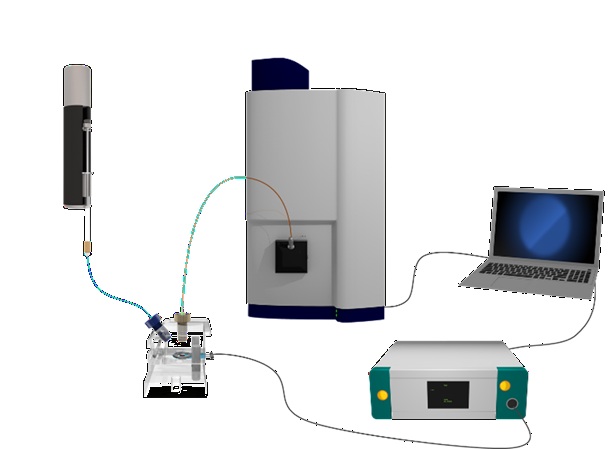
In the field of electroanalytics, we specialise in miniaturised analytical systems utilising ultramicroelectrodes. These electrodes, with dimensions in the µm and sub-µm range, are particularly suitable as probes for electrochemical scanning microscopy (SECM), which enables the spatially resolved characterisation of the electrochemical activity of surfaces. In addition, the direct coupling of electrochemical flow cells with mass spectrometry plays an important role. This allows so-called mass voltammograms to be generated in real time, which, in addition to the conventional current–voltage characteristic, provide mass-resolved information on the reactant and product species of electrochemical reactions. In the case of complex reaction processes, a capillary electrophoretic separation can be incorporated between the electrochemical cell and the mass spectrometer. Such coupling systems are only possible on the basis of instrumental developments, which play a key role in our analytical research. Instrumental innovations are generally first implemented and optimised using model systems; the instrumental systems developed can be deployed in various fields of application, such as bioanalytics, environmental analysis and the investigation of lithium-ion batteries .
Typical research questions
How can new viruses or pathogenic organisms be detected with high sensitivity and selectivity in complex biological samples such as blood, saliva or urine?
How can multiple analytes be quantitatively detected on test strips using several different detection systems?
How can the detection limits of bioanalytical methods be improved through new surface chemistries, nanostructures or intelligent assay concepts?
How can bioanalytical systems be miniaturised and automated to create portable point-of-care or lab-on-a-chip platforms?
What strategies enable the enrichment of trace analytes from biological or environmental samples?
How can optical methods such as fluorescence, Raman spectroscopy or plasmonic sensors be combined with microfluidic platforms?
What role do surface and interfacial effects play in the interaction of nanomaterials with biological systems?
How can instrumental developments increase the analytical information content?
What are the limits to the miniaturisation of analytical systems?
What are the advantages and disadvantages of various chromatographic and electrophoretic separation methods?
How can the performance of analytical separation methods be improved through new detection concepts?
How does a herbicideaffect insects? Is there an unintended insecticidal effect? (Ecotoxicology)
Are natural or synthetic nanomaterials toxic, and if so, at what concentrations and after how long? (Nanotoxicology)
Can a chemotherapeutic agent actually kill tumour cells or prevent them from dividing? (Chemosensitivity analysis, biomedicine)
When viruses infect a potential host cell, what reaction is triggered in the host cell, and can antiviral drugs prevent this? (Efficacy analysis, virological assays)
Is a new vaccine capable of inducing the production of sufficient quantities of suitable antibodies to reliably prevent a viral infection? (Neutralisation assays, virological assays)