

Sustainable Chemistry
Sustainable chemistry focuses on designing chemical processes and products in such a way that they are more environmentally friendly, conserve resources and are safer for both people and nature. The main focus is on avoiding waste, working in an energy-efficient manner and using renewable raw materials that are as non-toxic as possible, whilst ensuring that the products and solvents used are biodegradable and, where possible, recyclable. The aim is to minimise the negative impacts of chemistry on the environment and human health in the long term.
Bioeconomy
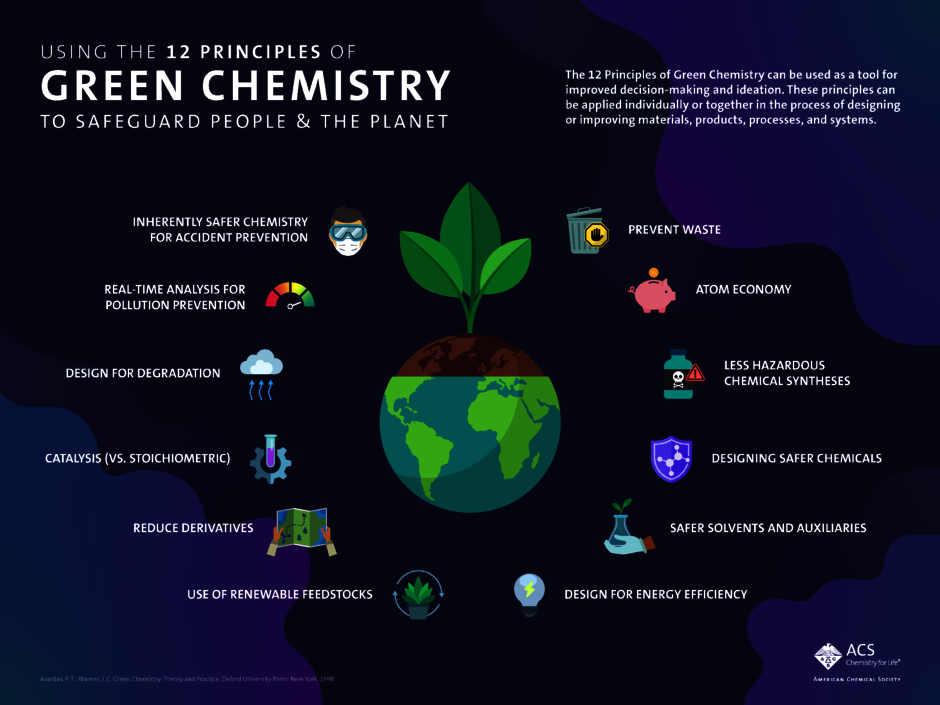
A key conceptual foundation is provided by the principles of ‘Green Chemistry’, which include, amongst other things, the minimisation of waste, the use of less toxic reagents, the improvement of energy efficiency, and the development of products with lower environmental persistence. Particular emphasis is placed here on the design of so-called atom-economical syntheses, in which as many of the atoms used as possible are incorporated into the end product in order to reduce by-products and waste streams. Furthermore, the development of closed-loop material cycles is becoming increasingly important, as it enables a transition from linear to circular value creation models.
Another key aspect of sustainable chemistry is the substitution of fossil raw materials with renewable resources. Biomass, CO₂ as a C1 building block, and bio-based platform chemicals are increasingly being researched as alternative starting materials to enable CO₂-neutral or even CO₂-negative chemical production in the long term. At the same time, innovative technologies such as homogeneous and heterogeneous catalysis, biocatalytic processes, and electrochemical and photochemical reactions play a crucial role. These not only enable a more efficient conversion of substances but also open up new avenues for utilising renewable energy within chemical processes.
 UR/Antonia Pröls
Resource efficiency
Furthermore, sustainable chemistry requires a life-cycle-based approach to products (‘Life Cycle Assessment’, LCA), in which all environmental impacts – from raw material extraction through production and use to disposal or recycling – are analysed and assessed. This holistic perspective makes it possible to identify conflicting objectives at an early stage and to make informed decisions in the interests of sustainable development. In this context, interdisciplinary collaboration between chemistry, engineering, environmental sciences and economics is also becoming increasingly important.
Last but not least, sustainable chemistry is of great relevance to society, as it makes a significant contribution to tackling global challenges such as climate change, resource scarcity and environmental pollution. Through the development of sustainable materials, low-emission production processes and innovative recycling strategies, the chemical industry can make a decisive contribution to a climate-neutral and resource-efficient economy.
Typical research questions
- How can chemical synthesis processes be designed so that they take place with minimal energy consumption and, as far as possible, without producing hazardous by-products?
- Which renewable raw materials are suitable as sustainable alternatives to fossil resources in the chemical industry?
- How can chemical reactions take place in solvents that are as environmentally friendly as possible and conserve resources and energy, whilst ensuring that the solvents are optimally tailored – including in terms of their structure – to the desired syntheses?