

 UR / Tanja Wagensohn
#talktime © 2026, Tanja Wagensohn UR. All rights reserved.
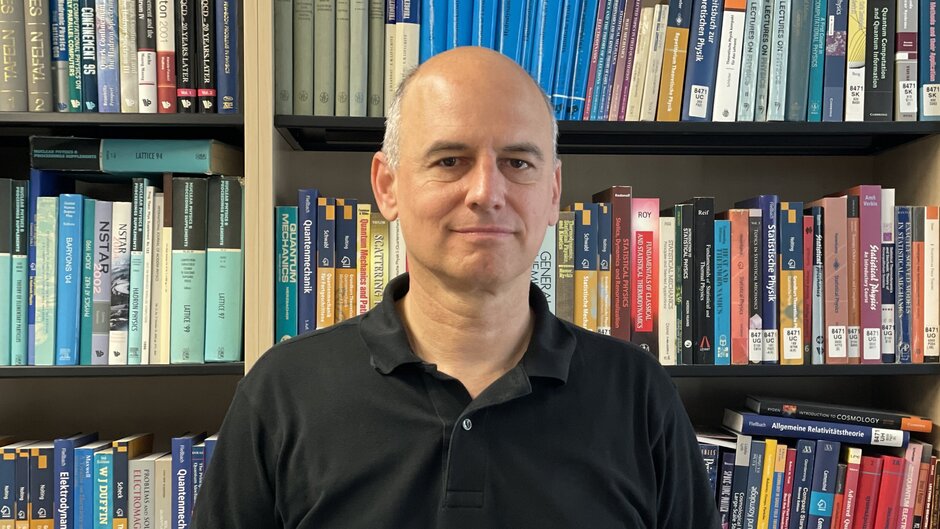
As a student, Professor Gunnar Bali was fascinated by mathematics. He enjoyed calculations more than proofs. Therefore, he has spent most of his life studying physics. He explores theoretical particle physics and computational physics at the University of Regensburg’s Faculty of Physics. In Bali’s working group, the researchers are investigating properties of quantum chromodynamics, the theory of strong interactions.
High-Energy Physics
Regensburg’s excellence in physics is reflected not only in the DFG-funded Cluster of Excellence,’ Center for Chiral Electronics (external link, opens in a new window)’. The University also has a particle physics group with “an ideal combination of expertise”, Bali says. The team includes researchers who perform analytical calculations and run simulations on supercomputers. A unique feature of this group is that in addition they develop software and hardware for supercomputers. "This started eighteen years ago with the development of the supercomputer QPACE. It was the most energy-efficient supercomputer in the world for a year," says Bali.
Much of Gunnar Bali’s research involves large-scale simulations. Working with international teams, he uses supercomputers to study the behavior of the quantum vacuum, the seemingly empty space that, according to modern physics, is filled with constant fluctuations. Bali and his group create countless digital "snapshots" of this vacuum and use them to calculate the properties of particles such as the proton.
Such calculations can take up to ten years and involve large international teams. Yet when Gunnar Bali speaks about science, he rarely starts with the answers. It is not about solving problems, Bali says:
"The most interesting thing is finding the right questions.”
That task is far more difficult than it sounds. Modern particle physics is based on the Standard Model, a theory that has been tested with extraordinary success. Scientists know these theories cannot be the final word, but clear clues about what comes next remain rare. In such a landscape, progress does not come from answering obvious questions. It comes from identifying the hidden questions that matter.
This is where Gunnar Bali sees a connection between physics and art. Maybe as artists decide what is worth expressing? A physicist at the frontier of knowledge must decide what is worth investigating. This requires judgment, intuition, and imagination. However, Bali is careful not to romanticize the comparison. Neither art nor scientific work usually results from a sudden flash of genius. They result from persistent work.
Big breakthroughs are rare.
Understanding himself as an empirical researcher, Gunnar Bali tries to make theoretical predictions more precise in order to detect possible deviations from experiments. “Since our field has a long history, the remaining questions are complicated and take longer to answer”, Bali says. New ideas often emerge only after years of patient work and in collaborations with researchers across the globe.
Together with his colleagues, Bali regularly applies for computing time on supercomputers at facilities such as the Jülich Supercomputing Center (JSC), the Leibniz Supercomputing Center (LRZ) near Munich, and CINECA in Bologna. The process of applying for supercomputing time requires proposals, reports, and lots of paperwork. There is one thing that frustrates him, Gunnar Bali says at the beginning of our conversation, “it is being interrupted all the time”.
Still, he enjoys the freedom of working at a university.
Unlike industry, academic research allows Gunnar Bali to openly discuss his work, teach students, and explore ideas without commercial non-disclosure restrictions. Teaching remains important to him, even if he wishes students would ask more questions. In his experience, they always ask too few. “Students are much to nice here”, he says with a smile. Obviously, it was different at his previous universities: University of Glasgow and Humboldt University in Berlin, the University of Southampton and the University of Wuppertal. Bali has been in Regensburg since 2006.
Work-Work-Balance
Away from research, Gunnar Bali describes his lifestyle as a "work-work balance." His days are filled with meetings, conversations, administrative tasks, and computer work. Yet he always finds time for cycling. The physicist would love taking longer tours, but everyday responsibilities usually limit him to four-hour rides. Once he finds his rhythm on a quiet road, the world shrinks to include only deer, birds, and hares crossing the landscape.
Cycling can also be combined with work. For example, he might extend a scientific workshop or conference with a short hiking or cycling trip, perhaps in the mountains near Trento or on the island roads of Cyprus. Yet even on vacation, Bali never completely switches off. Spending days on a beach doing nothing would not suit him. Gunnar Bali appreciates the beautiful countryside of Bavaria, but he prefers the energy of larger cities.
His fascination with how things work extends beyond physics. He enjoys repairing bicycles and if necessary, a washing machine, Bali says. However, modern products often annoy him because they are designed to be replaced rather than repaired.
What about AI?
The same practical attitude shapes his view of artificial intelligence. He sees AI as another tool, one that may help researchers in some areas, particularly in fields like biology or chemistry. “AI is particularly good at recognizing patterns that were previously unknown.” In general, AI does not frighten him. “You can save time using it when writing code. But our theories are such that there isn’t much hidden that we don’t already know. AI has to learn that first. It is not currently competitive with the programs we write ourselves.”
Gunnar Bali is more concerned about its effect on young people who want to pursue careers in software development. It is becoming harder for beginners to find opportunities in this field. However, the researcher believes that students of physics acquire skills and methods that can later be applied in many fields. Most importantly: They may also obtain the ability to ask the right questions in the right place, which is useful anytime, anywhere.