
Combining Ab Initio and Machine Learning to Predict Proximity Effects in Van Der Waals Heterostructures
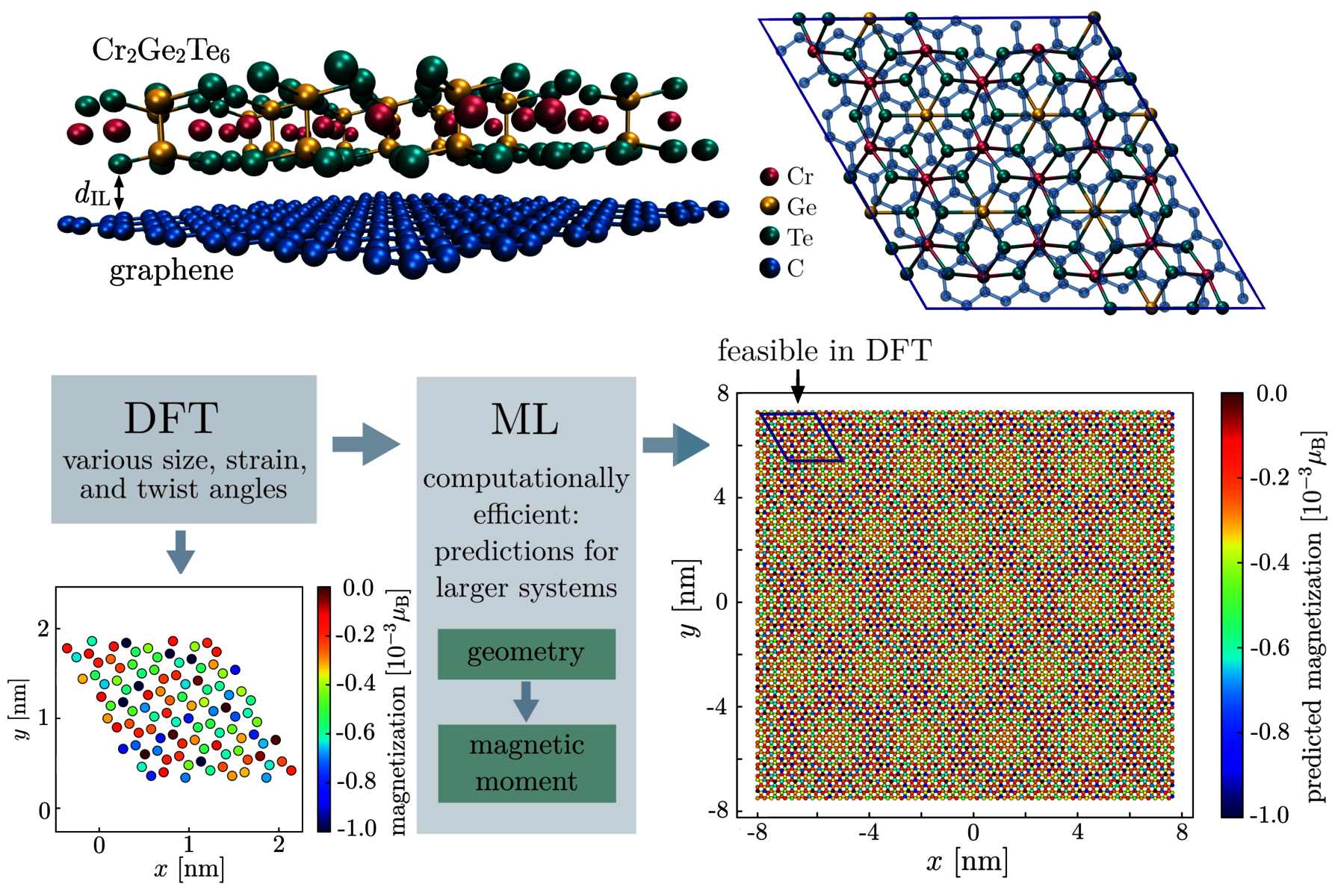
Proximity effects occur at the interface of van der Waals heterostructures and are highly sensitive to the local stacking geometry at the atomic scale. Each atom experiences a unique environment, leading to significant variation in interactions – even between neighboring atoms. These effects are inherently complex and have so far resisted accurate description by analytical models.
To capture this complexity, we developed a machine learning framework that links atomic-scale structure to proximity-induced properties. Trained on high-fidelity data, the model learns how subtle variations in stacking and local atomic configuration influence the physical response. This enables us to probe interface physics beyond the reach of conventional theory and reveals intricate spatial patterns of proximity effects across the material.
This work has been published in npj Computational Physics (external link, opens in a new window).