Anatomy of Spin-Orbit Torques in Monolayer Fe₃GeTe₂ and Fe₃GaTe₂: Insights from Atomistic and Momentum-Space Decompositions
Our group studied how electric currents exert spin-orbit torques (SOTs) on the magnetization of van der Waals magnets, and how those torques can be engineered for efficient, field-free switching. We computed the torque from first principles using fully relativistic density-functional theory combined with symmetry-adapted Wannier functions, and Kubo–Bastin linear response, which gives the torkance – the torque per unit applied electric field – split into Fermi-sea (time-reversal-even) and Fermi-surface (time-reversal-odd) contributions. Resolving the result by atomic site and by k-point shows which atoms and which electronic states carry the torque.
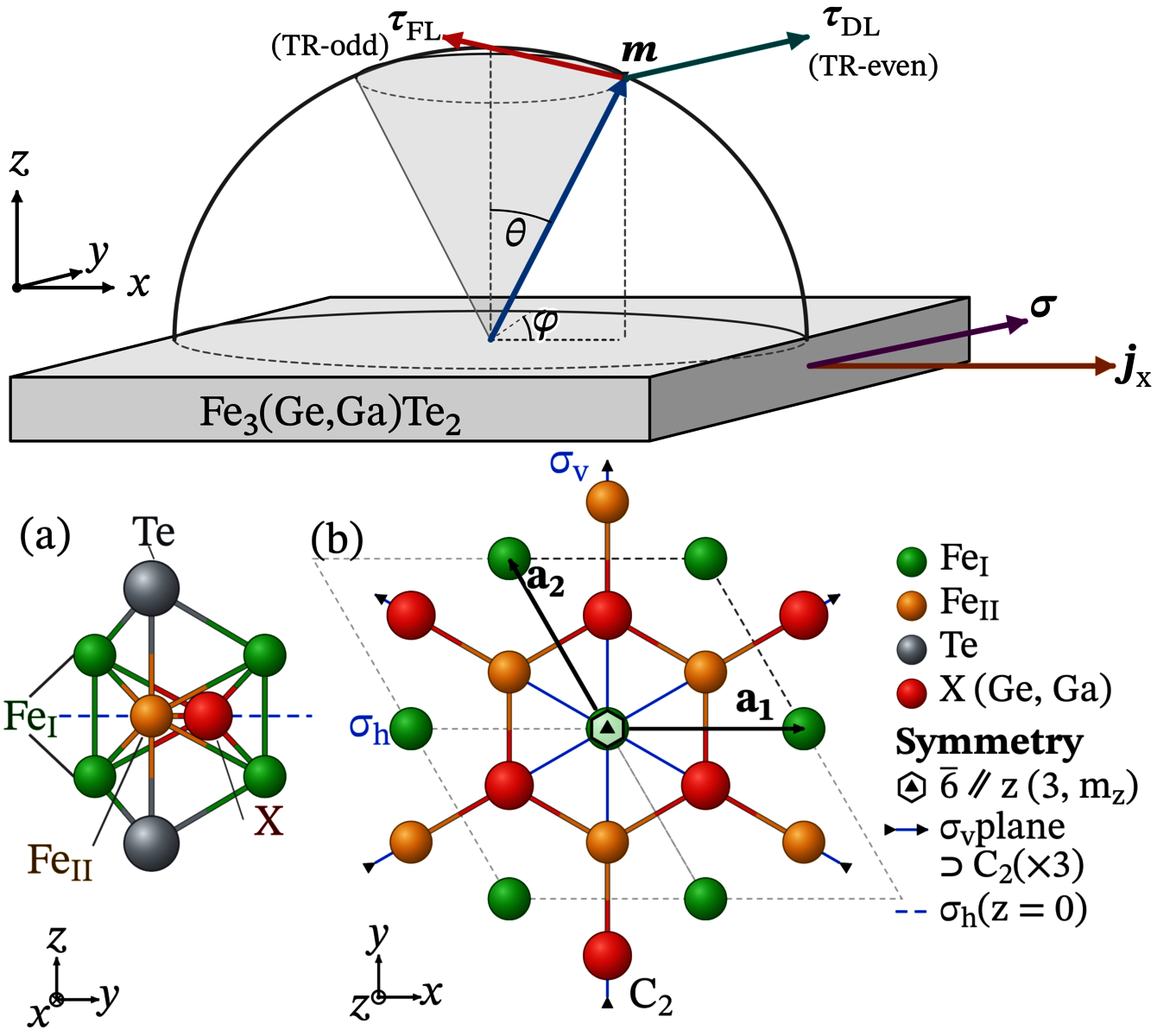
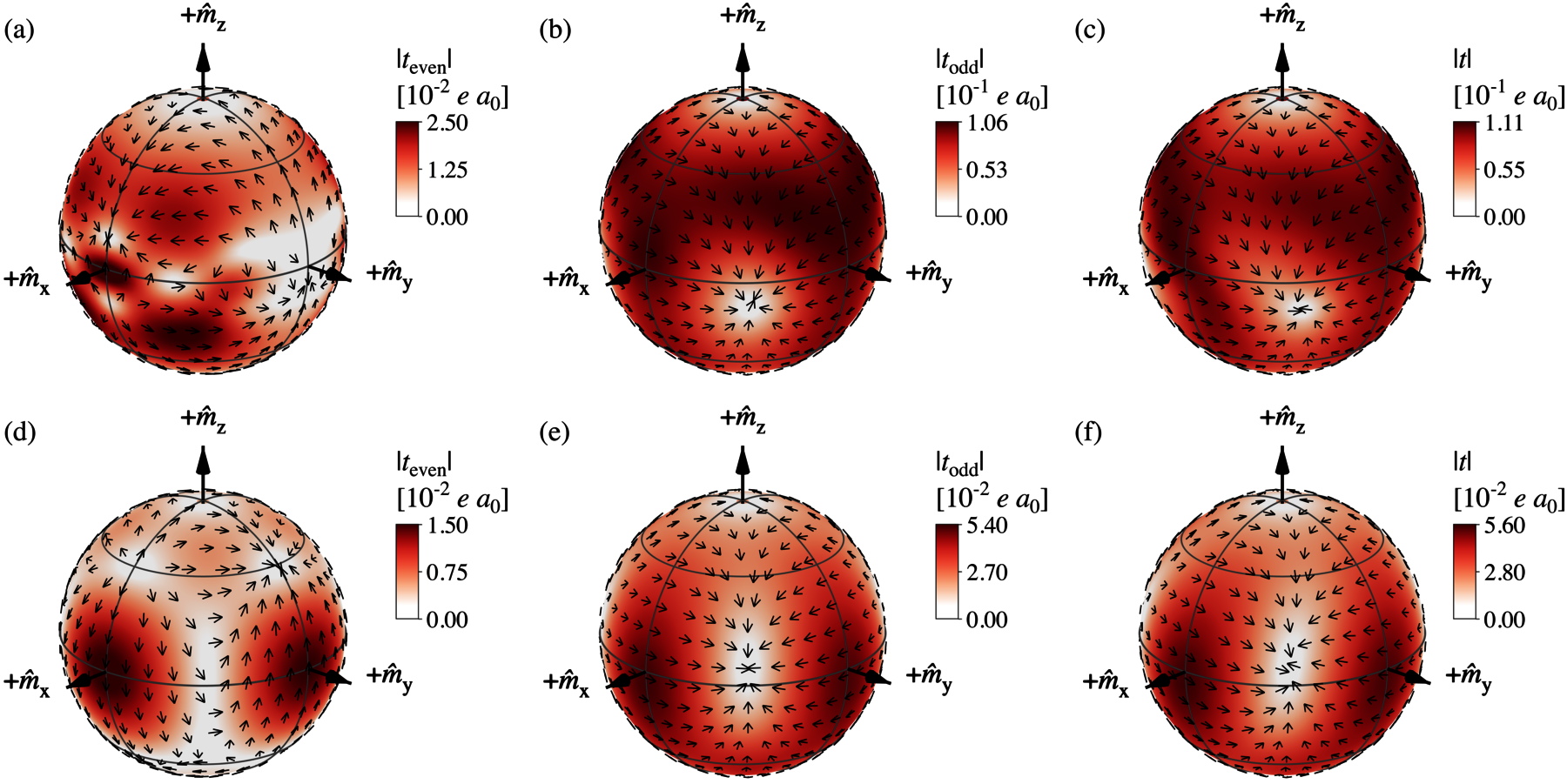
Monolayer Fe₃GeTe₂ (FGT) and Fe₃GaTe₂ (FGaT) demonstrate how strongly symmetry shapes these torques. Their D₃ₕ symmetry forbids the textbook Rashba–Edelstein spin accumulation, so the self-torque exists only because the tilted magnetization itself breaks the horizontal mirror. The resulting torque is rich in higher angular harmonics, and the current-induced spin polarization can even point parallel to the current. Replacing Ge by Ga removes one valence electron, a built-in hole doping that cuts the Fermi-level density of states threefold and flips its spin polarization from minority to majority. The Fermi-surface torque is almost unaffected. The Fermi-sea torque, which is concentrated at spin-orbit-mixed band anticrossings, reverses sign and loses its fourth harmonic, a change we trace to the shrinking K-point pockets.
Site-resolved analysis uncovers large hidden torques on the two mirror-related outer Fe atoms. They are opposite in sign and cancel exactly in the ideal monolayer, yet in FGaT each one exceeds the symmetry-allowed torque by nearly a factor of 30. Breaking the mirror through defects or van der Waals stacking can tap this reservoir and unlock an out-of-plane spin polarization, the key ingredient for deterministic switching of perpendicular magnets.
This work has been published in Physical Review B as Editors’ Suggestion (external link, opens in a new window).