Unconventional Josephson Supercurrent Diode Effect Induced by Chiral Spin-Orbit Coupling
The lacking mirror symmetry in chiral materials – e.g., in twisted van der Waals homobilayers – can rise unconventional spin-orbit fields such as fully momentum-aligned radial Rashba fields.
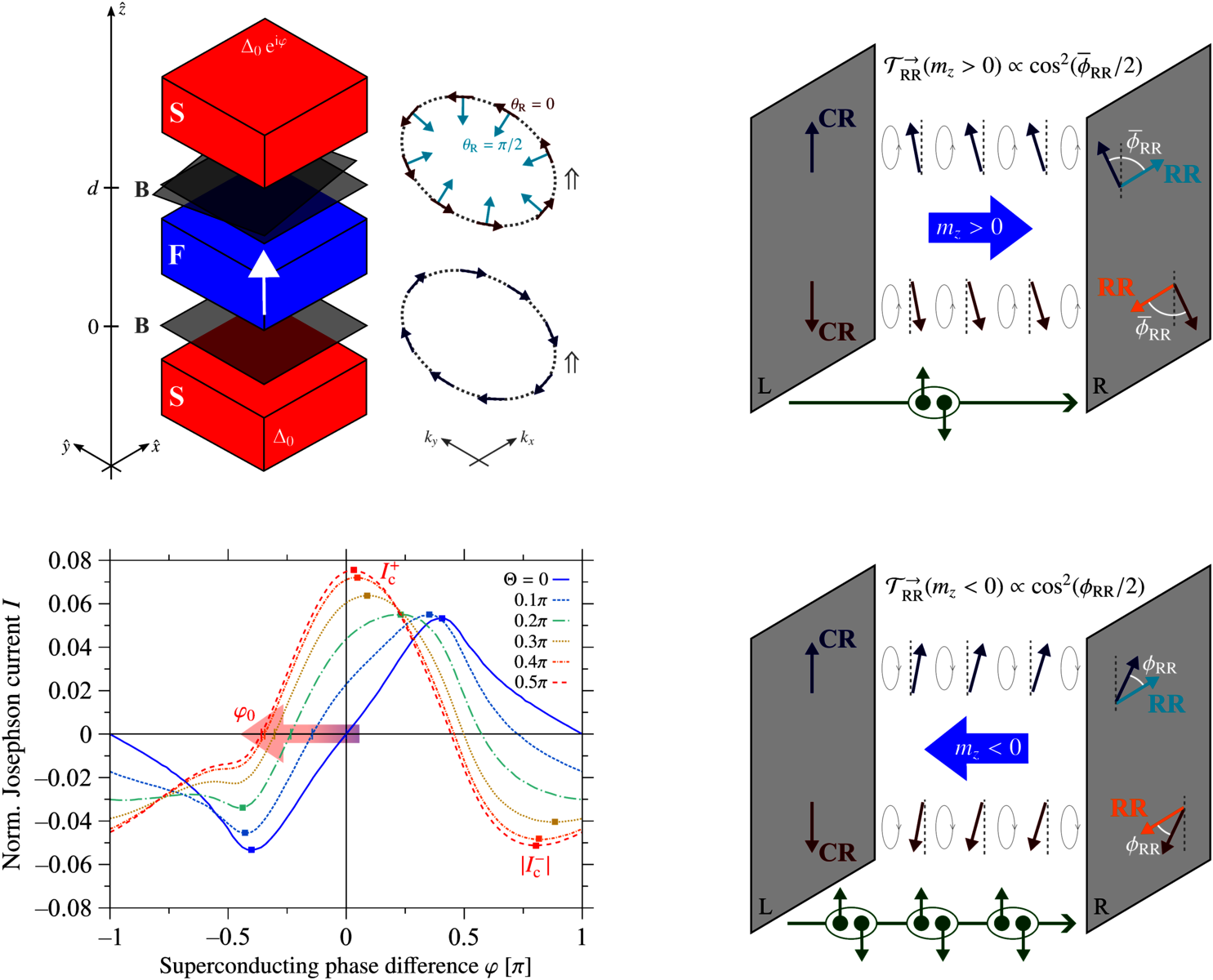
After predicting this novel radial Rashba spin-orbit coupling from first-principles calculations and performing large-scale magnetotransport calculations for proximitized graphene, we studied the Cooper-pair transfer in vertical superconductor/ferromagnet/superconductor Josephson junctions that host “crossed” (tangential and radial) Rashba fields at their interfaces. We unraveled that their interplay results in what we call the unconventional supercurrent diode effect (SDE) with maximal supercurrent rectification when the magnetization of the ferromagnetic link is collinear with the supercurrent (instead of perpendicular as in the conventional SDE). We showed that the microscopic origin of the unconventional SDE – spin precessions inside the ferromagnet – is well distinct from the Rashba-induced effects on Cooper-pair momenta in the conventional SDE, making it a particularly sensitive probe of interfacial chiral spin textures.
This work has been published in the Letter section of Physical Review B (external link, opens in a new window).