

| Adress | Institut I - Theoretische Physik Universität Regensburg |
| Telephone | +49 (0)941 943 2035 |
| Fax | +49 (0)941 943 2038 |
| milena.grifoni(at)physik.uni-regensburg.de (opens your email program) | |
| Office | PHY 3.1.29 |
CV
| Academic Education | |
| 1999 | Habilitation (Theoretical Physics): “Driven dissipative tunneling”, Universität Augsburg |
| 1991 – 1994 | PhD in Theoretical Physics (supervisor: M. Sassetti), |
| Università di Genova, Italy | |
| 1986 – 1991 | Study of Physics (diploma), Università di Genova, Italy |
| Research and Professional Experience | |
| since 2003 | Chair in Theoretical Physics (C4), Universität Regensburg |
| 2002 – 2003 | Universitair Hoofdocent (UHD) (associate professor, permanent), Technische Universiteit Delft, The Netherlands |
| 2000 – 2002 | Universitair Docent (UD) (assistant professor, permanent), Technische Universiteit Delft, The Netherlands |
| 2000 | Ricercatore INFM (associate professor, non permanent), Università di Genova, Italy |
| 1999 | Research associate, Universität Karlsruhe |
| 1998 | Visiting scientist, Universität Stuttgart |
| 1998 – 1999 | Research associate, Università di Genova, Italy |
| 1994 – 1998 | Postdoctoral position, Universität Augsburg |
| Further Activities, Awards and Scholarships | |
| 2020-2024 | Member of the working group (Fachkolleg) “Theory of Condensed Matter” of the German Science Foundation |
| 2019 | Member of the Review Panel for the assignment of Distinguished Professor grants of the Swedish Research Council |
| since 2017 | Member of the Advisory Board for the Norwegian Centre of Excellence on Quantum Spintronics |
| 2017 | Member of the Review Panel for the assignment of Distinguished Professor grants of the Swedish Research Council |
| 2015 – 2016 | Member of the Review Committee for the activities of the Italian Institute of technology (IIT) in the timeframe 2012-2014, Ministry of Education and Ministry of Economics and Finances, Italy |
| 2014 – 2016 | Member of the Scientific Advisory Board of the Finnish Centre of Excellence, Aalto University, Finland |
| 2014 | Scientific Advisory Board for the rating of the Physics Departments in Hessen, Ministry of Research and Arts of the State of Hessen |
| 2013 | Reviewer of the FP7 integrated project SOLID |
| 2011 – 2013 | Vice President of the University of Regensburg, resort Research |
| 2011 | Reviewer of the FP7 integrated project SOLID |
| 2009 – 2018 | Spokesperson of the DFG Research Training Group 1570 “Electronic Properties of Carbon Based Nanostructures” |
| 2009 – 2011 | Editorial Board Member of “Advances in Physics” |
| 2009 – 2011 | Dean of the Physics Department, Universität Regensburg |
| 2007 – 2009 | Vice Dean of the Physics Department, Universität Regensburg |
| 2004 – 2013 | Editorial Board Member of “The European Physical Journal B” |
| 2004 – 2007 | Responsible for Women Affairs of the Physics Department, Universität Regensburg |
| 2002 – 2010 | Editorial Board Member of “New Journal of Physics” |
| 2002 – 2003 | ASPASIA fellowship of the Netherlands Organisation for Scientific Research (NWO) |
| 2002 – 2003 | Captain of the Flagship “Quantum computing with nanodevices” within the dutch NanoNed Program |
Research
My research focuses on dynamical properties (transient and stationary) of open quantum systems out-of-equilibrium.
Fermionic open quantum systems are for example nanosized conductors coupled to source and drain electrodes. The electrodes, play here the role of fermionic heat baths. In this context we study many-body properties of hybrid nanojunctions, molecular systems in STM configuration or complex quantum dots. Focus is on quantum transport set-ups where particle, heat or spin currents arise due to particle or temperature gradients, or in response to external electromagnetic fields.
Bosonic open quantum systems are encountered when (effective) quantum particles interact with a bosonic environment, e.g. with a phonon bath in a crystal or with the quantized modes of an electromagnetic cavity. Systems of interest are for example quantum Brownian particles, driven and dissipative multilevel systems, or superconducting platforms containing linear and non-linear elements for quantum computation and quantum information purposes.
In recent years we have developed a many-body theory of quantum transport based on the reduced density matrix approach, which we have applied to investigate transport in carbon nanotube based nanojunctions and molecules. Also, we have used non-perturbative field theory approaches to investigate strongly correlated systems in the Kondo regime and interacting one-dimensional systems. Path integral approaches have recently been used to investigate decoherence and relaxation properties of superconducting qubits interacting with an electromagnetic environment, as well as strongly interacting impurity systems.
Qantum transport in nanostructures
Topological
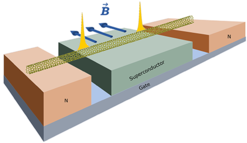
Image: Author - Magdalena Marganska-Lyzniak
Single molecule junctions

Image: Author - Andrea Donarini
Carbon nanotube based junctions
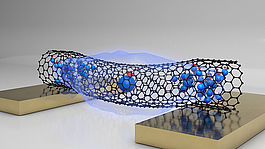
Image: Author - Michael Niklas
Interacting quantum dots

Image: Author - Leonhard Mayrhofer
Spintronics

Image - Source: A. Dirnaichner et al., PRB 91, 195402 (2015)
Quantum dissipative systems
Superconducting platforms for quantum information and quantum simulations
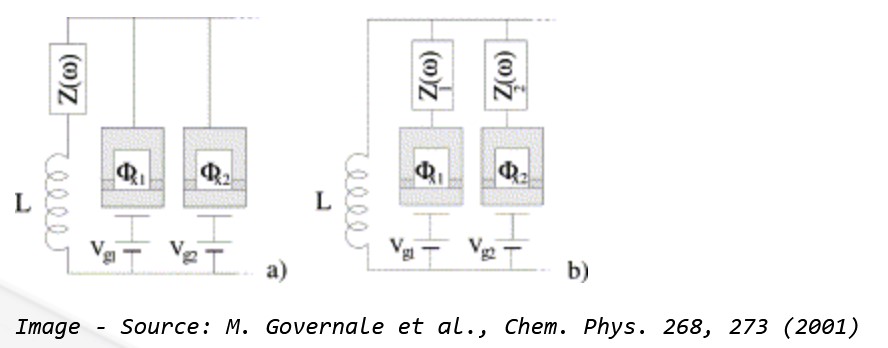
Image - Source: M. Governale et al., Chem. Phys. 268, 273 (2001)
Dissipative qubits and multi-level systems

Image - Source: M. Goorden et al., Phys. Rev. Lett. 93, 267005 (2004)
Driven dissipative tunneling
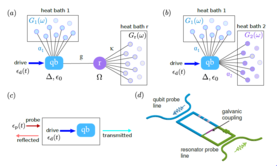
Image - Source: Magazzú et al., arXiv: 2104.14490v2 [quant-ph] 9 May 2021
Quantum ratchets
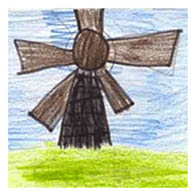
The windmill: a classical ratchet
Quantum stochastic resonance
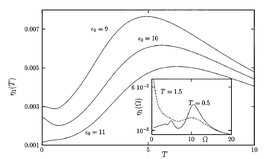
Image - Source: M. Grifoni and P. Hänggi, Phys. Rev. Lett. 76, 1611 (1996)
Acoustic properties of quantum glasses at low temperatures
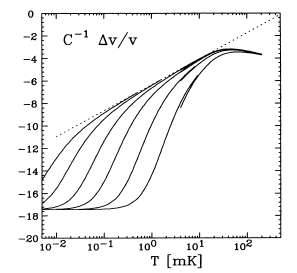
Image - Source: J. Stockburger et al., Phys. Rev. B 51, 2835 (1995)
Publikationen
- Grifoni, Milena, Hartmann, Ludwig, Berchtold, Sabine and Hänggi, Peter (1996-06) Quantum tunneling and stochastic resonance.
Physical Review E: 53 (6), P. 5890-5898.
https://dx.doi.org/10.1103/PhysRevE.53.5890 - Grifoni, Milena and Hänggi, Peter (1996-03) Coherent and Incoherent Quantum Stochastic Resonance.
Physical Review Letters: 76 (10), P. 1611-1614.
https://dx.doi.org/10.1103/PhysRevLett.76.1611 - Grifoni, Milena, Sassetti, Maura and Weiss, Ulrich (1996-03) Exact master equations for driven dissipative tight-binding models.
Physical Review E: 53 (3), P. R2033-R2036.
https://dx.doi.org/10.1103/PhysRevE.53.R2033 - Grifoni, Milena, Sassetti, Maura, Hänggi, Peter and Weiss, Ulrich (1995-10) Cooperative effects in the nonlinearly driven spin-boson system.
Physical Review E: 52 (4), P. 3596-3607.
https://dx.doi.org/10.1103/PhysRevE.52.3596 - Stockburger, Jürgen T., Grifoni, Milena and Sassetti, Maura (1995-02) Nonlinear acoustic response of glasses in the tunneling model.
Physical Review B: 51 (5), P. 2835-2843.
https://dx.doi.org/10.1103/PhysRevB.51.2835 - Stockburger, Jürgen, Grifoni, Milena, Sassetti, Maura and Weiss, Ulrich (1994-12) Nonlinear acoustic response of amorphous metals in the tunneling model.
Zeitschrift für Physik B Condensed Matter: 94 (4), P. 447-459.
https://dx.doi.org/10.1007/BF01317407 - Grifoni, Milena, Sassetti, Maura, Stockburger, Jürgen and Weiss, Ulrich (1993) Nonlinear response of a periodically driven damped two-state system.
Physical Review E: 48 (5), P. 3497-3509.
https://dx.doi.org/10.1103/PhysRevE.48.3497