

How to steer properties of quantum systems by light or time-dependent perturbations has been object of investigation since the early days of quantum mechanics. Nowadays though, the rapid development in optical and microwave techniques has fueled renewed interest in this rapidly growing research field. In our research we focus on strongly driven quantum systems, whose properties can be shaped by intense time-dependent external perturbations. Pathways to manipulate properties of quantum matter by a time-periodic drive are often dubbed as Floquet-engineering. Exemplarily, tunneling can be brought to a complete standstill due to destructive interference between a tunneling two-level particle and the photons of the radiation filed, a phenomenon known as coherent destruction of tunneling (CDT). Also, Floquet band-engineering can favor novel states of matter, e.g. the occurrence of a topological phase transition in an otherwise conventional superconductors. Finally, a time-dependent drive, e.g. a time-dependent bias voltage can be used to gain important information on the properties of the system of interest. An example here are missing Shapiro steps in a microwave irradiated topological Josephson junction.
Superconducting platforms for quantum information and quantum simulations
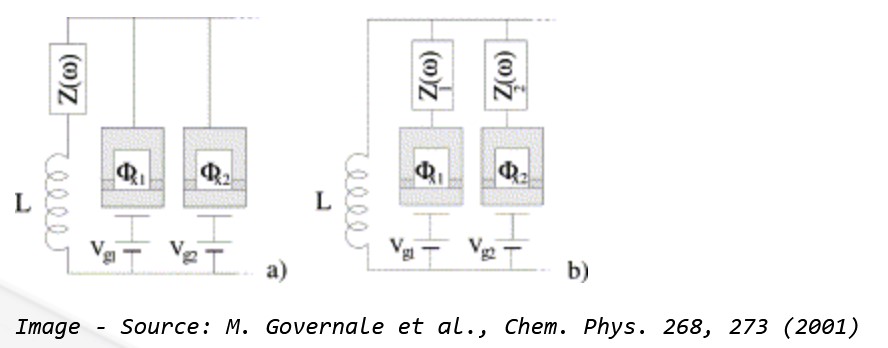
Superconducting platforms have recently attracted much interest as possible candidates for the implementation of quantum computers. On the one hand the coherence of the superconducting state can be exploited to reach long dephasing times, on the other hand superconducting based qubits and other circuit elements can be fabricated by well established lithographic methods.
Additionally, superconducting systems containing linear and nonlinear elements. e.g. resonators and qubits, are used nowadays to simulate properties of complex quantum systems.
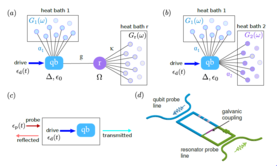
In our works we focus on the impact of dissipative environments on the coherence properties of superconducting-based circuits and on the possibility to tune their properties by intense microwave drive. Recently, we investigated transmission spectra of the spin-boson model and of the Rabi model realized in superconducting platforms.
Dissipative qubits and multi-level systems

Driven dissipative tunneling
Quantum ratchets
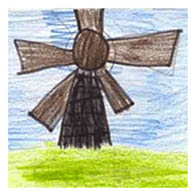
A ratchet is an asymmetric periodic structure with the possibility to extract net particle flow from unbiased driving. A classical example of a ratchet is the windmill. In our work we focus on quantum ratchets, with the aim of describing the interplay among quantum fluctuations, unbiased driving, and spatial potential asymmetry.
Quantum stochastic resonance
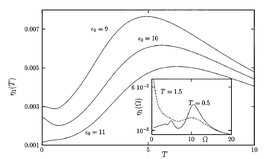
Stochastic resonance is a counterintuitive effect occurring in nonlinear dynamical systems, whereby the response to a weak coherent input is enhanced by the presence of noise. For example, in a bistable classical system, the resonance condition is assumed when the thermal hopping frequency is near the frequency of the modulation. In our work we investigate whether the interplay between quantum noise and coherent drive on the tunneling dynamics of a tunneling particle. Similar to the classical case, conditions for the occurrence of quantum stochastic resonance are provided.
Acoustic properties of quantum glasses at low temperature
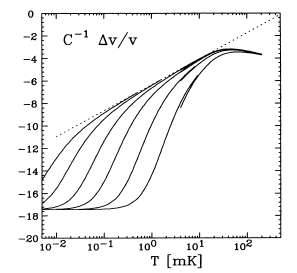
The low-temperature thermal and acoustic properties of amorphous solids can be explained in terms of the phenomenological tunneling model (TM). This postulates the existence of low energy excitations which can be treated in the two-level approximation. Using the TM we were able to successfully describe the acoustic response of metallic and dielectric glasses.