

Topological superconductors
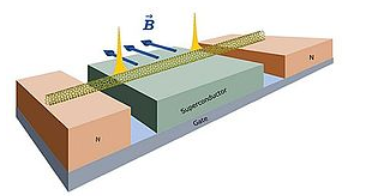
Topological superconductivity (TS) is rare in nature but it can be engineered in low dimensional systems. In our group we study TS in 1D and 2D systems with strong spinorbit coupling. Exemplainly, we have proposed the existence of Majorana bound states in superconducting carbon nanotubes. For this we study the topological properties of such systems and calculate the bound state spectrum, the corresponding wave functions, and the associated transport characteristics.
Single molecule junctions
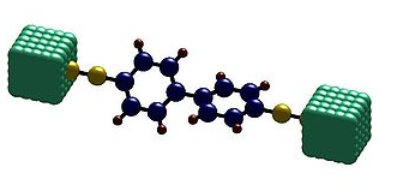
Bottom-up electronics based on single-molecule transistors can constitute a viable alternative to top-down semiconducting electronics. We are interested in the key signatures of electronic transport through single-molecule transistors. Also topographic features as revealed im STm set-ups are investigated.
Carbon nanotube based junctions
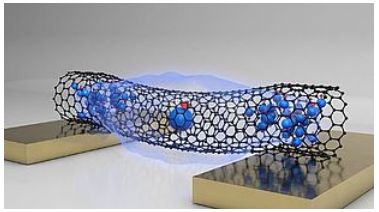
Carbon nanotubes, graphene rolled onto a seamless cylinder, are prototypes of one-dimensional quantum conductors.
Their diameter of a few nanometers and their length up to several micometers makes them interesting for applications. At the same time quantum correlations and electronic interactions constitute a challenge for the theoretical description of their properties.
Along the years we have been focusing on various transport properties of carbon nanotubes, encompassing Fabry-Perot interference, Kondo anomalies and Luttinger liquid physics.
Interacting quantum dots

Quantum dots are small conductors where the interplay between size quantization and electronic interactions gives rise to intricate many-body phenomena like interaction driven dark-states formation or the Kondo effect.
We have developed various theoretical methods, encampassing quantum master quation approaches or Keldysh field theories to cope with such intricacies.
Spintronics
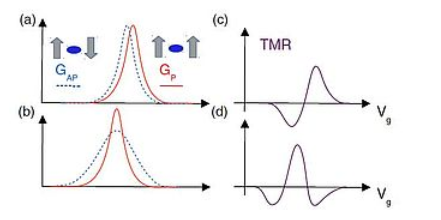
Electrons are charged particles characterized by an intrinsic halb-integer spin degree of freedom.
Such proberty manifests itself in magnetic properties of some elements, like iron or mangonise.
In addition it is very useful in storage applications using magnetic memories.
In our group we investigate the impact of the electron at the nanoscale systems, of interest are e.g. hyprid structures with ferromagnetic elements.
Also, we consider how spin-orbit coupling impacts the transport properties of small nanoconductors.