

The idea: Scientific Perspectives on Global Issues of the 21st Century
How do we tackle the pressing global challenges of our time – from the climate crisis and social inequality to the impact of new technologies? Science provides important insights and potential solutions, but their implementation depends on political, economic and societal decision-making processes. Sustainable development is therefore not a purely technical issue, but a deeply political one. The Young Colloquium explores how scientific findings can help tackle these challenges and what political framework is needed to bring about effective change.
As a student-organised, interdisciplinary lecture series, we are particularly keen to encourage discussion – for example, in the informal sessions following the lectures, over pizza and drinks. Experience has shown that there is certainly plenty to discuss after the lectures: it is no coincidence that the problems in question have not yet been solved… However, that shouldn’t stop us from thinking about how we might approach solutions more constructively and to what extent dialogue between academia and society could play a role in this. We look forward to seeing lots of new faces at the third edition of the event! :)
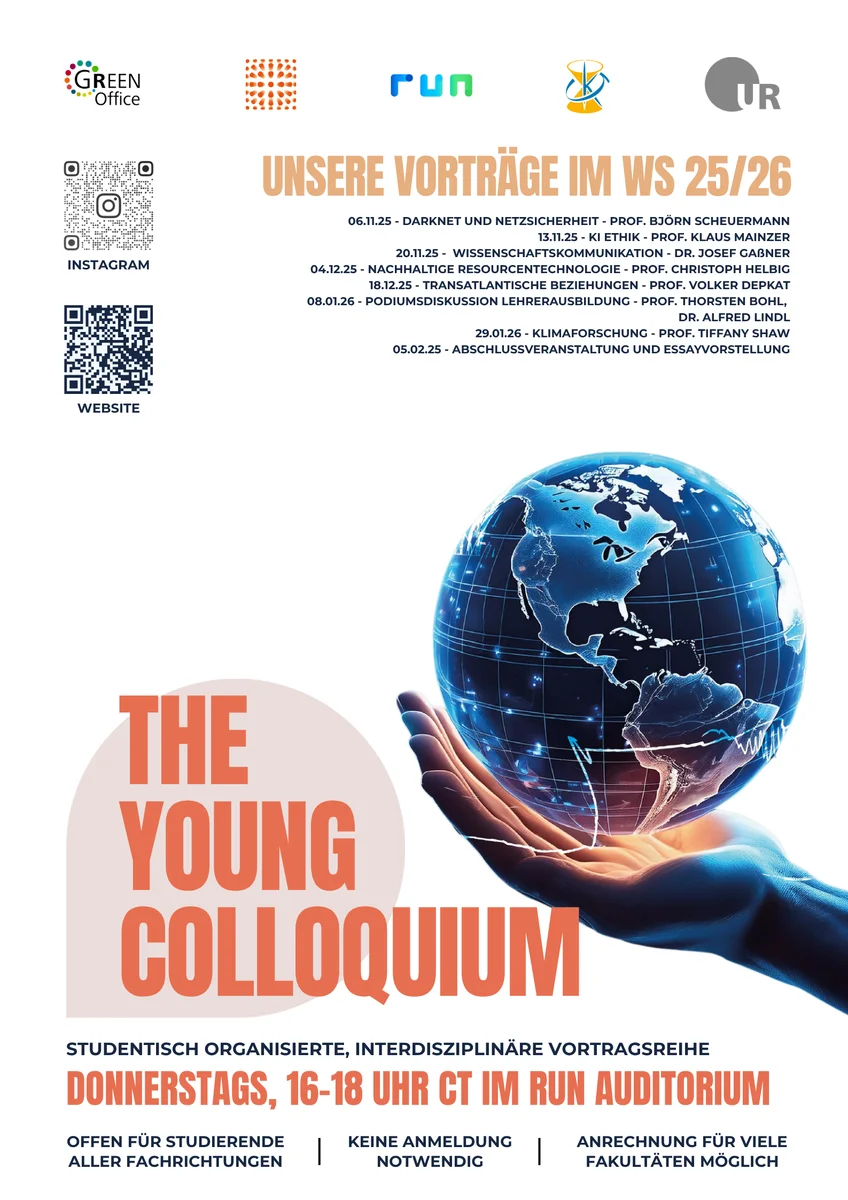
Our lectures in the winter semester 2025/26
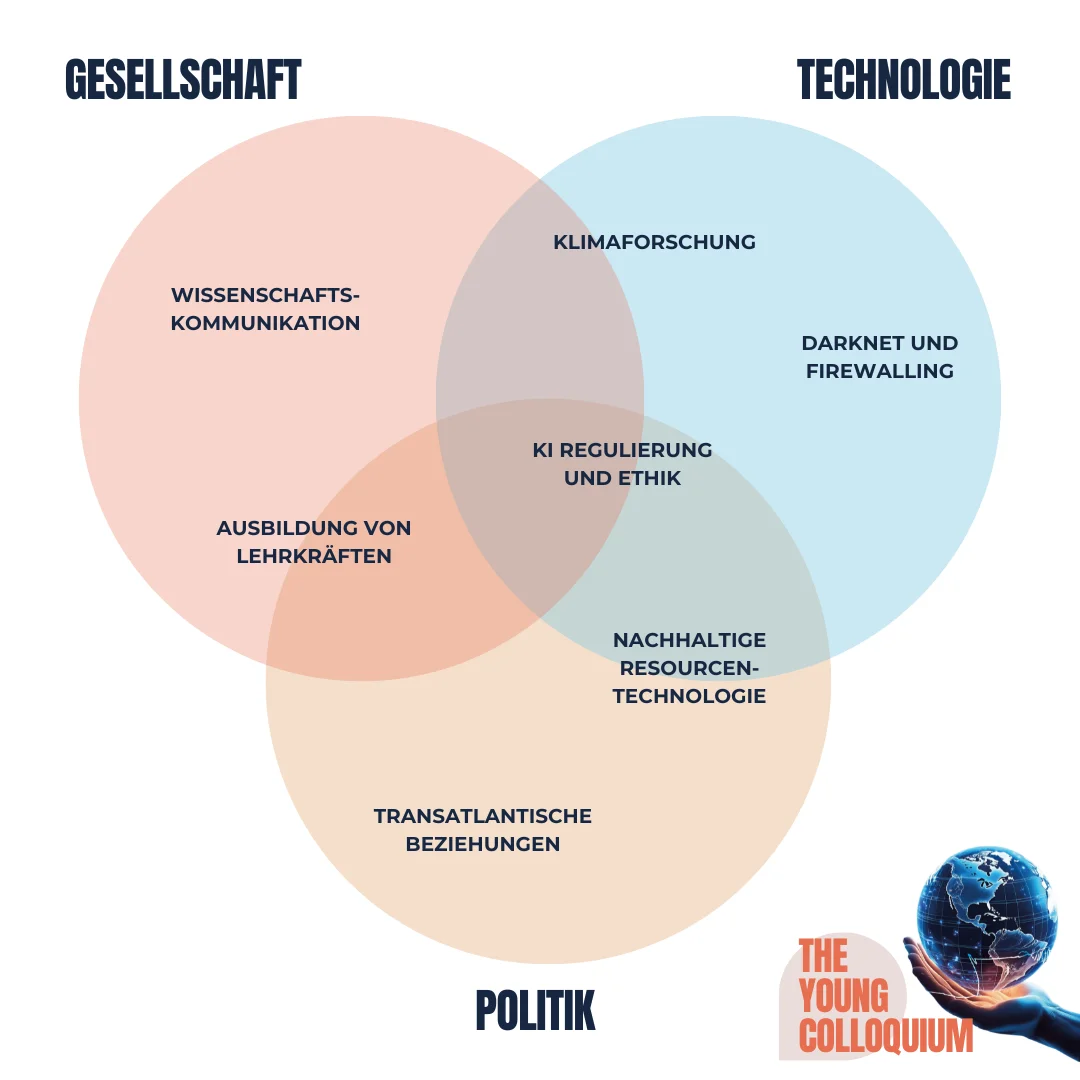
Our lectures this term broadly fall into three main thematic areas: technology, politics and society. The classification under one of these areas is intended merely to highlight the focus of the lectures; most lecture topics could probably be assigned to any of the areas.
Schedule overview
Here is a detailed list of our dates and speakers:
| Date | |
|---|---|
| 23 October 2025 | Introductory session Prof. Ferdinand Evers, Franziska Fröhlich, Philipp Erhardt, Simon Spörl |
| 6 November 2025 | Anonymity on the Internet – The Technology Behind the Darknet Prof. Björn Scheuermann |
| 13 November 2025 | Artificial Intelligence: Innovation, Limits and Challenges Prof. Klaus Mainzer |
| 20 November 2025 | Out of the ivory tower! Should science be on social media? Dr Josef Gaßner |
4 December 2025 5 pm! | Critical raw materials in times of geopolitical conflict Prof. Christoph Helbig |
| 18 December 2025 | What next for academic freedom in Trump’s America? Prof. Volker Depkat |
| 8 January 2026 | Panel discussion: Quo vadis, teacher training? Perspectives in dialogue Prof. Thorsten Bohl and Dr Alfred Lindl |
| 15 January 2026 | Technology Meets Teamwork: How Three Mercedes-Benz Research Projects Are Pushing Boundaries. Tim Wölfel, Dr Adrian Prochaska |
| 29 January 2026 | The Other Climate Crisis Dr Tiffany Shaw |
| 5 February 2026 | Closing event Prof. Ferdinand Evers, Franziska Fröhlich, Philipp Erhardt, Simon Spörl |
Further details on the individual talks, credit allocation and the event in general can also be found in the associated GRIPS course (external link, opens in a new window) or on Instagram (external link, opens in a new window).
The talks usually take place from 4 to 6 pm c.t. in the auditorium of the RUN (Regensburg Centre for Ultrafast Nanoscopy) on the first floor and consist of a 60-minute talk followed by a 30-minute question-and-answer session and discussion. Afterwards, everyone is warmly invited to join us for further discussion in a more relaxed setting with pizza and drinks!
Credit transfer at the University of Regensburg
The Young Colloquium is open to all students, whether you just want to attend one talk or come along every time. However, there is also the option of having the Young Colloquium recognised as a module worth 3 ECTS credits. To do so, you must:
- attend all lectures (with the possible exception of one session)
- write and present a two- to three-page essay in which you explore the topics covered in the lecture series
The Young Colloquium can be credited towards, amongst other things,
- the combined BA in Humanities
- the BSc in Physics and Mathematics
- other degree programmes on request
We are working to make credit recognition possible for students from all disciplines; please feel free to email us at young.colloquium(at)uni-regensburg.de (opens your email program) if you are interested in the event and your degree programme is not listed here. Alternatively, please feel free to drop by the introductory session on 23 October for further information on credit recognition and the event in general.
In any case, credit transfer is just one of the options on offer: we’d love to see you there, even if you just pop in once!
Your organisers,
Franzi, Philipp and Simon