

It is easy to feel overwhelmed by the sheer number of problems we face today, and even easier to seek simple answers and solutions to the complex and interlinked challenges of our time. Yet it is precisely universities that should act as a counterbalance to this and challenge students from diverse backgrounds to think together about genuine solutions. Our main aim is to view the university as more than just a place of encounter and to deliberately look beyond the confines of our own specialist training.
This is precisely what motivated us – Franzi, Philipp and Simon – to organise the Young Colloquium. All three of us are studying physics and believe it is essential to discuss socially and politically relevant topics in an interdisciplinary manner. We find it a shame that, in the highly specialised research landscape, attention to other disciplines and ways of thinking is sometimes neglected. Young academics are under increasing pressure to specialise earlier and more deeply. Every discipline has its own way of analysing problems, but specialisation carries the risk that valuable insights remain confined within the boundaries of one’s own discipline.
Through the Young Colloquium, we aim to play our part in bridging this gap and promoting interdisciplinary exchange, because for us, the university is more than just a place of learning – it is a hub of ideas that brings students together.
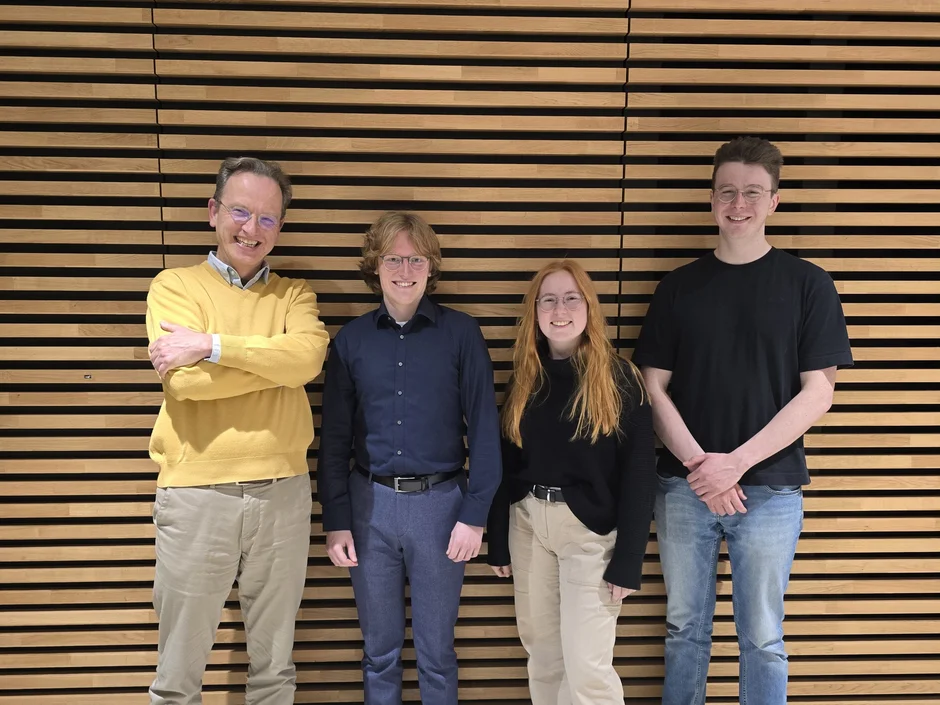
And those were our talks…
The technology behind the darknet – Prof. Björn Scheuermann
In the first talk, Prof. Björn Scheuermann introduced us to the fascinating world of the darknet and internet privacy. After covering the basics and the various mechanisms by which Alice and Bob can communicate with varying degrees of security, we eventually moved on to how the TOR browser works today and why it remains superior to most VPNs in terms of security and anonymity (and, contrary to what some people believe, is not illegal!). It was only in this way that, by the end of the talk, we were all able, for example, to understand TOR’s potential vulnerabilities or to grasp how information can be leaked anonymously to major newspapers via the darknet.
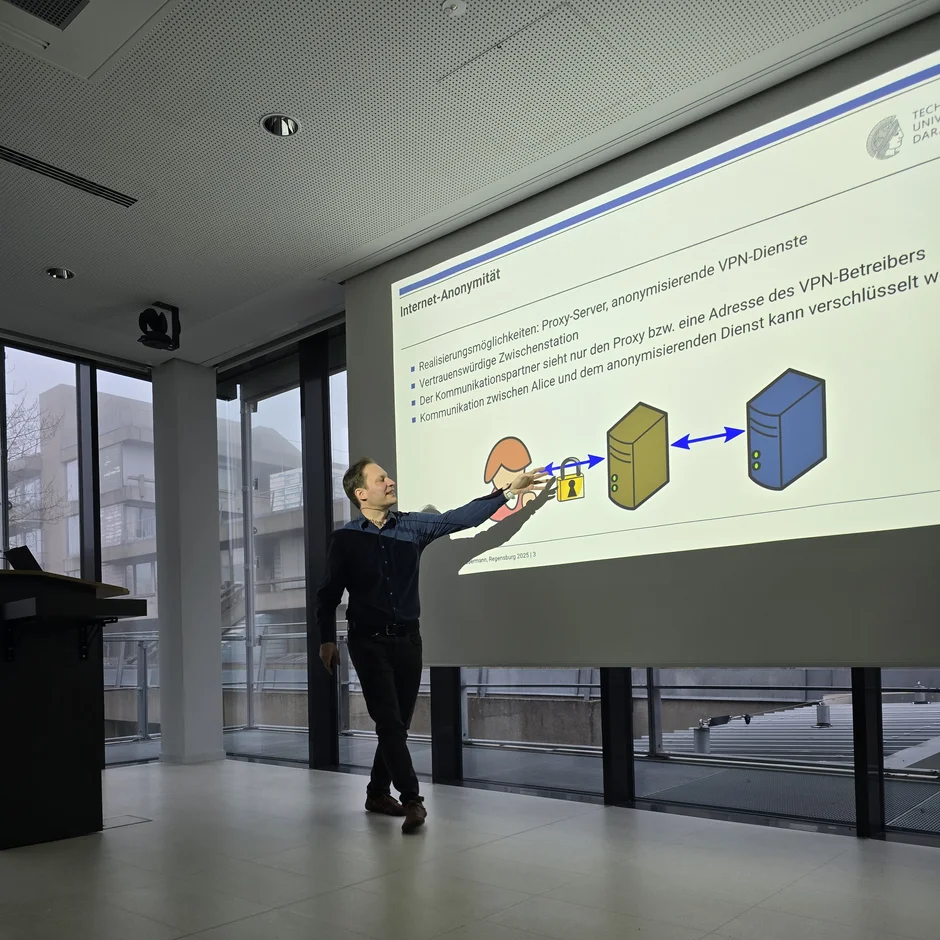
During the relaxed get-together over pizza and cold drinks, Prof. Scheuermann answered a few questions from interested attendees and shared some amusing anecdotes from his everyday life as a professor. It’s certainly rare for your own tutorial partner in an introductory physics lecture to already hold a professorship in computer science – and to even hire you as a student assistant at the end of the semester – a rather different sort of job interview. All in all, we could hardly have imagined a more successful start to the Young Colloquium 2025.
Artificial Intelligence: Innovation, Limits and Challenges – Prof. Klaus Mainzer
For our second lecture, we were delighted to welcome Prof. Klaus Mainzer, a TUM Emeritus of Excellence. As a renowned philosopher of science, he provided a historical perspective on the ever-present topic of artificial intelligence. Prof. Mainzer has made a name for himself not only through his academic achievements but also, in part, through his commitment as Founding Director of the Munich Centre for Technology in Society and President of the European Academy of Sciences and Arts. He was, therefore, the perfect speaker for a journey through the history of AI. Starting with Alan Turing and the fundamentals, through the statistical mechanics behind neural networks, right up to the latest developments in neuromorphic AI, quantum AI and AGI, Prof. Mainzer truly left no stone unturned. This journey was then rounded off by some ethical considerations regarding the use of AI in science and, above all, the tension between AI regulation and competitiveness. Prof. Mainzer was particularly keen to emphasise that an understanding of the fundamentals of AI should precede any discussion of ethical implications and, in particular, regulation at European or international level.
Out of the ivory tower! Should science be on social media? – Dr Josef Gassner
At the third event of the Young Colloquium, theoretical astrophysicist Dr Josef Gaßner visited us at the University of Regensburg and hosted a panel discussion on the topic of science communication . He has been running the successful YouTube channel ‘The Big Bang, the Universe and Life’ for over 10 years, which now has over 350,000 subscribers. Josef Gaßner manages to appeal to a wide audience, ranging from laypeople interested in physics to trained physicists. He enriched the discussion with many of his own experiences and offered plenty of practical and encouraging tips for those who can envisage getting involved in science communication themselves. Above all: don’t overthink things beforehand; your own style will develop naturally over time. True to the motto: Just do it!
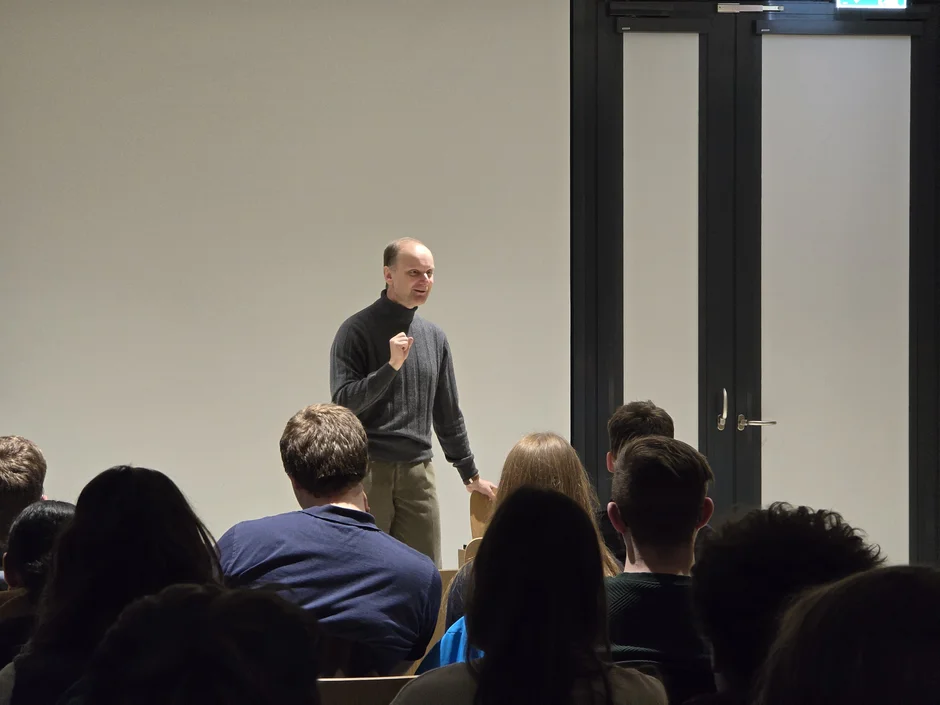
We quickly agreed on one thing: science must not be an exclusive club, but must share its findings ‘with the wider world’. This requires people who are both interested in science and skilled at communicating with the wider public. This kind of public engagement is of vital importance, not least for the preservation of our democracy.
Even after the event, Dr Gaßner stayed with us in the seminar room for quite some time, delving deeper with us into the content of the lecture as well as broader political issues. It was a very enriching experience to discuss matters with Mr Gaßner on an equal footing, to explore and compare different perspectives, and ultimately to benefit from his experiences.
Critical raw materials in times of geopolitical conflict – Prof. Christoph Helbig
We, too, are naturally concerned about climate protection, but we wanted to approach the subject from a slightly different angle. To this end, we were able to enlist the help of Prof. Christoph Helbig, who took us on a journey into the world of raw material cycles and global supply chains.
The supply of neodymium magnets, for example, illustrates how critical raw materials harbour the potential for geopolitical instability. These magnets are at the heart of wind turbines and electric motors, yet are mined almost entirely in China. Europe finds itself in a difficult position here: we have virtually no domestic reserves and are therefore extremely dependent on imports. The relocation of industry also poses a challenge in this regard, as it means that important co-products such as gallium or indium – which would otherwise have been produced as by-products at local manufacturing sites – now have to be imported as well.
So what can be done? Helbig’s suggestion: we must strengthen strategic partnerships and harness our innovative capacity to make the recycling of materials worthwhile. A clear example of losses in the circular economy is the use of titanium dioxide in wall paint: once applied to the wall, the raw material is so finely dispersed that it is effectively lost to the cycle. Such effects must be taken into account and avoided right from the product design stage.
All in all, it was a highly informative talk which, whilst not necessarily reassuring, was nonetheless encouraging. This is because it also highlighted a wide range of academic careers situated at the intersection of many disciplines. It can therefore certainly be worthwhile to pursue interests outside one’s own field – because solutions to complex issues such as these can only be found through precisely this kind of exchange.
What does the future hold for academic freedom in Trump’s America? – Prof. Volker Depkat
What is the actual state of the American higher education system under Trump? We put this question to our very own American studies expert , Prof. Volker Depkat, and were somewhat surprised by his assessment. His central argument is that the US system could be considerably more resilient than we often assume from a German perspective.
He attributed this primarily to the structural framework: whilst German universities are heavily dependent on the state, US universities are protected by their decentralised organisation and the diversity of private funding sources. According to Depkat, direct political interference in research and teaching – which, in Germany, would theoretically be possible more quickly following a radical change of government – often comes to nothing there due to institutional autonomy. The sheer number of different funding sources and local independence act as a buffer here, which we do not have in Germany.
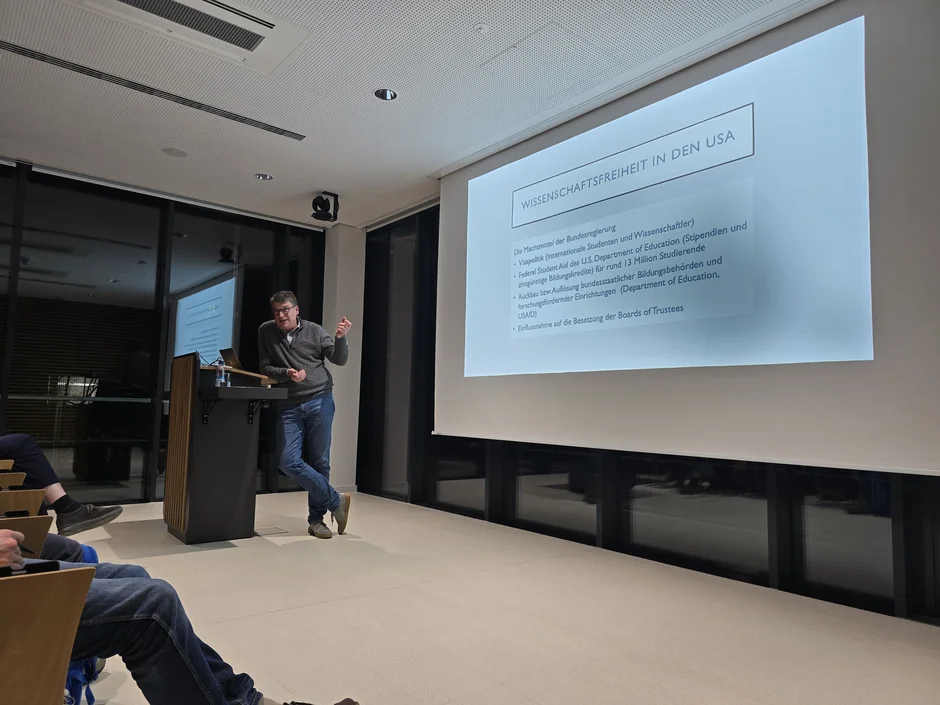
Beyond this comparison, the discussion also centred on the question of how the current culture war came about in the first place. Prof. Depkat made it clear that today’s polarisation is not a sudden phenomenon, but the result of a strategic conservative agenda spanning decades. An interesting detail here is that even the famous slogan ‘Make America Great Again’ is actually borrowed from the past – it was used in almost identical form by Ronald Reagan during his 1980 election campaign. Such developments show how deeply rooted certain narratives are and also offer important lessons for us in Europe on how social institutions can come under pressure. Above all, however, it also highlights just how effectively a ‘polarisation entrepreneur’ like Trump can exploit this division to advance his own political agenda – unlike other presidents, he apparently sees his role less in uniting the country.
All in all, it was a fascinating evening, which led to a slight change of topic during the traditional post-event pizza get-together: how should we actually train the teachers who are meant to inspire children’s enthusiasm for science in the first place – and what structural changes might be needed in that area? It was the perfect lead-up to our panel discussion on teacher training, which followed immediately afterwards, and which we were all the more eager to attend after this input.
Panel discussion: Where is teacher training heading? Perspectives in dialogue – Prof. Thorsten Bohl, Prof. Alfred Lindl
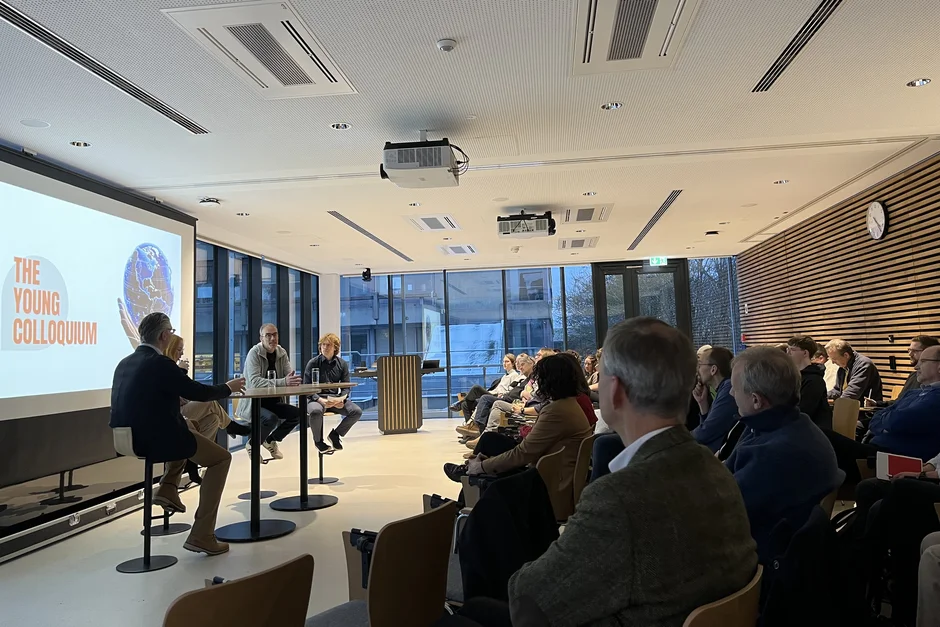
Everyone has an opinion on teacher training – after all, we’ve all been to school at some point. But how do we make the leap from mere gut feeling to a meaningful, academic evaluation of the strengths and weaknesses of our training system? We explored this question together with Prof. Thorsten Bohl, who has established a renowned teacher training centre in Tübingen, which is now regarded nationwide as a model of excellence and provides much of the impetus for current reforms. He was joined by Prof. Alfred Lindl, who has conducted research at the University of Regensburg into the influence of teachers’ subject knowledge on pupils’ subsequent learning success.
At the heart of our discussion was the fundamental question of a teacher’s role: how does one deal productively with the varying levels of attainment within a class, and where does the right balance lie between educational guidance and subject-specific achievement? Whilst universities often (and rightly so) insist on excellent subject-specific training, Lindl’s research, for example, makes it clear that, whilst excellent subject knowledge forms an indispensable foundation, it only unfolds its full effect in the classroom when combined with strong subject-specific teaching methodology. It is therefore not a question of ‘either/or’, but rather of how to teach trainee teachers to present their knowledge in such a way that it truly resonates with their pupils.
To bridge this gap between theory and practice, we have held in-depth discussions on the use of learning laboratories and work placements, which enable students to receive targeted feedback on their own actions whilst still at university. It became clear that professional development is a lifelong process: continuing professional development for qualified teachers must play a much more central role so that they do not lose touch with current research and societal developments.
Finally, we turned our attention to the ‘question of all questions’: how can we persuade ministries to listen more flexibly to such research recommendations and actually implement reform proposals? The example of Tübingen impressively demonstrates how scientifically sound models can also gain political traction when they highlight realistic approaches for everyday school life.
For us organisers, moderating this discussion was a real challenge, but it was well worth the effort. This topic forms the foundation for solving almost all societal problems – for it is only through strong teacher training that we can equip the next generation for whatever lies ahead.
Technology meets teamwork. How three research projects at Mercedes-Benz are pushing the boundaries – Tim Wölfel, Dr Adrian Prochaska
In our penultimate talk, we were delighted to welcome, for a change, two speakers from the industry to our Young Colloquium – and on yet another highly topical subject: German e-mobility. Tim Wölfel, head of the Mercedes team for Electric Drive Special Projects, and his colleague Dr Adrian Prochaska used three selected projects to show us what German car manufacturers – particularly in the face of strong competition from China – currently have to offer in the field of e-mobility. How, for example, do you build a car that has a range of over 1,000 km but looks like a perfectly normal car at first glance? After all, simply cramming a bus full of batteries cannot be the solution to the problem. The result of their work is the highly efficient Vision EQXX, which is doing its bit to further push the boundaries of what is achievable in the field of electric mobility. This is also exemplified by the all-electric Concept AMG GTXX, which circumnavigated the globe in 8 days. Following their presentation, there is no doubt that this was a tremendous achievement in terms of teamwork and engineering.
Ultimately, when it comes to electric cars, there’s no getting round the issue of charging – and Mr Wölfel and Dr Prochaska had an answer to this too, in the form of the Experimental Charging Vehicle, or EFL for short. This minibus can truly be charged in every conceivable effective and innovative way. Throughout the presentation, we particularly appreciated not only gaining an insight into Mercedes’ range of products, but also hearing first-hand about the thoughts, concerns, compromises and pitfalls that research within a global corporation entails. In the relaxed after-talk with Mr Wölfel and Dr Prochaska, over pizza and cold drinks, we also had the chance to discuss, amongst other things, their personal career paths, which differ significantly from the largely purely academic careers of our other speakers.
The other climate crisis – Prof. Tiffany Shaw
Thanks to modern technology, our most recent lecture by Prof. Tiffany Shaw, broadcast live from Chicago, went off without a hitch – and the fact that it was delivered entirely in English made no difference. It should by now be clear to everyone that climate change is one of the greatest challenges of our time. But what, then, are climatologists actually doing right now? We know, in principle, what is going to happen and what we need to do, so what is currently happening in climate research? Prof. Shaw’s lecture addressed precisely these questions. We were somewhat taken aback, however, when she began with a brief digression into the history of physics-based models in climate research. Nevertheless, without this, it would not have been possible to understand the upheaval – which she pointedly described as ‘the other climate crisis’ – that is now wreaking havoc in current climate research. Alongside their evidence-based and outstanding predictions, our best models are also showing an increasing number of inconsistencies; whilst these cast no doubt on climate change itself, they do provide growing evidence that the underlying assumptions and beliefs in the field are not entirely tenable. One example of this is that the coupling between the atmosphere and the ocean has so far been underestimated. A more precise understanding of this could explain the discrepancies that are arising and improve the forecasts.
Some of their thoughts then provided a smooth transition to the subsequent plenary discussion; these went beyond the factual state of affairs in climate research and focused on communicating this to the public. Striking a balance between the scientifically proven consequences of fossil fuels and the uncertainties that still exist is, of course, extremely challenging; however, these are insights that we, as the scientists and academics of tomorrow, greatly appreciated. All in all, a very successful conclusion to the Young Colloquium 2025/26!
So what happens next?
With another edition of the Young Colloquium in the winter term of 2026/27, of course!
We’ve once again managed to secure some top-class speakers for this event and are really looking forward to lots more exciting discussions and pizza nights with you all! You can find all the information about the talks here or on Instagram (external link, opens in a new window)!