

Wolfgang Thönissen / Martina Aras (Hgg.), Ökumene und die Einheit der Kirche (Handbuch der Ökumene und Konfessionskunde Band 2)
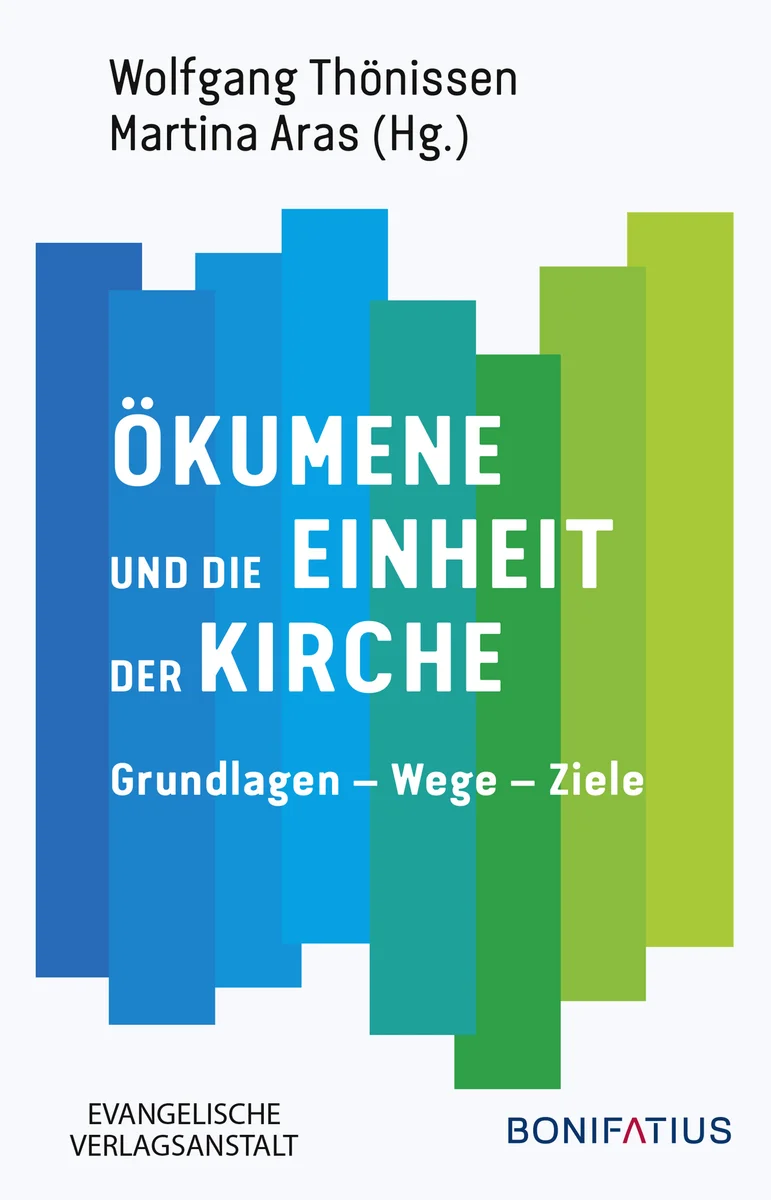
Ecumenism has become more diverse and less straightforward. As its complexity increases, there remains a need to consider and reflect on the path of ecumenism, on the divisions within the Church, and on the unity of the Church of Jesus Christ. With this in mind, the Johann-Adam-Möhler Institute in Paderborn, which has been conducting research into ecumenical issues since 1957, is embarking on the publication of a new ‘Handbook of Ecumenism’. The first volume, which has already been published, focuses on the study of denominations. It provides information on the churches and denominations with which the Catholic Church is engaged in dialogue. This second volume is devoted to the foundations and principles of ecumenism and provides information on the historical development of the question of unity.
With contributions by Martina Aras, Tim Lindfeld, Johannes Oeldemann, Andrea Riedl, Wolfgang Thönissen, Robert Vorholt and Burkard Zapff.
Click here to view the entry on the publisher’s website. (external link, opens in a new window)
Marco G. Rainini / Andrea Riedl (Eds.), Die zweite Generation. Transformationsprozesse in den Anfängen von Orden und religiösen Gemeinschaften in der Geschichte des Christentums

The phenomenon of religious orders and communities—together with their complex development and the establishment of guidelines, rules, and forms of communal life—has shaped Christianity from the very beginning. The founders, provided they are well known or even prominent, are often credited with charismatic appeal and bold determination. For the most part, they are the key figures who shape our understanding of the origins of religious community life throughout the history of the Church.
This book, however, focuses on the second (and third) generations of religious orders and communities. For, more often than is assumed, the origins of religious communal life remain obscure, or are only constructed—sometimes considerably later—as a narrative of those origins. Of particular interest are the transitions from fluidity and experimentation toward permanence and stability within a community; from charisma—to be defined more precisely in each individual case—toward institution; and from a tentative character toward a legally stable order. Such transitions were—and continue to be—almost always marked by crises, conflicts, and narratives that read and transmit the origins of a community in the light of contemporary tensions, or that undergo processes of adaptation whose key figures are frequently and unjustly relegated to the background. It is to this hitherto little-studied phase of crisis and "fermentation" in religious communal life that the authors of this book devote their attention.
Editors: Prof. DDr. Marco G. Rainini, born 1967, Department of Religious Studies, Università Cattolica del Sacro Cuore, Milan, Italy Prof. Dr. Andrea Riedl, born 1984, Chair of Medieval and Modern Church History, Faculty of Catholic Theology, University of Regensburg, Germany
Further details about the book can be found here (external link, opens in a new window). If interested, the book can be purchased through the Chair at the author's price; it will also be available as an open-access publication from July 2026.
Andrea Riedl/ Elias Haslwanter/ Hans-Jürgen Feulner (Eds.), Das Gebet für die Verstorbenen. Zugänge aus Theologie und Praxis

The study of death and dying (thanatology) has experienced a multidisciplinary and practice-oriented resurgence in recent decades, to which theology contributes as a dialogue partner. The authors of this book, drawn from academia and pastoral care, discuss theological approaches to the connection between death and life, focusing on prayer for the deceased. Why—and with what hope and purpose—do Christians pray when they pray for their dead? From an ecumenical perspective, the book addresses concepts of the afterlife throughout the history of Christianity, liturgy and ritual in the face of death, the challenges in the church's preaching and pastoral care, and processes of cultural and social transformation in dialogue with theology and religion.
Click here (external link, opens in a new window)to access the flyer (external link, opens in a new window) with all the information about the print edition (published on 10 November 2024). To download the book free of charge via open access, visit the publisher's website here (external link, opens in a new window) (external link, opens in a new window). Link to the book launch event (external link, opens in a new window) on 22 November 2024 at 4:30 pm.
Andrea Riedl, Tractatus contra Graecos - Traktat gegen die Griechen. New publication by Andrea Riedl in the renowned bilingual Herder series "Fontes Christiani"

The Tractatus contra Graecos (1252), published for the first time in German translation, reflects the relations between the Western and Eastern Church in the 13th century. Written by a learned anonymous Dominican, the treatise also sheds light on the early history of the Order's Province of Graecia and its most important convent in Constantinople. Owing to its character as a collection of sources and an argumentative aid for Latin actors, the work was frequently copied—particularly in the 15th century—and used in preparation for theological debates with the Greeks.
Measured by today's standards, the work is a valuable record of the state of affairs and the objectives of Orthodox-Catholic dialogue at a time when the schism between these two Churches—which continues to this day—first began. The volume (FC 5/102) has been available in bookshops and libraries since 8 April 2024.
Click here to access the entry on the publisher's website (external link, opens in a new window).
Ebenbauer, Peter (Ed.), Synodalität - Beiträge zur gemeinschaftlichen und partizipativen Gestalt der Kirche

The "Synodal Process" initiated by Pope Francis in 2021 provided the Faculty of Catholic Theology at the University of Graz with the occasion for a lecture series on current questions of ecclesial synodality, which is documented in this volume. Drawing from various theological disciplines — from Biblical Studies and Church History through Ecumenical and Systematic Theology to Christian Social Teaching and Practical Theology — the contributions in this volume offer academically grounded impulses for strengthening and deepening co-responsibility and participation in the Church.
Special attention is drawn to the contribution by Andrea Riedl and Bert Groen entitled: The Relationship between Synodality and Primacy. Perspectives of the Catholic-Orthodox Theological Dialogue: The Study of the St. Irenaeus Working Group.
Click here to access the entry on the publisher's website. (external link, opens in a new window)
Christian Lange, Dietmar W. Winkler, Karl Pinggéra, Hacik Rafi Gazer (Eds.), Die katholischen Ostkirchen - Herkunft - Geschichte - Gegenwart

On 21 November 1964, the Decree on the Eastern Churches of the Second Vatican Council, Orientalium Ecclesiarum, was promulgated in Rome. With it, the rich Eastern Christian heritage within the Catholic Church received special appreciation. International scholars are taking the 60th anniversary of the decree as an occasion to present the origins, history, and present situation of these churches.
Special attention is drawn to the contribution by Prof. Dr. Andrea Riedl: Rome and the Christian East.
Click here to access the publisher's homepage. (external link, opens in a new window)