

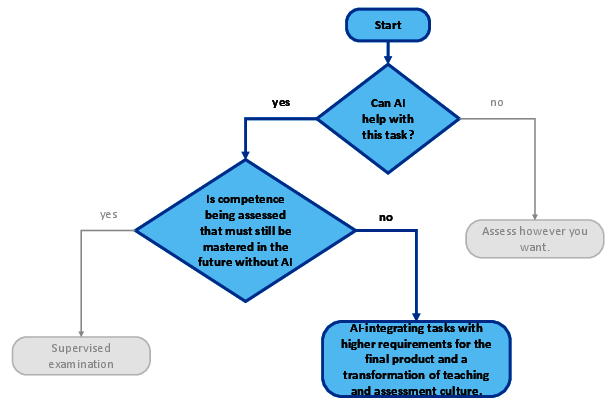
If the deliberate use of AI can promote the acquisition of competences, the course and examination performance should be designed in such a way that the use of AI is specifically integrated and reflected upon. This means that the assessment of individual performance should not focus exclusively on the final result (e.g. a thesis), but must take the entire development process into account to a greater extent.
A general ban on the use of AI entails considerable risks, as AI-generated content cannot be reliably or legally identified using (plagiarism) detection software (see video on AI detectors at TU Darmstadt (external link, opens in a new window)).
This is associated with the risk of scientific integrity being jeopardized - for example through the unauthorized use of non-approved aids. Teachers have various strategies at their disposal to use unsupervised examination formats sensibly:
Allow AI use subject to documentation requirements
- Students may use AI, but must make this transparent and document its use in a complete and transparent manner. The extent of the documentation obligation can be individually defined using the AI policy generator .
- Students assume responsibility for all AI-generated results.
- Teachers should transparently set out expectations and rules regarding the use of AI so that students feel safe when using AI.
Combine written and oral examination components
- Another option for unsupervised forms of assessment is to supplement them with oral tasks (Hanke, 2023). One example would be the defence of a thesis or the presentation of a paper or seminar paper that has previously only been submitted in writing for assessment.
- In the oral part, students who have sufficiently familiarized themselves with the topic can demonstrate that they have acquired a deep understanding.
- However, this approach requires sufficient staff capacity on the part of the lecturers and, if necessary, adjustments to the examination and study regulations.