

DIMAS Statute
The Statute of DIMAS (opens in a new window). (This PDF is not accessible) was passed by the University Senate in April 2021 and approved by the University President on 7 July.
The Concept of DIMAS
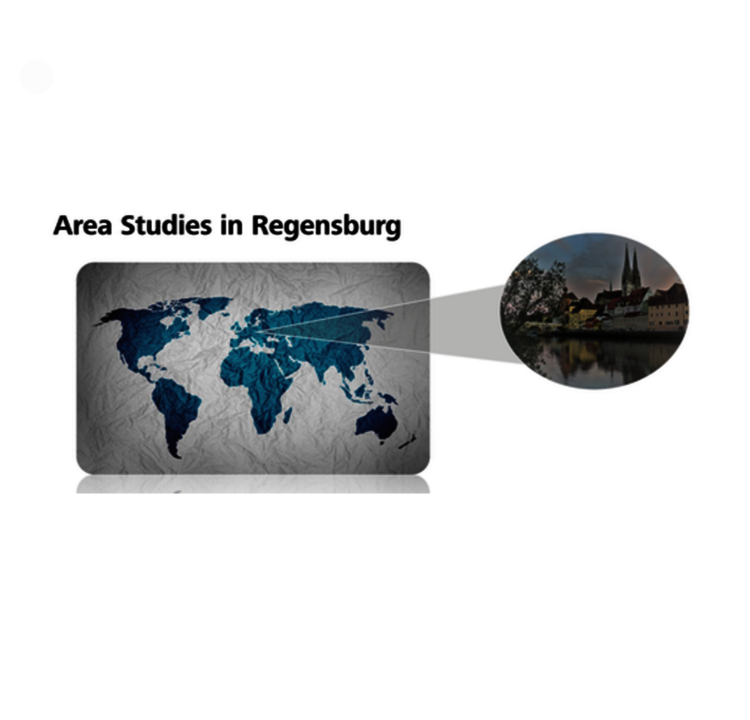
Area Studies in Regensburg
In recent years, the University of Regensburg (UR) has established a focus on area studies through a variety of initiatives. In cooperation with the Faculties of Law and Catholic Theology, the SLK and PKGG faculties want to contribute to the further development of this research field at the UR. In order to achieve this goal, the faculties have designed an innovative co-operative departmental structure: the Department for Interdisciplinary and Multiscale Area Studies (DIMAS).
The special knowledge potential of area studies is realised when expertise on different regions and spatial dynamics is brought together in a joint research agenda. The CITAS (Centre for International and Transnational Area Studies) in Regensburg, from which DIMAS emerged, was already based on this idea. DIMAS thus also ties in with the wider landscape of area studies research in Regensburg, for example at the Leibniz ScienceCampus "Europe and America in the Modern World: Frictions and Transformations of Globality", (external link, opens in a new window) at the Leibniz Institute for East and South East European Studies (external link, opens in a new window) and in the Graduate School for East and Southeast European Studies (external link, opens in a new window). Here, major questions of our time, such as the tensions produced by globality, are examined from the perspective of those regions for which Regensburg has particularly strong expertise: (South) Eastern and Western Europe as well as North and Latin America. But DIMAS and its professorships go beyond this perspective - and extend into transreligious, transmedial and transregional spaces and structures of values and norms.
Department of Interdisciplinary and Multiscale Area Studies (DIMAS)

With the Department for Interdisciplinary and Multiscalar Area Studies (DIMAS), a dynamic and flexible structure has been created that brings together existing expertise in Regensburg (at the participating faculties of the UR in close cooperation with the Leibniz Institute for East and South East European Studies (external link, opens in a new window)) and systematically develops it further.
In contrast to faculties, which are organised according to respective disciplines, the department is therefore primarily subject- and goal-oriented. This does not render disciplinary localisations obsolete, but instead focuses on specific projects within a regional science framework. This allows to react more quickly to new developments and research needs. At the same time, new interfaces to the existing disciplines have been created, as the expertise brought together in the department is multivariant.
DIMAS - The Concept
Why Area Studies?
In an increasingly globalized world, why is there still a need for regional knowledge based on a deep understanding of regional knowledge bases and contexts? First, because the intensification and spatial expansion of the global circulation of ideas, narratives, rituals, goods, rules, and people does not automatically lead to the homogenization of social structures and cultural systems across the globe. Societies, groups, and individuals respond to global challenges in diverse ways, choosing different modes of adaptation or resistance in conjunction with specific local institutional conditions and cultural ways od meaning-making. The different responses to contemporary challenges that can be observed around the world and, in some cases, within individual countries, repeatedly show that a globally analogous phenomenon elicits different social responses depending on the location or culture.
We live in a world that is increasingly interconnected yet also characterized by difference. History, as constituted in institutions, social structures, knowledge bases, and cultural systems of interpretation, as well as spaces of experience and horizons of expectation, are specific to particular places and cultures. They not only determine how individuals and societies react and adapt to global processes (such as technological innovations, climate change, or the challenges of globalized markets), but they also determine the potential for innovation and resilience in societies. Area studies, with their sensitivity to location-specific knowledge, are essential for understanding these connections. Area Studies research and explain this diversity in the context of the globalized world and against the backdrop of far-reaching globalization processes. They are therefore more relevant than ever before, but they need an interdisciplinary and multiscalar update beyond traditional spatial studies; a view that goes beyond existing disciplines and takes into account micro, meso, and macro structures and puts them into perspective.
This is not about adding up locally isolated findings, but rather generating new questions by taking into account connections, interrelationships, references, and also boundaries between regions. How have regions such as Latin America and Eastern Europe processed their historical experience of dependence on countries in the global North? How are virtual and real spaces connected when transcultural fairy tales are told? How are identities shaped by gender roles and sexuality in the transition from socialist to religious-nationalist government structures? An interdisciplinary and multiscalar area studies perspective therefore asks what manifestations a particular process takes locally, how these spatially bound differences can be explained by similarities, and how the phenomenon itself changes through site-specific appropriations. A particular idea, a technology, even a natural phenomenon can mean something completely different in different places, depending on the attributions of meaning and institutional responses that are anchored in the history and culture of the place.
DIMAS tackles the imposing task of exploring key questions relating to the social and cultural dimensions of globalization, such as the renaissance of nationalism, the constitution of new urban and rural spaces, the formation of religious and legal norms, and the consequences of migration movements. DIMAS is a platform facilitating innovative and excellent collaborative research, while also supporting novel forms of knowledge transfer.
Why interdisciplinary and multiscalar?
We describe the special Regensburg approach as multiscalar. This expresses the fact that phenomena must be examined at different spatial levels and that the geographical relevance structures of a phenomenon must be determined empirically. Everything may be connected to everything else, but not in the same way or with the same intensity. Since even in a world of comprehensive networking, not all spaces of communication and action are global, the scale of the respective approach and its methods must be determined in relation to the specific research question.
The multiscalarity of the Regensburg approach to area studies expresses our interest in the interaction of diverse levels—from global to local, from large-scale to small-scale, from contemporary relevance to historical depth—without hierarchizing them. This is because multiscalarity often requires a specific methodological toolkit to be researched. The departmental structure allows us to bring together methodological expertise that typically focuses on specific spatial scales in order to analyze the interdependence and mutual conditioning of these spatially relevant structures. This results in a subject-oriented interdisciplinarity or multidisciplinarity.
While methods of international relations, international law, and transnational law focus primarily on the level of intergovernmental interactions, and those of political science, law, sociology, and social geography focus on larger social aggregates (such as the nation state, society, or social groups), linguistics, humanities, and cultural studies are interested in spaces constituted by communication and cultural repertoires, whereas social anthropology, ethnology, and empirical social science specialize in the spaces of everyday interactions and meanings. Disciplines such as religious studies and history add a time axis to this, on which multiscalarity also develops temporally.
DIMAS brings together this knowledge via a growing team of researchers from the various departments, thereby producing interdisciplinary, systematic findings on different spaces. In terms of the department's structure, this means that the professorships are organized beyond traditional disciplinary boundaries from the outset. Findings arise precisely from the simultaneity and connection of the different perspectives. The department is interdisciplinary because it examines phenomena through the interplay of different theoretical and methodological approaches, each of which contributes its own specific characteristics and makes them available to the others.
From CITAS to DIMAS
The Centre for International and Transnational Area Studies (CITAS) at the University of Regensburg was founded in 2017 and was an interfaculty academic institution of the Faculty of Philosophy, Art, History, and Humanities and the Faculty of Languages, Literatures, and Cultures. The aim of the centre was to bundle synergies between university and non-university regional science research institutions in Regensburg.
The IOS (external link, opens in a new window) is a central partner in this endeavour. CITAS also contributed to the successful application for a Leibniz ScienceCampus (external link, opens in a new window): "Europe and America in the modern world. Transformations and Frictions of Globalization in the Past and Present". The ScienceCampus began its work in September 2019.
Since 2019, regional science research has also been included in the university's strategic goals in coordination with the Free State of Bavaria (Freistaat Bayern). CITAS received funding for the further development of this research area in Regensburg. This involved the regions of South and Southeast Europe, Western and Southern Europe as well as North and Latin America. The centre worked towards further developing comparative, transregional and global approaches to area studies with a focus on these regions and the relationships between them. Two research networks led by early career researchers were established with part of this funding. One of the networks focussed on Mediterranean island studies(see Ex-Citas: Island Network), the other on knowledge infrastructures(see Ex-CITAS: Know-In).
The transnational perspective of CITAS emphasised interdependencies and connections between actors, structures, objects and organisations that operate across borders and shape different cultures and societies. The international approach, on the other hand, examined the relationships between states and supranational actors and organisations. CITAS aimed at interdisciplinary and transregional teaching and research as well as knowledge transfer for a local, regional, national and international audience. The centre worked closely with the innovative Binational Program and international study programmes. DIMAS officially emerged from CITAS in 2021, when it became increasingly necessary to consolidate these ideas with a view to area studies-related teaching in Regensburg.
Ex-CITAS: Know-In
KNOW-IN: Knowledge Infrastructures: Circulation, Transfer and Translation of Knowledge across Borders
This CITAS-funded research network “Knowledge Infrastructures: Circulation, Transfer and Translation of Knowledge across Borders” (short: KNOW-IN) explores the interconnections between infrastructures and knowledge production and the processes of circulation, transfer, and translation they facilitate across and beyond borders. We bring together scholars from multiple disciplinary and institutional backgrounds to build on a set of case studies from a broad variety of historical and cultural contexts to put Area Studies and Science and Technology Studies into a productive conversation.
How do infrastructures create connections that enable the generation, circulation, translation, and dissemination of various forms of knowledge across cultural, regional, or national borders? And conversely, how do these (emerging) forms of knowledge contribute to the construction, stabilization and maintenance of infrastructures? How exactly do infrastructures manifest, for instance as institutions or institutional webs, agents, gatekeepers, routes, and other structures of transfer, translation, and circulation? What role do they play for knowledge production by enabling the transmission of cultural goods and objects, material, people, or ideas, thus creating spaces for inter- and transnational collaborations and alliances or zones for intercultural and intellectual exchange? This is the central set of questions our transdisciplinary network focuses on in its collective research.
Ex-CITAS: Island Network
Welcome on board!
MS ISLA is a CITAS-funded research network for Mediterranean Studies on Island Areas. Our network consists of UR- and external members specialized in different disciplines and equipped with different regional competences. Our research questions are to be approached in a comparative and multidirectional manner and will be addressed with transregional approaches of Area Studies, given the complexity of regional, cultural and political interdependence of the Mediterranean area(s) through the centuries. The Mediterranean Studies on Island Areas (MS ISLA) network wants to bundle and further develop already existing regional competences of the University of Regensburg with those of (non-)university cooperation partners.
Useful links
- Connections - eJournal in the field of transnational, transregional and global area studies and history (external link, opens in a new window)
- TRAFO - Blog for transregional research (external link, opens in a new window)
- CAS Centre for Area Studies, Leipzig - digital newsletter (external link, opens in a new window)
- GIGA - Leibniz Institute of Global and Area Studies. Newsletter (external link, opens in a new window)
- H-Net networks - coordinates several networks that provide information on topics in the humanities and social sciences (external link, opens in a new window)
- Comparativ - Online Journal for Area Studies (external link, opens in a new window)
- Cross Area e.V. - Umbrella organisation of Area Studies (external link, opens in a new window)
- Forum Transregional Studies (external link, opens in a new window)