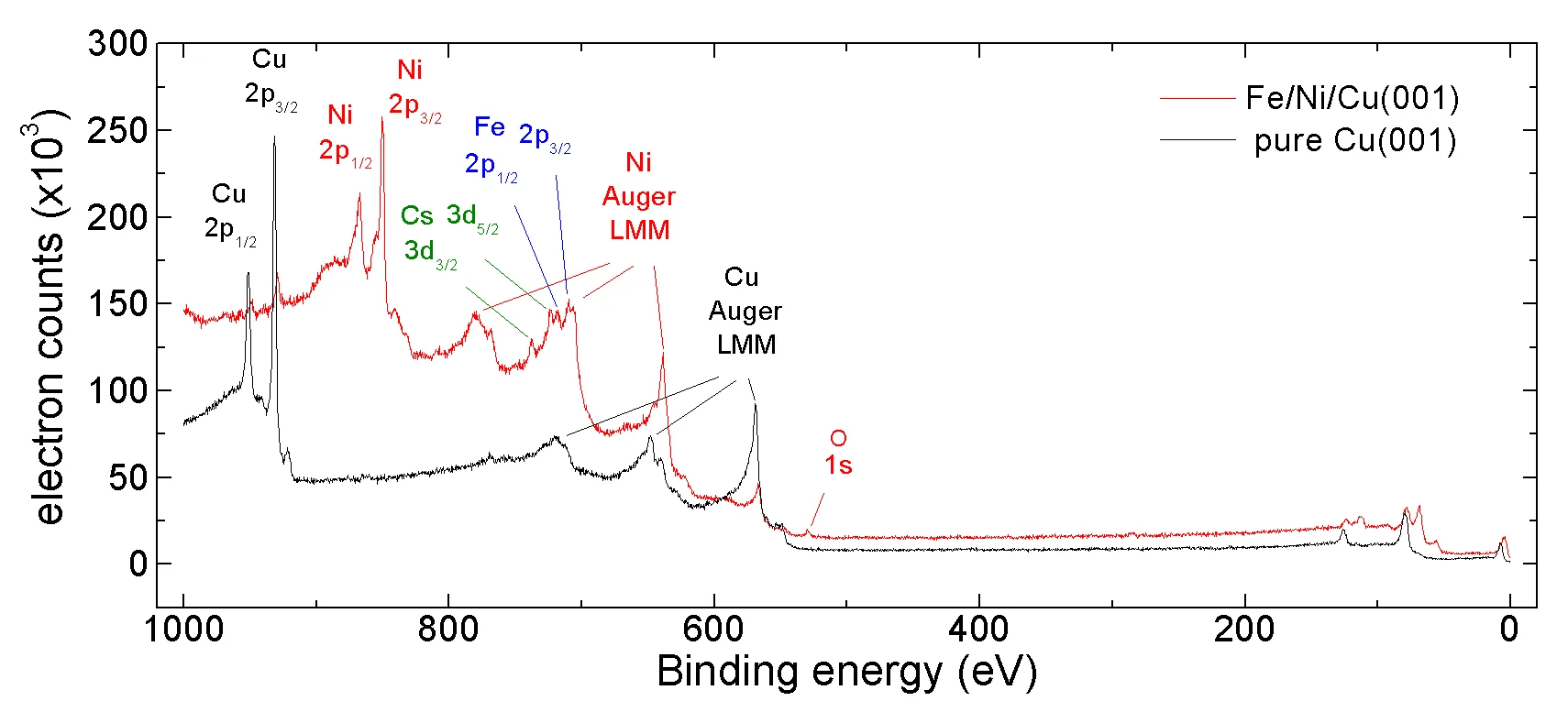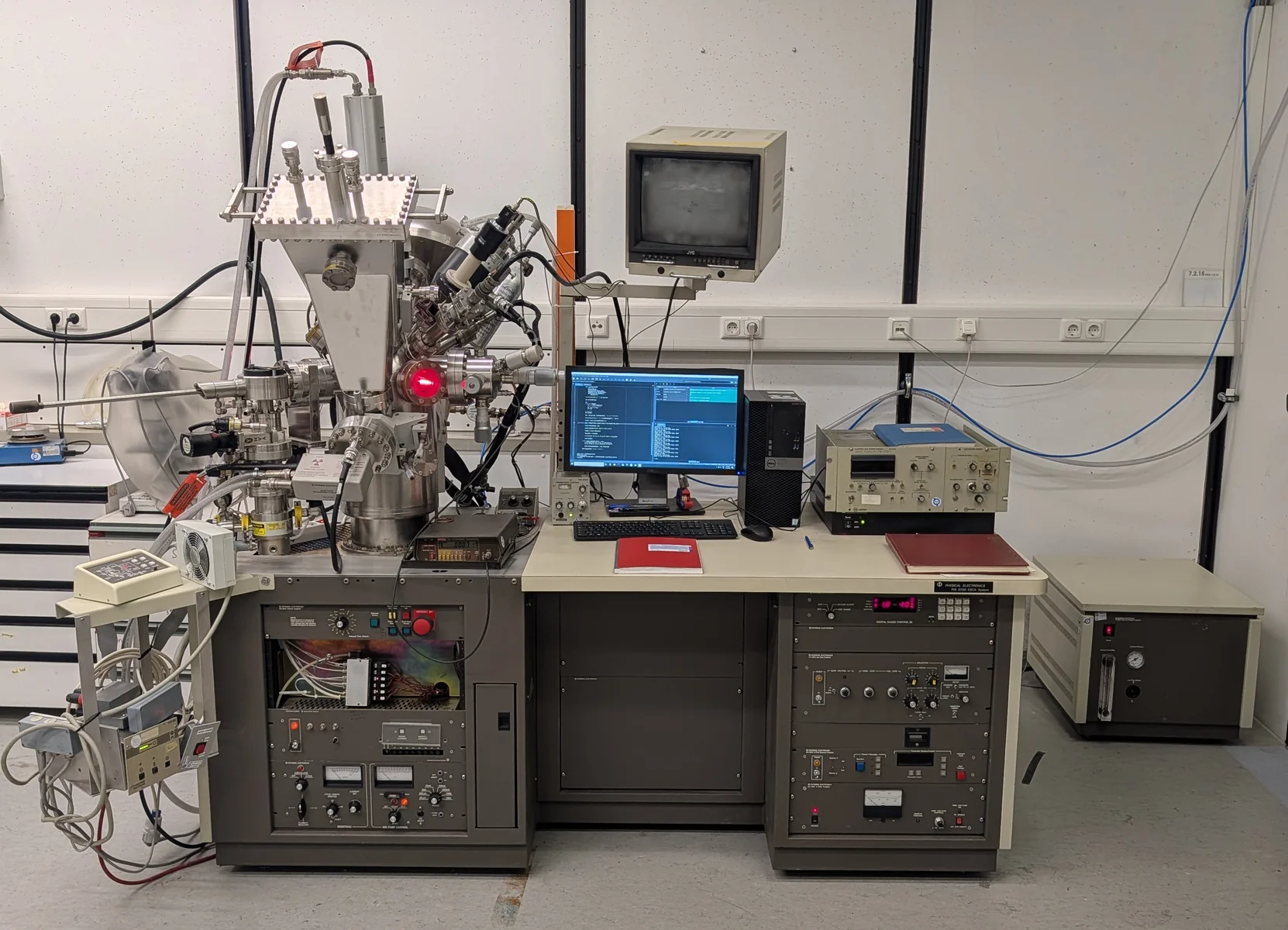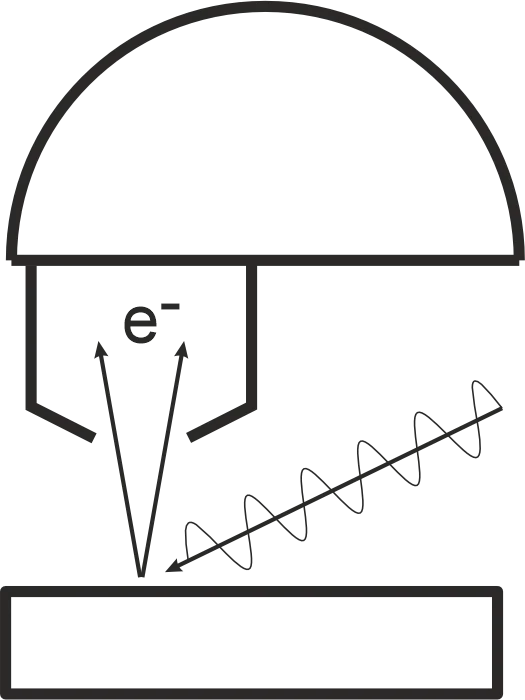
Photoelectrons are generated by illuminating the samples to be investigated with X-Rays. The emitted photoelectrons are collected and analyzed with respect to their intensity and energy distribution. The chemical sensitivity of this measurement technique is given by the element-specific distribution of binding energies of the electronic core levels leading to characteristic energy spectra. The presented X-Ray Photoemission Spectra is taken from a clean Cu crystal as well as ultra thin Fe (~2 mono layers) and Ni (9 mono layers) films on the same Cu crystal featuring separated peaks which belong to individual elements. XPS is - due to the short mean free path (1-4nm) of the excited photoelectrons - rather surface sensitive, as can be recognized by the reduction of the Cu peaks in the spectra in the case of ~11 atomic layers of Fe and Ni on top of the Cu substrate. XPS is highly sensitive to metals. Our setup is a ESCA / XPS from PHI.
Measurement Methods
1. Scan Mode:
The chemical composition in a predefined area (ranging from 0.5 to 2mm) on the sample is analysed by XPS. The sample can be cleaned prior to or simultaneously during the measurement process by Ar-Ion-bombardment.
2. Depth Profile
During a continuous Ar-ion sputtering process which removes the sample structure layer-by-layer the element-specific profile across the sample is recorded.