

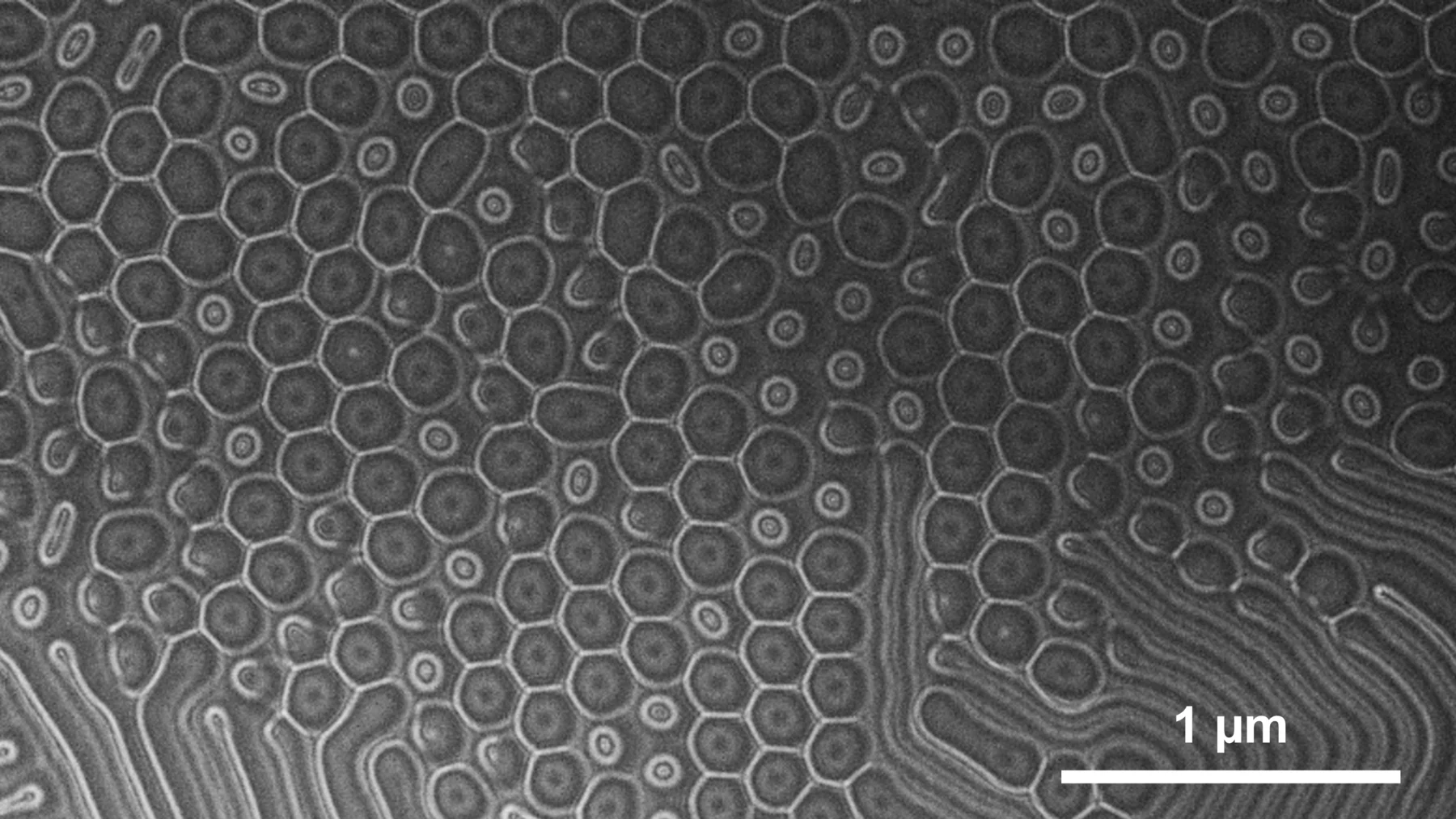
Magnetic textures such as domain walls, vortices and topological spin structures like skyrmions and anti-skyrmions are promising building blocks for future memory and spintronic devices. Whether they can be used in practice depends crucially on how they form, move and switch, processes that often unfold on nanometer length scales and picosecond time scales.
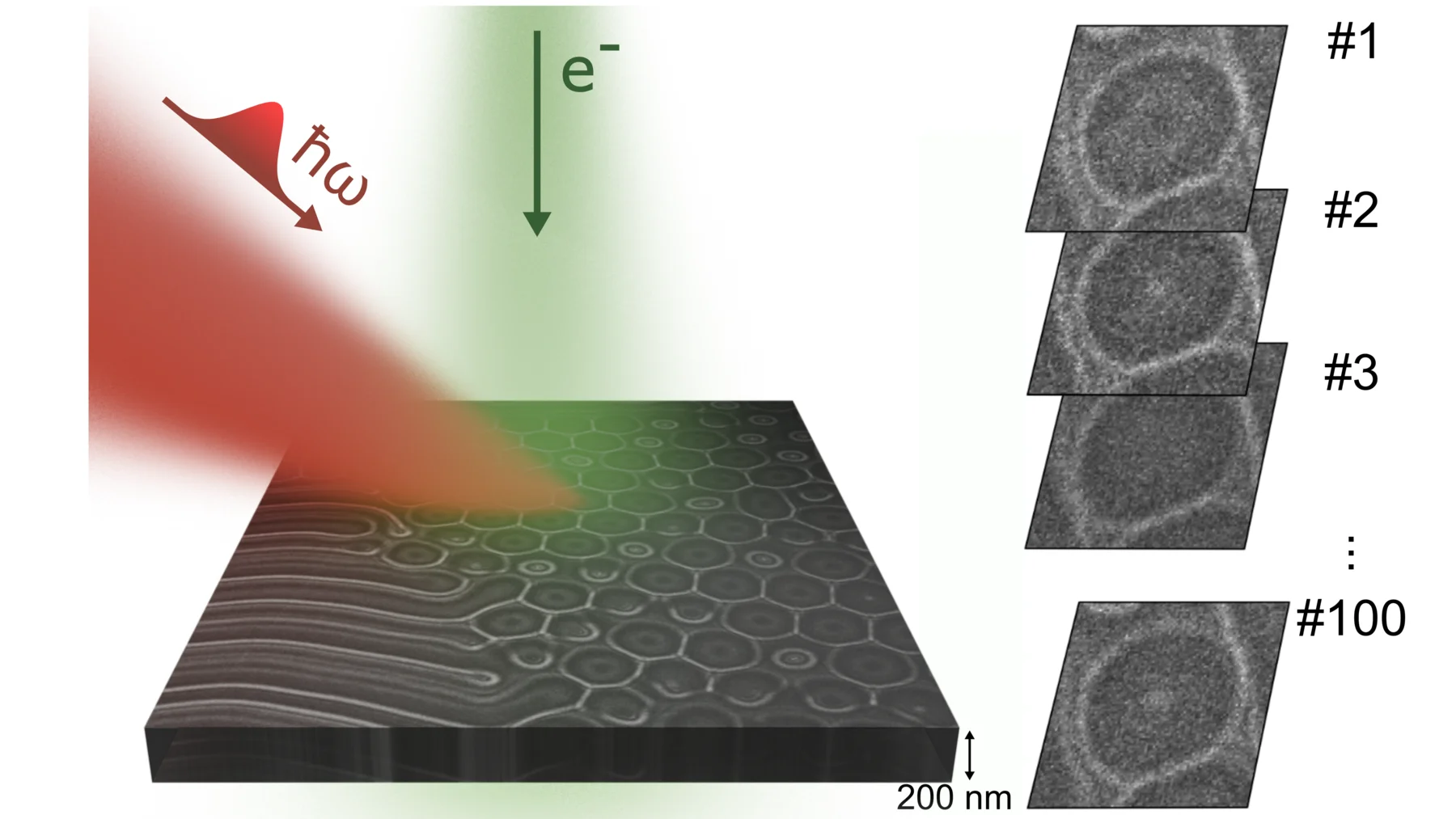
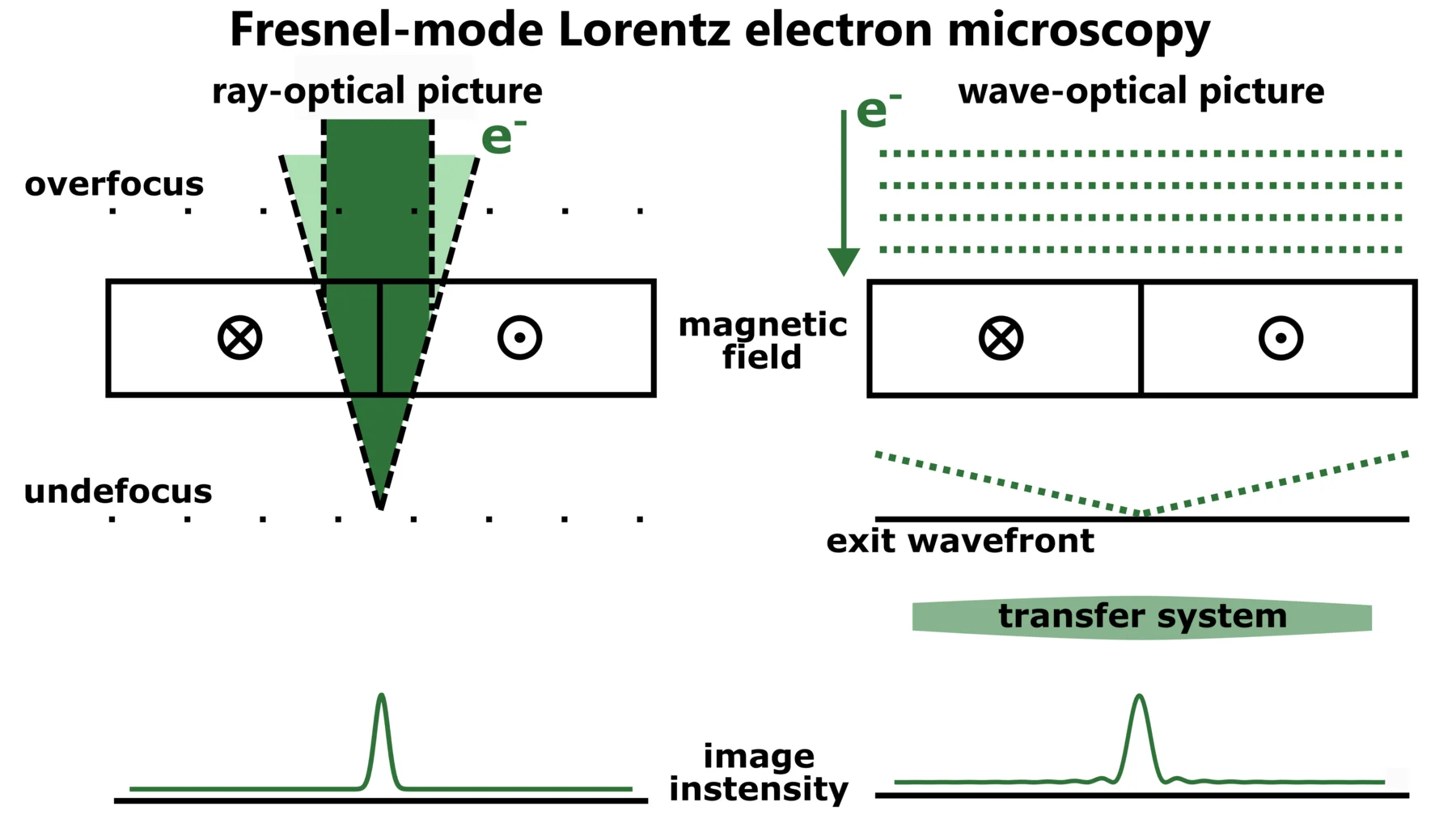
To image these textures, we use Lorentz microscopy: as the electrons pass through a magnetic sample, the in-plane magnetization alters the phase of the electron wave, making the magnetic structure directly visible in the TEM. Combined with the ultrashort electron pulses of our UTEM, we can follow changes in these textures with picosecond time resolution. This allows us to investigate ultrafast phenomena such as domain-wall motion, spin waves and the dynamics of topological spin textures in ferromagnetic and antiferromagnetic materials.
In a complementary approach, we stimulate the sample with individual ultrashort laser or electrical pulses and track how the magnetic texture responds. By statistically analyzing many such switching events, we determine transition probabilities between different magnetic states and map out the energy landscape of the system.
Selected Publications
A. Kovács, J. T. Weber, M. Charilaou, D. Kong, L. Prodan, V. Tsurkan, A. Schröder, N. S. Kiselev, I. Kézsmárki, R. E. Dunin-Borkowski, A. H. Tavabi, S. Schäfer, All-optical stochastic switching of magnetization textures in Fe3Sn2, Communications Materials 6, 223 (2025). (externer Link, öffnet neues Fenster)