

We are pleased to announce a new publication by Florian Hartig, together with Patrick Barth, Jakob Drumm and Aline Koch (Plant RNA Biotechnology, University of Regensburg) and Alexandra Erika Schmidt (University of Hohenheim): “Efficiency of RNAi-based gene silencing in fungi: a meta-analysis”, published open access in New Phytologist on 2 September 2026.
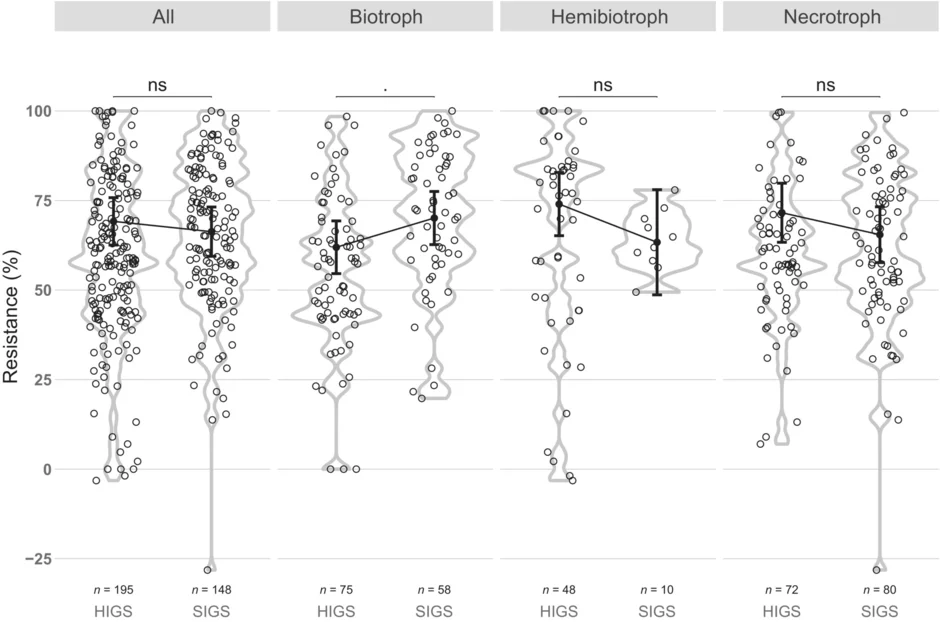
RNA interference (RNAi) is a promising route to protect crops against fungal diseases, either by letting transgenic plants produce double-stranded RNA themselves (host-induced gene silencing, HIGS) or by spraying it onto the plant (spray-induced gene silencing, SIGS). Because reported efficiencies vary widely, the team screened 114 publications, extracted 343 standardised resistance measurements from the 89 eligible studies, and analysed them in a hierarchical meta-regression.
Contrary to expectation, SIGS achieved slightly higher resistance overall and was significantly better against biotrophic fungi, whereas HIGS was relatively more effective against necrotrophs. Formulated dsRNA did not outperform naked dsRNA, and neither dsRNA length nor the number of constructs or targets had a consistent effect. The position of the target site did matter, favouring the 3' end for HIGS and the 5' end for SIGS. Overall, the measured predictors explained only about 12% of the variation between studies, underlining how much remains to be understood about dsRNA uptake and processing in fungi.
Read the full article: doi.org/10.1111/nph.71552
Kontakt aufnehmen
Prof. Dr. Florian Hartig
Theoretical Ecology and Ecological Data Science Group
Homepage see here