

We are pleased to announce a new publication by Dimitry Wintermantel, Julia Osterman, Magdalena M. Mair and Florian Hartig: “Equivalence testing in pesticide risk assessment: evaluation and practical guidance for design, analysis and interpretation”, published open access in Environment International in October 2026.
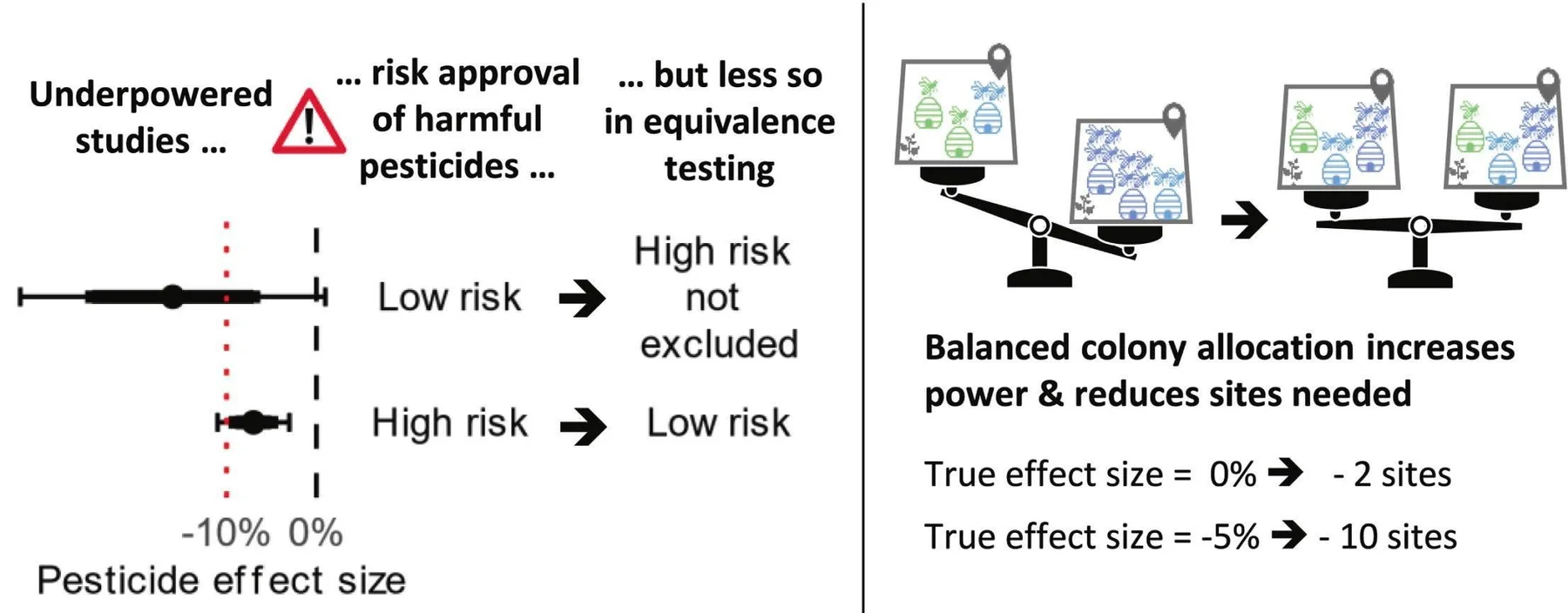
Harmful pesticide effects that exceed specific protection goals (SPG) can go undetected when experimental designs are underpowered. Regulatory honeybee field studies have consistently failed to reach the statistical power required under European Food Safety Authority (EFSA) guidance, which may have led to the approval of high-risk substances. EFSA therefore advised a shift from testing the null hypothesis of “no effect” to equivalence testing: a pesticide is classified as “low risk” only if the hypothesis that its effect exceeds the SPG can be rejected. For honeybees, the recommended SPG is a colony size reduction below 10%. Critics argued that this framework requires excessive site replication and proposed an alternative test that defines treatment effects relative to the lower bound of the 90% confidence interval of the control group.
Using simulations that mimic a regulatory honeybee field study, the authors show that both equivalence tests share the same trade-off between false “low-risk” and false “high-risk” classifications, but only EFSA’s original recommendation reliably identifies pesticides with effects larger than the SPG at α = 0.2. Increasing site replication beyond current practice is therefore unavoidable for a reliable regulatory assessment. For pesticides with effect sizes of 5% or less, however, site requirements remain lower than those implied by the power requirement of the former EFSA guidance. Moreover, covariate adjustment, either through a model term or through balanced colony allocation using anticlustering randomisation, reduces site requirements without losing power and thus saves costs. The paper closes with practical guidance and R functions for anticlustering randomisation and equivalence testing in pesticide risk assessment.
Read the full article: doi.org/10.1016/j.envint.2026.110576 (externer Link, öffnet neues Fenster)
Kontakt aufnehmen
Prof. Dr. Florian Hartig
Theoretical Ecology and Ecological Data Science Group
Homepage see here