

Mechanisms of eukaryotic transcription
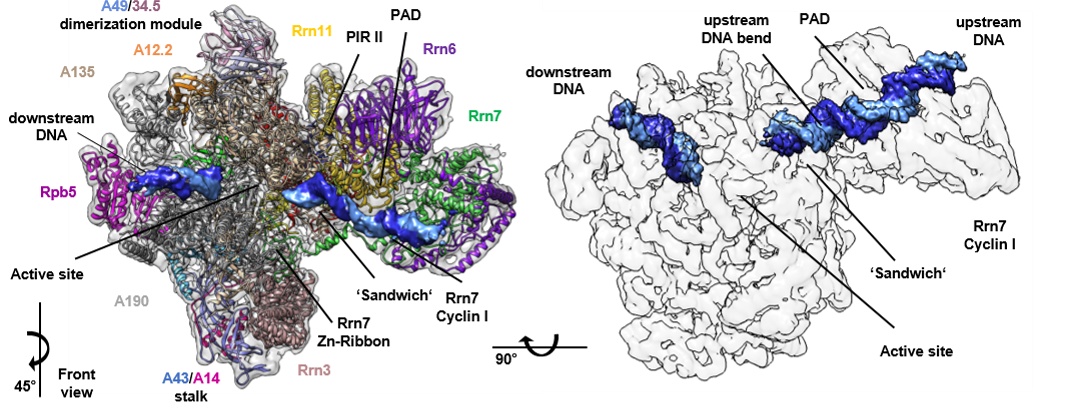
Multi-subunit RNA polymerases (Pols) are central to the expression of genes and synthesis of functional RNA in all organisms. The Structural Biochemistry team studies the molecular mechanisms underlying the functionality of eukaryotic transcription machineries. We are especially interested in RNA polymerase I, which synthesizes the ribosomal RNA precursor in all cells (Hori, Engel*, and Kobayashi*, Nature Reviews Molecular Cell Biology 2023). Using a bottom-up strategy, we reconstitute physiologically relevant states of the transcription cycle for their detailed structure-function analysis (e.g. Pilsl and Engel, Nature Communications 2020).
Evolutionary conservation of transcription systems
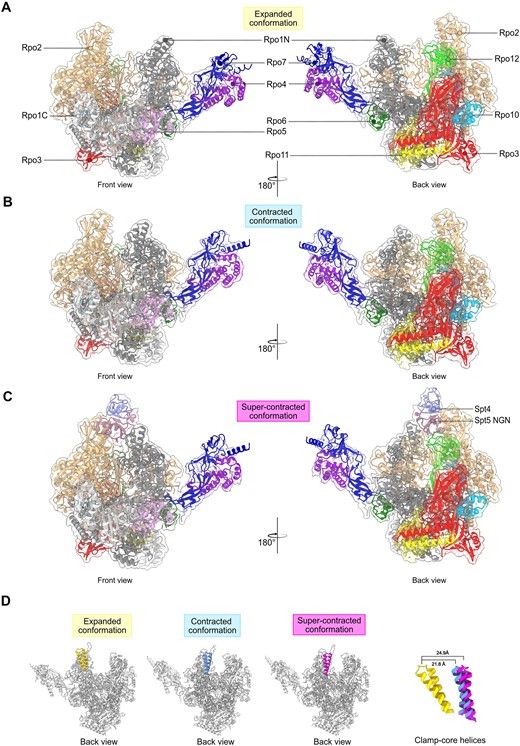
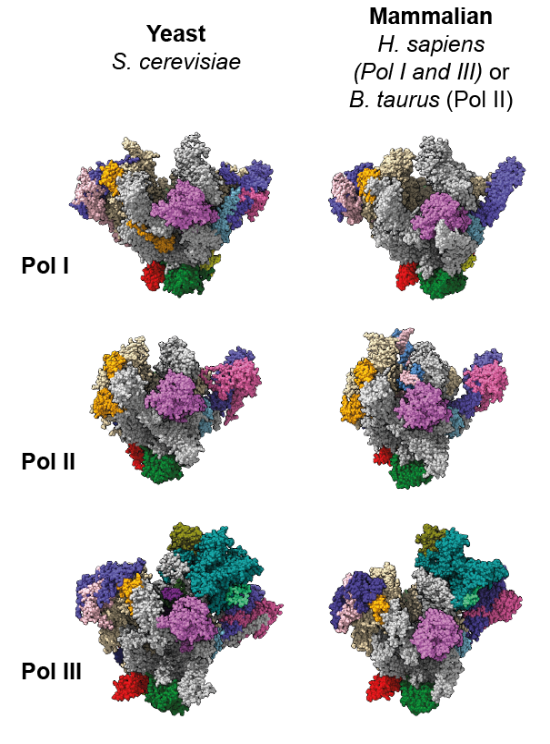
While the mechanisms of transcription have been studied for many years, the general understanding is often biased on a small set of model systems, such as the messenger-RNA producing Pol II. With the goal to identify common features and distinguish species-specific traits, we aim to mechanistically compare transcription systems throughout evolution. This includes studies from archaea (Tarau et al., Nucleic Acid Research 2024) over different yeast species (Heiß et al., Nature Communications 2021; Pilsl and Engel, Nature Communications 2020) and parasites (Mair et al., Nucleic Acid Research 2025) all the way to highly differentiated human systems that allow the study of disease-relevant features (Daiss et al., Life Science Alliance 2022, Daiss et al., Biological Chemistry 2023).
Multi-protein assembly
The physiologically correct assembly of multi-protein complexes is of enormous importance to their functionality in cells. This assembly is often highly specialized but also underlies common principles. Strikingly, misassembly can be correlated with developmental diseases. The group studies assembly mechanisms of eukaryotic multi-subunit complexes in a combined bottom-up (in vitro) – top-down (ex vivo) approach combining global screening techniques with single-particle structural analysis in an international team recently installed by the “Weave Europe” funding scheme.
Core Methodology: Single-particle cryo-EM of macromolecular complexes
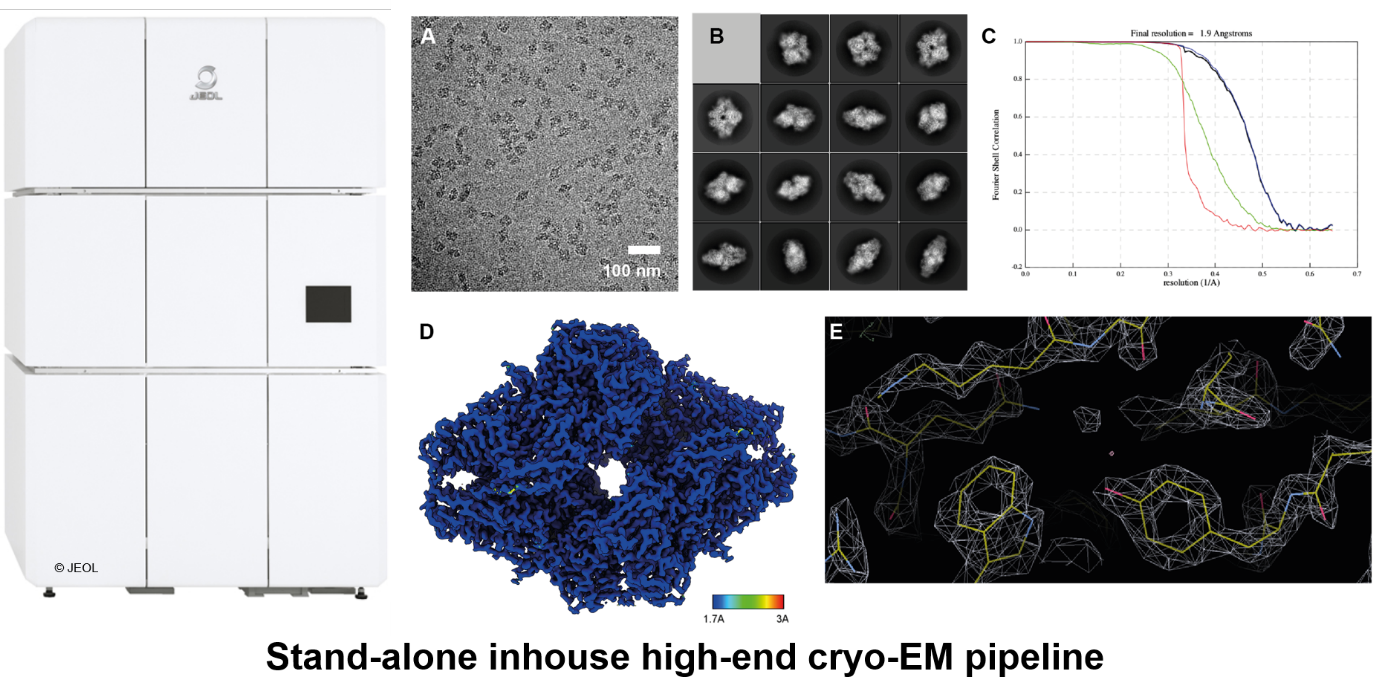
Our in-house single-particle cryo-EM pipeline is centered around a high-end CryoARM200 with direct electron detector and customized data processing and storage architecture. This pipeline allows us to iteratively optimize samples and determine high-resolution cryo-EM reconstructions (Hochheiser et al., Nature 2022; Pilsl et al., Methods Mol Biol 2022) and contributed to the setup of facilities world-wide (eg. Sengupta et al., Science Advances 2025). Training includes a combined theory/hands-on block course each summer term (internal application number: 54254) and is available to students from Regensburg and from external institutes. In addition, we develop functional assays and apply biophysical technologies to combine structural with functional analyses.