

Why do people become participants in morally reprehensible acts? How do individual acts develop into systems of violence? And what enables resistance? These questions lie at the heart of the international conference Obedience to Authority: Milgram's Legacy and Emerging Directions (external link, opens in a new window), which will take place from 9–11 September 2026 at the University of Regensburg and the Flossenbürg Concentration Camp Memorial.
Approximately thirty researchers from Europe and North America will come together to examine the current state of obedience research and, for the first time, place contemporary psychological theories in systematic dialogue with historical research on violence, perpetration, and resistance. By bringing together psychological, neuroscientific, and historical perspectives on authority, responsibility, violence, and resistance, the meeting seeks to establish a dialogue between disciplines that have largely developed independently over recent decades. The scientific highlight of the conference will take place at the Flossenbürg Concentration Camp Memorial, where psychologists and historians will jointly explore how experimental and historical perspectives can inform – and challenge – one another.
"Ever since Milgram's experiments, we have known that many people obey authorities even when doing so means harming others. Today, however, we are less interested in whether people obey than in understanding how they become participants in morally reprehensible acts, how such acts develop into systems of violence, and what enables resistance. Answering these questions requires a much closer dialogue between psychology, history – and perhaps, in the future, other disciplines as well."
— Dr. Felix Johannes Götz, University of Regensburg
Sixty-Five Years after Milgram
Few topics in social psychology have had an impact comparable to Stanley Milgram's obedience experiments of the 1960s. By demonstrating that many ordinary individuals were willing to administer what they believed were painful electric shocks when instructed by an authority figure, Milgram fundamentally changed how psychologists think about authority, responsibility, and moral action. Over the past decades, however, obedience research has undergone profound transformation. New experimental paradigms, neuroscientific findings, and theoretical frameworks have expanded, challenged, and in some cases revised Milgram's original interpretation. Contemporary research increasingly focuses on agency, responsibility, conflict, social influence, and a diversity of psychological mechanisms through which obedience emerges.
At the same time, historical scholarship has moved far beyond simplistic notions of hierarchical command. Research on organized violence and mass atrocities demonstrates that participation in atrocities rarely resulted from ideology or coercion alone. Instead, organizational structures, divisions of labor, institutional routines, peer dynamics, and the anticipation of superiors' expectations often played decisive roles. Although both disciplines have advanced considerably over recent decades, they have largely evolved independently. The Regensburg conference seeks to change that.
From the Laboratory to History – and Back
The conference follows a deliberately two-stage scientific design. During the first two days, leading psychologists and neuroscientists will discuss the current state of obedience research, addressing fundamental questions about how obedience should be conceptualized, experimentally investigated, and explained through different psychological mechanisms. Historians will participate in these discussions from the outset, contributing their perspectives while jointly preparing the interdisciplinary final day.
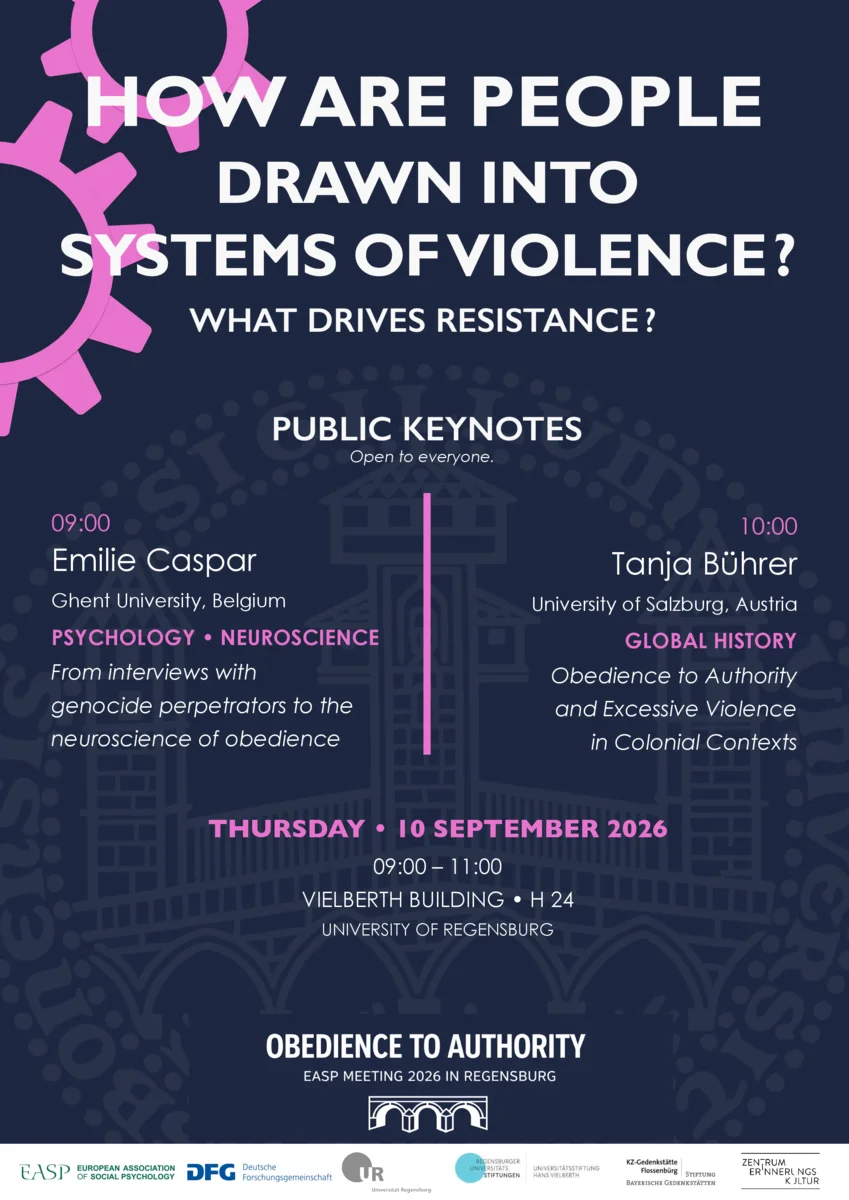
On Thursday morning, the conference will also open to the wider university community through two public keynote lectures. Social neuroscientist Professor Emilie Caspar (Ghent University) will provide an overview of current developments in psychological and neuroscientific obedience research, followed by military historian Professor Tanja Bührer (University of Salzburg), who will discuss historical perspectives on authority, violence, and military organization.
The third conference day, entitled Obedience to Authority: Interdisciplinary Perspectives, is organized in close cooperation with the Center for Commemorative Culture at the University of Regensburg and brings both disciplines together at the Flossenbürg Concentration Camp Memorial. Following a scholarly tour of the memorial led by Professor Jörg Skriebeleit, historians and psychologists will discuss how experimental findings on obedience, responsibility, and resistance relate to historical analyses of perpetration – and, equally importantly, how historical research challenges and refines psychological theories of obedience.
Rather than serving merely as the setting for a site visit, the Flossenbürg Memorial becomes a place of scientific exchange. As part of the Democracy Workshop on the Future of Commemorative Culture, initiated by Professor Skriebeleit, participants will explore how psychological research can contribute to historical education and commemorative practice – and how historical scholarship can, in turn, reshape psychological models of authority, responsibility, and resistance.
Towards a New Interdisciplinary Research Agenda
The conference is intended to initiate a sustained dialogue between psychology, history, and commemorative culture, bringing these fields together to formulate questions that no single discipline can answer on its own. The meeting is organized around three guiding questions:
How do people become participants in morally reprehensible acts? How do systems of violence emerge? And what enables resistance?
The conference is organized by an international and interdisciplinary team consisting of psychologists Dr. Felix Johannes Götz (University of Regensburg), Dr. Vanessa Mitschke (University of Göttingen), Professor Megan Birney (University of Birmingham), and Professor Emilie Caspar (Ghent University); historians Dr. Michael Rösser and M.A. Eileen Weiß (Center for Commemorative Culture, University of Regensburg); and Professor Jörg Skriebeleit, Director of the Flossenbürg Concentration Camp Memorial and member of the Center for Commemorative Culture at the University of Regensburg. The conference is organized in cooperation with the European Association of Social Psychology (EASP), the Center for Commemorative Culture at the University of Regensburg, and the Flossenbürg Concentration Camp Memorial. It is funded by the German Research Foundation (DFG), the Vielberth University Foundation, and the participating partner institutions.
Public Lectures
Topic : “From Interviews with Genocide Perpetrators to the Neuroscience of Obedience”
Speaker : Prof. Dr. Emilie Caspar, Ghent University, Belgium
Date : Thursday, September 10, 2026, 9:00 a.m.
Location : H24, Vielberth Building, University of Regensburg
Topic : “Obedience to Authority and Excessive Violence in a Colonial Context”
Speaker : Prof. Dr. Tanja Bührer, University of Salzburg, Austria
Date : Thursday, September 10, 2026, 10:00 a.m.
Location : H24, Vielberth Building, University of Regensburg
Click here to visit the conference website (external link, opens in a new window)
Contacts
Dr. Felix Johannes Götz
Chair of Psychology II
University of Regensburg
Mail: felix-johannes.goetz@ur.de
Dr. Michael Rösser
Center for Commemorative Culture
University of Regensburg
Mail: michael.roesser@ur.de