

Regensburg Forum for Procedural Law
3rd Regensburg Forum on Procedural Law:
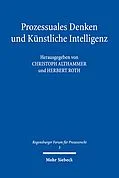
Procedural Thinking and Artificial Intelligence
This volume brings together the papers presented at the 3rd Regensburg Forum on Procedural Law.
In it, representatives from academia and the legal profession address future issues surrounding the use of artificial intelligence from a civil procedural perspective. The focus is not only on the influence of artificial intelligence on judicial decision-making but also on the broader phenomenon of the digitalisation of procedural law. In addition to examining the legal policy rationale behind certain technical innovations and their potential areas of application, the volume also highlights the limits of constitutional law regarding algorithm-based applications and discusses conflicts with established procedural principles. The contributions to the discussion by the forum participants included in this volume reflect a lively debate on the topics under consideration.
Table of Contents
Thomas Dickert: The Code of Civil Procedure and Digitalisation (The Digitalisation of Civil Procedure) – Martin Spitzer: Digitalisation and Procedural Principles – Stefan Huber: Decision-making in civil proceedings through artificial intelligence – Christian Heinze: Civil procedural evidence and artificial intelligence – Volkert Vorwerk: Algorithms in civil proceedings. Legal classification and reviewability at the appeal stage
A press release on the 3rd Regensburg Forum on Procedural Law can be found here (external link, opens in a new window).
2nd Regensburg Forum on Procedural Law:
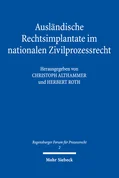
Foreign Legal Elements in National Civil Procedure
This volume brings together the papers from the 2nd Regensburg Forum on Procedural Law.
The title ‘Foreign Legal Elements in National Civil Procedure’ addresses an issue that concerns not only German but also European civil procedure. The focus is on the question of whether, and to what extent, foreign legal models – so-called ‘legal implants’ – can be found in national codes of procedural law. This raises a further question: do these foreign legal concepts also influence those parts of the codification previously regarded as genuinely national, or can the foreign elements be clearly distinguished and might they even exist as foreign elements?
Table of Contents
Thomas Sutter-Somm: The influence of foreign civil procedure systems on the new Swiss Code of Civil Procedure – Athanassios Kaissis: Legal transplantation as a condition for granting credit? Towards the creation of a market-compatible Code of Civil Procedure in Greece – Georgios Orfanidis: Collective remedies under Greek law. The influence of foreign models on Greek law – Dimitrios Tsikrikas: Appeal proceedings under Greek law. The influence of foreign models on Greek law; in particular, the appeal by cassation from a comparative law perspective – Peter G. Mayr: Legal transplants and European law. An overview from an Austrian perspective
1st Regensburg Forum on Procedural Law:
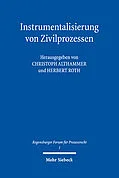
The instrumentalisation of civil proceedings
This volume brings together the papers from the 1st Regensburg Forum on Procedural Law and launches the new series ‘Regensburg Forum on Procedural Law (RFP)’.
Austrian, Greek, Italian and Turkish academics examine claims that are imbued with public interest. The claimant does not go to court primarily to enforce their own subjective rights, but rather to mobilise the state or society for their own purposes or those of an organisation backing them. In the form of ‘strategic civil litigation’, examples both nationally and internationally include ‘human rights lawsuits’ or ‘climate change lawsuits’. What they have in common is that, beyond the specific individual case, they seek to establish precedent-setting rulings intended to bring about political, social or economic change. Ultimately, this is about the politicisation of civil proceedings.
Table of Contents
Walter Rechberger: The instrumentalisation of civil proceedings – Nikolas K. Klamaris: The instrumentalisation of civil proceedings – Kamil Yildirim: The procedural provisions of the new Turkish Consumer Protection Act – Remo Caponi: ‘Doing Business’ as a Purpose of Civil Justice? The Impact of World Bank ‘Doing Business’ Indicators on the Reforms of Civil Justice Systems: Italy as a Case Study – Georg Kodek: ‘Instrumentalisation’ of civil proceedings? ‘Strategic litigation’ as a challenge for procedural law
Real-world Laboratory Background Document
This project, carried out jointly by the Ministries of Justice of Bavaria and Lower Saxony in collaboration with the Chairs of German Procedural Law (Prof. Dr Althammer) and media informatics (Prof. Dr Wolff (external link, opens in a new window)) (external link, opens in a new window) at the University of Regensburg aims to gain insights into the digital possibilities for formally structuring the parties’ submissions in civil proceedings.
It is intended to be tested in practice in selected civil proceedings to determine the specific form this should take and in which cases the use of a so-called ‘base document’ – as a means of structuring the case material from both a factual and legal perspective – proves beneficial for the parties involved in the proceedings – lawyers, judges and the parties – in both factual and legal terms. The testing will be carried out using a prototype with limited functionality, which is being developed within the project using legal design methods.
The project is to be conducted with an open-ended approach, taking into account the perspectives of all stakeholders. At the end of the project, the aim is to produce an empirically grounded recommendation regarding the introduction of the ‘basic document’ by the legislature.
Further information can be found on the research project’s website (external link, opens in a new window).
Law Students’ Society
Law Students’ Society
The Regensburg Law Students’ Society (juristische Studiengesellschaft Regensburg e.V.) was (external link, opens in a new window)founded on 30 June 1987. Its aim is to examine legal issues of all kinds from an academic perspective amongst legal professionals from various fields. It seeks to achieve this aim primarily through lectures and discussions which provide members with professional stimulation, impart knowledge and experience from the various fields of law, and at the same time foster personal contact amongst them.
Professor Althammer is the Society’s First Chairman.
Guestbook
2015
During the summer term of 2015, Professor Dr Viktória Harsági from Pázmány Péter Catholic University, Budapest, was a visiting researcher at the Chair.
In the summer semester of 2015, Professor Amalia Diurni from the Università degli Studi di Roma Tor Vergata was a visiting scholar at the department for a research stay.
2018
In the summer semester of 2018, Professor Dr Eva Dobrovolná, Assistant Professor at the University of Brno (Czech Republic), was a guest researcher at the Chair in June.
Guests from Turkey included Mr Aslan, from the Faculty of Law at Dokuz Eylül University, İzmir, and Dr Konuralp, a research fellow at Bilkent University in Ankara, who were at the Chair for an extended research stay.
Publishers
ZZP – Journal of Civil Procedure (external link, opens in a new window)
The ZZP is the specialist journal for procedural issues in civil justice. Its regular editorial programme includes articles on fundamental topics in German and foreign civil procedure law, significant judgments in civil procedure law with commentary, and book reviews of important works on procedural law.
The Journal of Civil Procedure is edited by Prof. Dr Christoph Althammer and Prof. Dr Alexander Bruns.
NZFam – New Journal of Family Law (external link, opens in a new window)