
More Research Highlights
Twisted heterostructures and proximity effects (in chronological order)
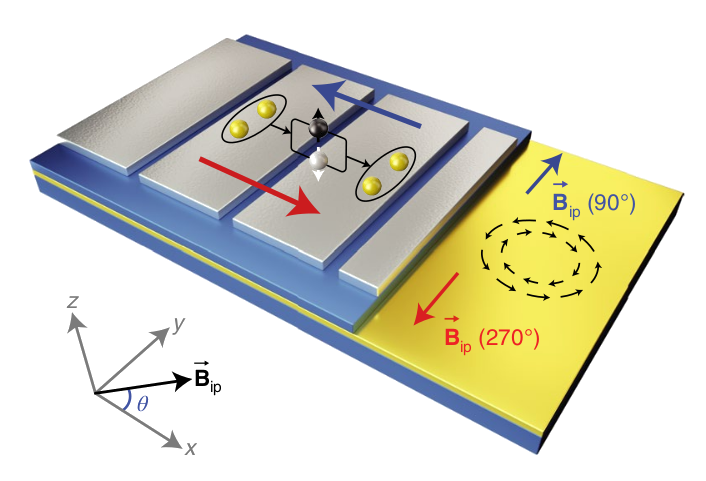
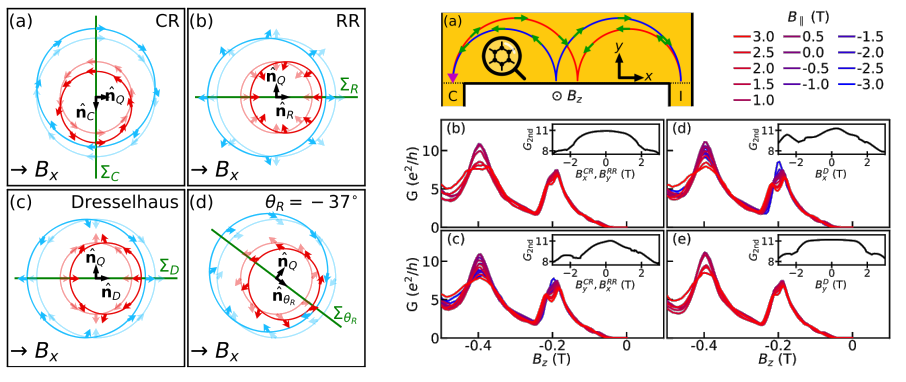
Magnetotransport and Spin-Relaxation Signatures of the Radial Rashba and Dresselhaus Spin-Orbit Coupling in Proximitized Graphene
Graphene-based van der Waals heterostructures offer unprecedented possibilities to engineer the proximity-induced spin-orbit fields through knobs like stacking, twisting, or gating, and might therefore provide an ideal platform to induce new unconventional types of spin-orbit coupling such as the chiral radial Rashba fields recently proposed by first-principles calculations performed in our group (see below).
In this work, we performed large-scale magnetotransport calculations based on the KWANT package to investigate transverse magnetic focusing and Dyakonov–Perel spin relaxation in proximitized graphene. Our results guide to practical experimental signatures to disentangle radial from conventional (tangential) Rashba and/or Dresselhaus spin-orbit coupling. Moreover, we demonstrated that a radial Rashba component in a two-dimensional electron gas will impose a characteristic magnetization-angle shift on the superconducting-diode-effect efficiency, allowing us to determine the so-called Rashba angle and thereby quantify the amount of radial Rashba coupling in these “crossed” spin-orbit fields.
This work has been published in Physical Review Letters (external link, opens in a new window).
Swapping Exchange and Spin-Orbit Induced Correlated Phases in Proximitized Bernal Bilayer Graphene
Combining sophisticated simulations and theoretical models, we discovered that we can electrically control the electronic behavior of Bernal bilayer graphene sandwiched between magnetic Cr2Ge2Te6 and strong spin-orbit-coupling-inducing WS2 layers to explore a wide range of correlated phases within a single system. Our research opens up novel possibilities to design such advanced EX-SO-tic van der Waals devices with tunable properties, simultaneously exploiting magnetic exchange (EX) and spin-orbit coupling (SO).
This work has been published in Physical Review B (external link, opens in a new window).

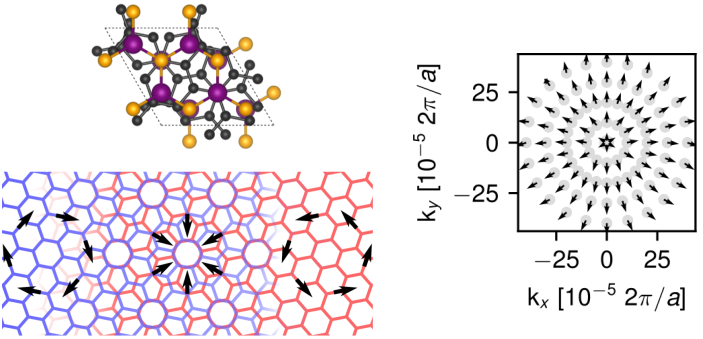
Emergence of Radial Rashba Spin-Orbit Fields in Twisted Van der Waals Heterostructures
From first-principles calculations, we investigated the functional form of the spin-orbit fields that emerge in twisted van der Waals heterostructures consisting of graphene and WSe2 multilayers. We proposed that the Rashba spin-orbit fields of these structures can be electrically tuned from the conventional – tangential to momentum – to a predominantly radial – parallel to momentum – spin texture. Such spin-orbit engineering could be useful to design spin-charge-conversion and spin-orbit-torque schemes, as well as for controlling correlated phases and superconductivity in van der Waals materials.
This work has been published in Physical Review B (external link, opens in a new window) as Editors' Suggestion.
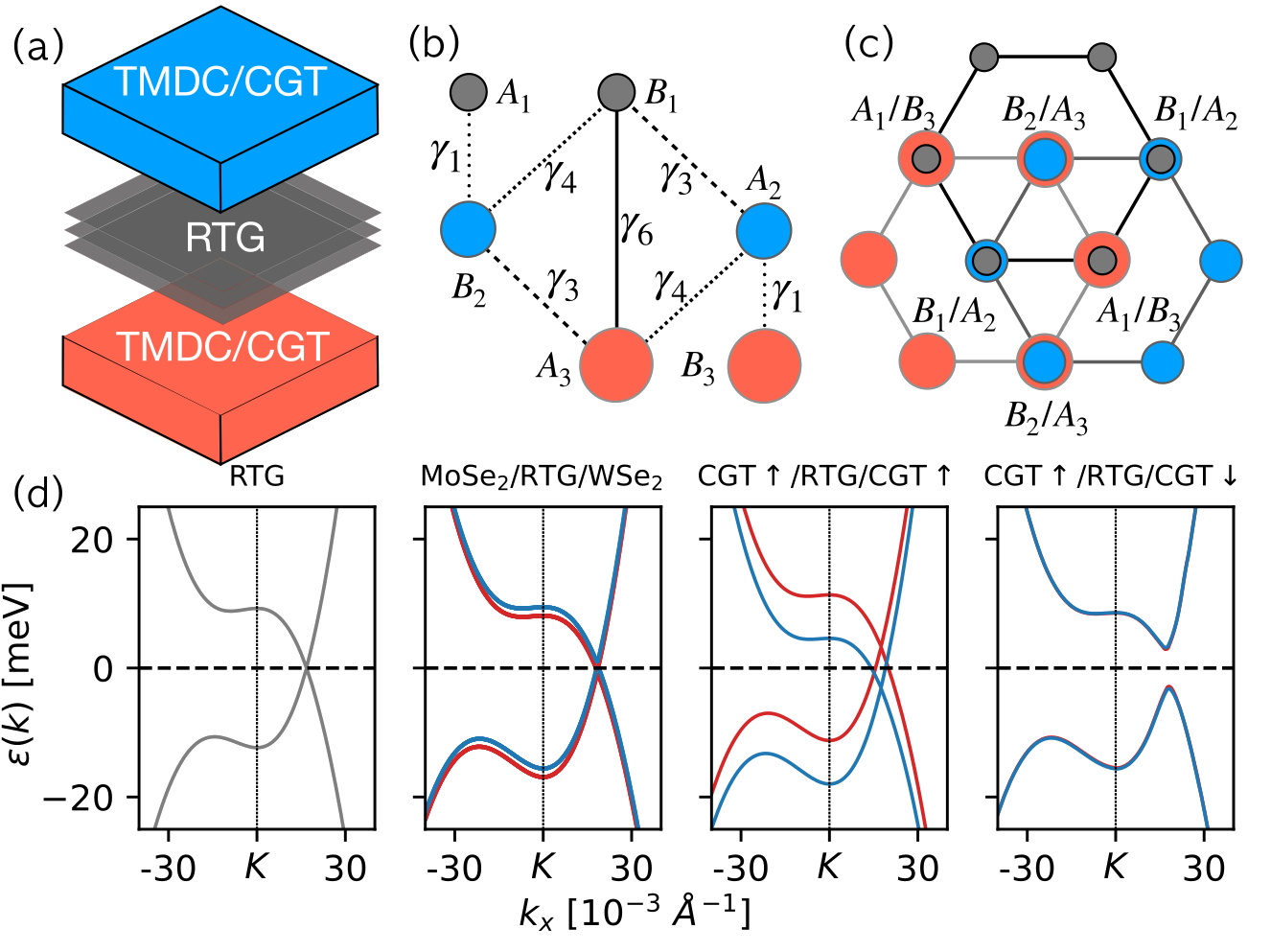
Emergent Correlated Phases in Rhombohedral Trilayer Graphene Induced by Proximity Spin-Orbit and Exchange Coupling
In collaboration with Dr. Denis Kochan from the Slovak Academy of Sciences in Bratislava, we studied the impact of proximity-induced spin-orbit (through proximity to a transition-metal dichalcogenide; TMDC) and exchange coupling (through proximity to CGT) on rhombohedral trilayer graphene. We identified a rich spectrum of correlated phases that originate, e.g., from valley–Zeeman coupling, and also unraveled a magnetocorrelation effect, which causes a strong sensitivity of the correlated phases to the relative magnetization orientations (parallel or antiparallel) of the proximitizing ferromagnetic (CGT) layers.
This work has been published in Physical Review Letters (external link, opens in a new window).
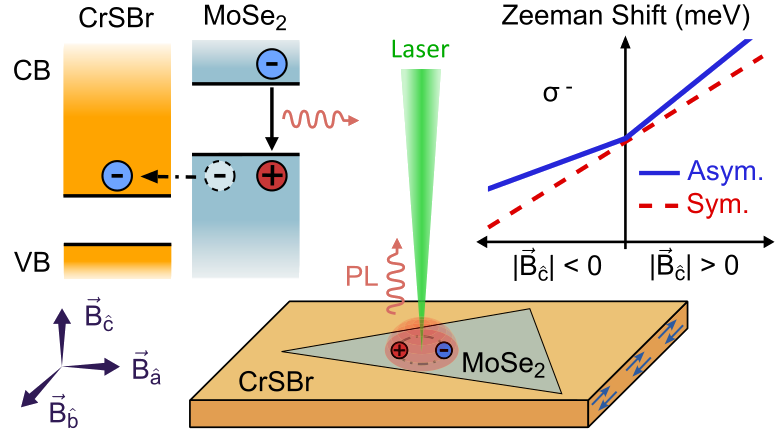
Charge Transfer and Asymmetric Coupling of MoSe₂ Valleys to the Magnetic Order of CrSBr
In an international collaboration, we investigated the control of the valley and excitonic properties of van der Waals heterostructures composed of two-dimensional transition-metal dichalcogenides (MoSe2) and magnetic materials (CrSBr) exploiting proximity effects. We found a clear impact of the magnetic order of CrSBr on the optical properties of MoSe2, the exciton and trion energies, and a valley g-factor reflecting asymmetric magnetic proximity interaction. Our first-principles calculations furthermore indicated that MoSe2/CrSBr forms a broken-gap band alignment and supports charge transfer.
This work has been published in Nano Letters (external link, opens in a new window).
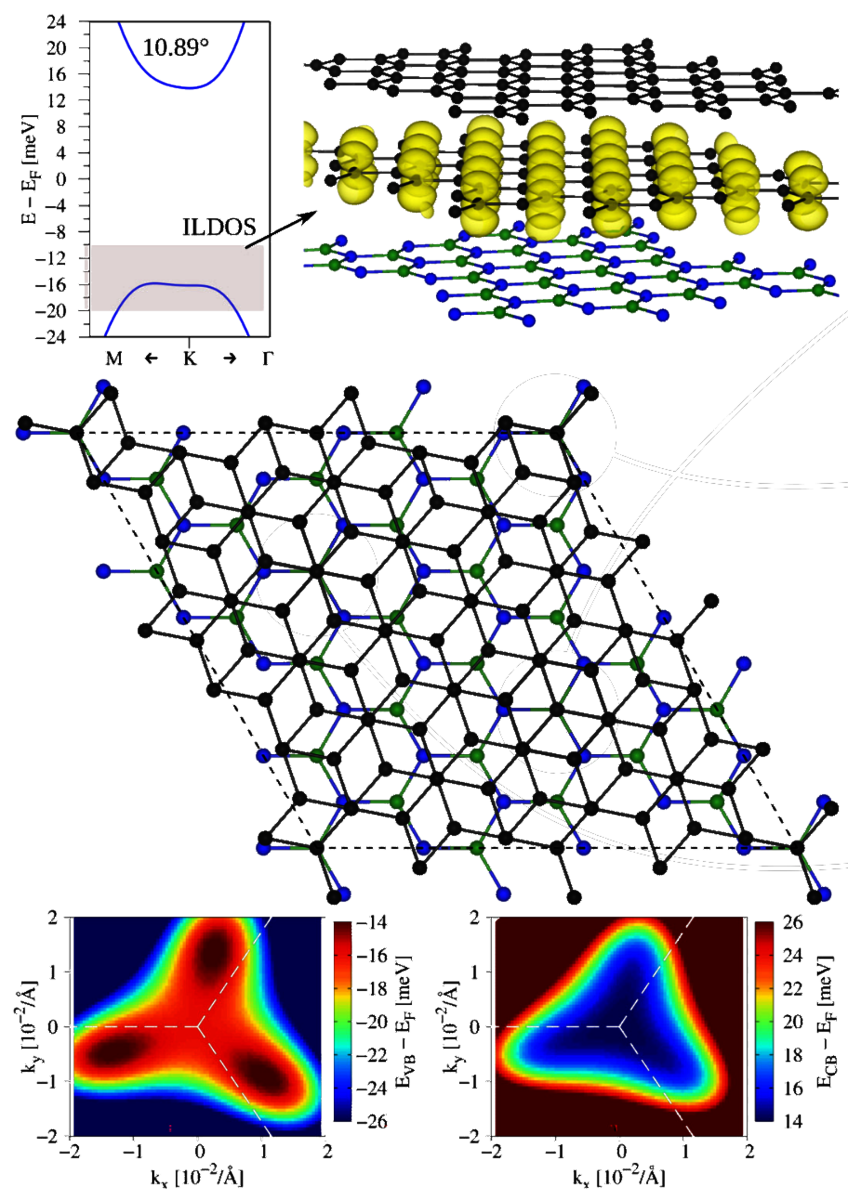
Electronic and Spin-Orbit Properties of hBN Encapsulated Bilayer Graphene
In collaboration with experimental colleagues from RWTH Aachen and Forschungszentrum Jülich, we employed first-principles calculations to model the electronic properties and spin-orbit coupling of bilayer graphene encapsulated by hexagonal boron-nitride (hBN). We extracted the spin-orbit coupling parameters fitting the computed band structures to a model Hamiltonian and furthermore studied the impact of twisting.
This work has been published in Physical Review B (external link, opens in a new window).
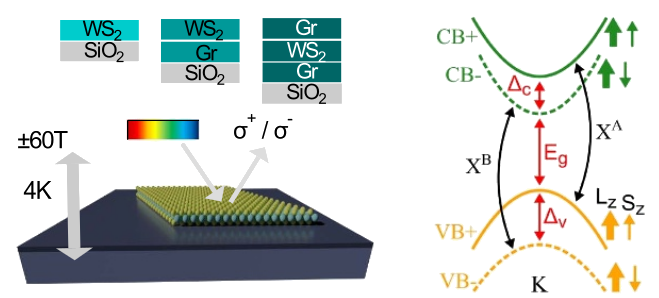
Proximity-Enhanced Valley Zeeman Splitting at the WS₂/Graphene Interface
Based on first-principles calculations, we characterized proximity effects occurring at the interfaces between the van der Waals material WS2 and graphene. We fitted the obtained band structures to an analytical model Hamiltonian and extracted the g-factors of the bilayer, suggesting a clear enhancement of the valley Zeeman effect due to proximity.
This work has been published in 2D Materials (external link, opens in a new window).
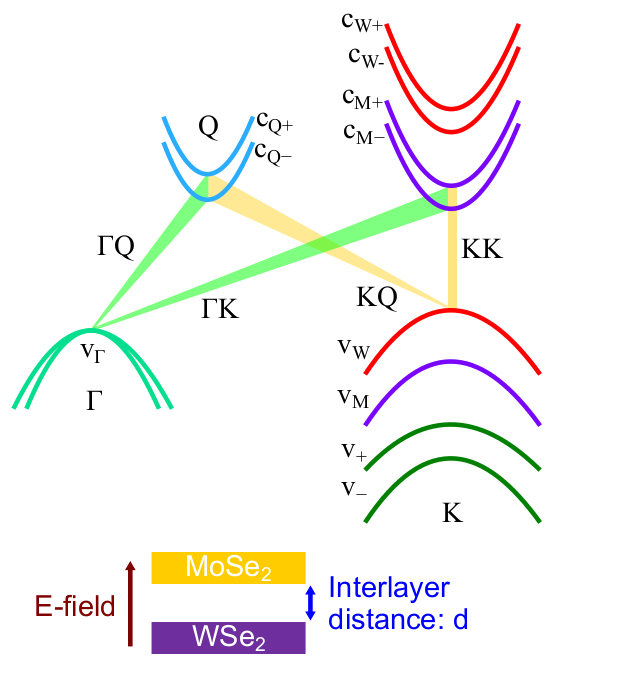
Signatures of Electric Field and Layer Separation Effects on the Spin-Valley Physics of MoSe₂/WSe₂ Heterobilayers: From Energy Bands to Dipolar Excitons
We explored the effects of electric fields and the separation of individual layers on the spin-valley physics of van der Waals MoSe2/WSe2 heterobilayers using advanced first-principles methods. Within our recent work, we put a special focus on dipolar (interlayer) excitons – the exciton-forming electrons and holes are thereby localized in different layers – for which multilayered van der Waals heterostructures provide a suitable platform to emerge.
This work has been published in Nanomaterials (external link, opens in a new window).
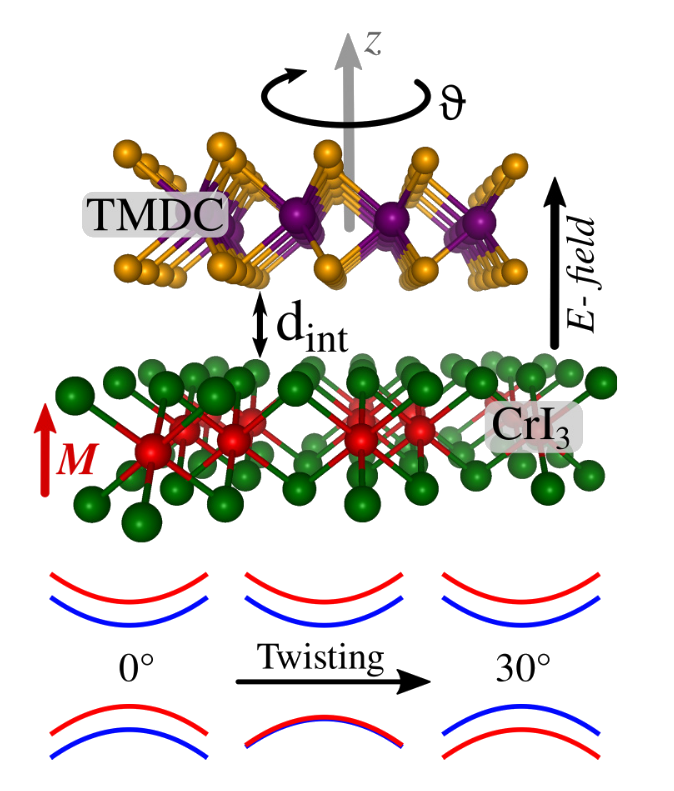
Strong Manipulation of the Valley Splitting upon Twisting and Gating in MoSe₂/CrI₃ and WSe₂/CrI₃ Van der Waals Heterostructures
By means of first-principles calculations, we studied the impact of twisting and gating on the electronic properties of MoSe2/CrI3 and WSe2/CrI3 van der Waals heterostructures. Fitting the ab-initio band structures to a well-established model Hamiltonian, we demonstrate that twisting and gating provide important control knobs to strongly tune the valley splitting.
This work has been published in Physical Review B (external link, opens in a new window).
Superconducting junctions (in chronological order)
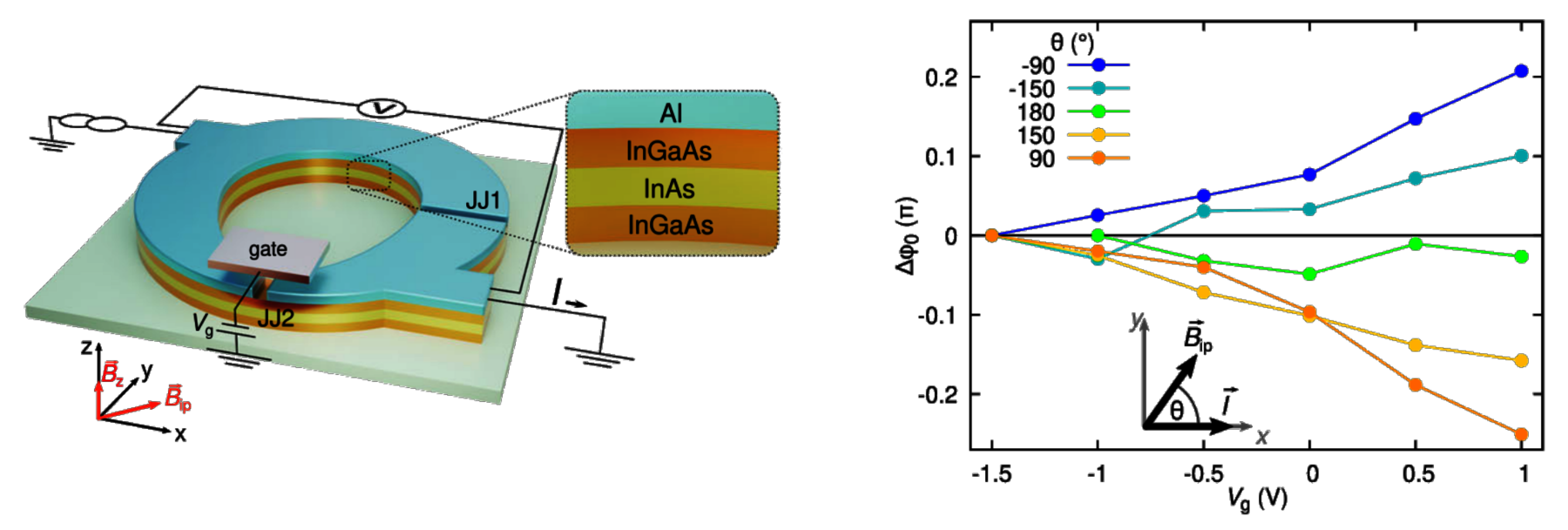
Link between Supercurrent Diode and Anomalous Josephson Effect Revealed by Gate-Controlled Interferometry
In collaboration with our experimental colleagues in Regensburg, we further investigated the supercurrent diode effect in two-dimensional electron gas (2DEG) Josephson junctions. We simultaneously explored the φ0-shift (anomalous Josephson effect) and the supercurrent diode effect in the same system using a superconducting quantum interferometer. Electrostatic gating of the junction revealed a direct connection between the φ0-shift and the diode effect. Our findings suggest that spin-orbit interaction plays, together with a Zeeman field, a crucial role for the supercurrent diode effect to appear.
This work has been published in Nature Communications (external link, opens in a new window).
Sign Reversal of the Josephson Inductance Magnetochiral Anisotropy and 0–π-like Transitions in Supercurrent Diodes
After the first realization of a supercurrent diode based on two-dimensional electron gas (2DEG) Josephson junctions in the group of Prof. Dr. Christoph Strunk/Dr. Nicola Paradiso at UR, which we supported with theoretical calculations (Ref. 1 (external link, opens in a new window), Ref. 2 (external link, opens in a new window)), we demonstrate in a recent work – again in close collaboration with our experimental colleagues – the peculiar role of 0–π-like transitions for the reversal (sign change) of both the supercurrent diode effect and the magnetochiral anisotropy. Our findings provide an important contribution to establish supercurrent diodes as the dissipationless counterparts of present-day semiconductor diodes and as essential building blocks of future electronic devices.
This work has been published in Nature Nanotechnology (external link, opens in a new window) and Physical Review B (external link, opens in a new window).
The UR press release can be found here (external link, opens in a new window).