

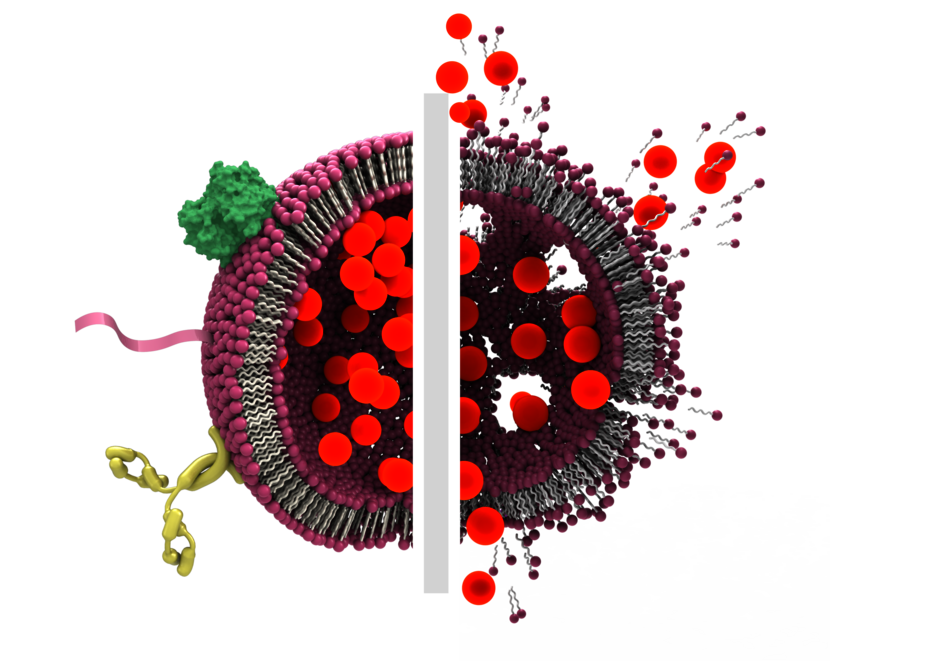
Liposomes are lipid-based nanovesicles used in bioanalysis, drug delivery and as cell biomimick. Our research focuses on their application in bioanalytical assays for signal amplification in high-throughput assays, biosensors and rapid tests. We also study them as substitute for red blood cells in hemolysis and complement disease-associated assays. Various liposome synthesis methods enable us control over their composition, size, stability and nature of the encapsulants and the insertion of surface ligands during or post synthesis. We routinely characterize the liposomes through dynamic light scattering (DLS), zeta potential measurement, ICP for the total lipid concentration, and various optical and electrochemical methods relating to their encapsulant yield and stability. In the meantime we have very good control over the liposome’s surface chemistry and can attach small ligands, receptors, proteins, nucleic acids covalently and quantitatively onto their surface.
To-date, we have established protocols that allow for reliable liposome synthesis and for their physical, chemical and biological characterization. Comparing liposomes to other signal generation and amplification means such as enzymes, quantum dots, gold nanoparticles, and fluorescence molecules had demonstrated their superior performance for bioanalytical sensors.
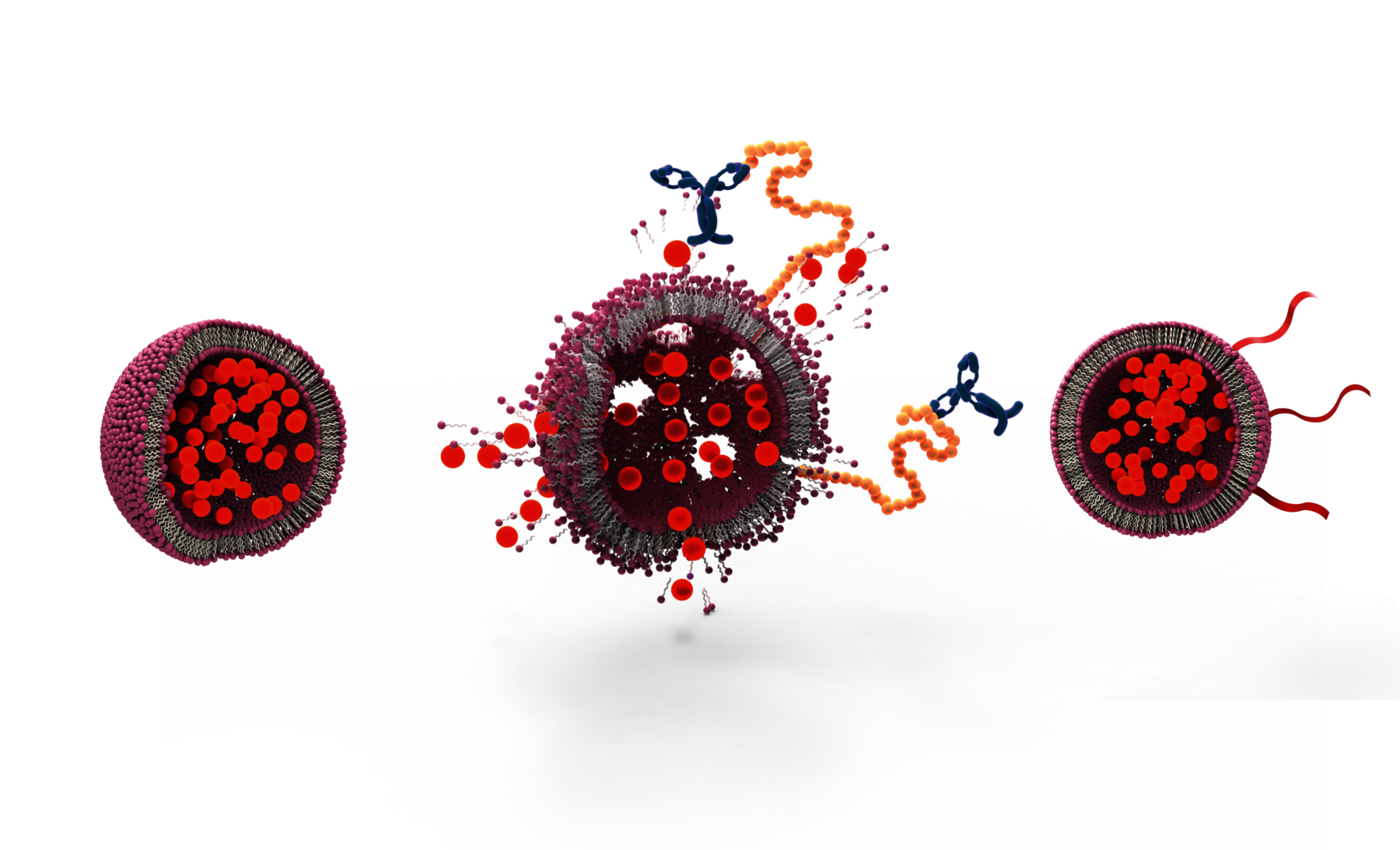
We also study liposome stability under extreme conditions including dehydration, lyophilization, and storage at temperatures above 40 °C, in blood, urine and other matrices. We have investigated liposomes for nucleic acid, protein, and whole cell detection, and their use for bioimaging and for multiplexing. New projects investigate the development of multimodal liposomes to further enhance their bioanalytical capabilities and as biomimic for the analysis of the complement system.
Over the years we have worked on numerous international and national research programs together with colleagues in Europe, South East Asia and the USA as well as industrial partners enabling us to challenge the liposome application to various diseases, food and environmental monitoring-related problems and their comparability and competitiveness in comparison to other signal generating systems. Checkout our collaborators’ links for their research interests.
For example:
- Rink, S., Kaiser, B., Steiner, M.-S., Duerkop, A., Baeumner, A.J. “Highly sensitive interleukin 6 detection by employing commercially ready liposomes in an LFA” Analytical and Bioanalytical Chemistry, (2022) 414: 3231–3241, https://doi.org/10.1007/s00216-021-03750-5
- Yagati, A.K., Behrent, A., Tomanek, V., Chavan, S.G., Go, A., Park, S.R., Jin, Z., Baeumner, A.J., Lee, M. “Polypyrrole-palladium nanocomposite as a high-efficiency transducer for thrombin detection with liposomes as a label” Analytical Bioanalytical Chemistry (2021) 3205 - 3217, https://doi.org/10.1007/s00216-021-03673-1
- Hofmann, C., Kaiser, B., Märkl, S., Duerkop, A., Baeumner, A.J. ‚ Cationic liposomes for generic signal amplification strategies in bioassays, Analytical and Bioanalytical Chemistry, 412(14), 3383-3393. Front cover, https://doi.org/10.1007/s00216-020-02612-w
- Hermann, C., Hofmann, C, Duerkop, A., Baeumner, A.J. “Magnetosomes for bioassays by merging fluorescent liposomes and magnetic nanoparticles: encapsulation and bilayer insertion strategies“ Analytical and Bioanalytical Chemistry (2020), 412, 6295–6305, https://doi.org/10.1007/s00216-020-02503-0
- Mayer, M., Takegami, S., Neumeier, M., Rink, S., Jacobi von Wangelin, A., Schulte, S., Vollmer, M., Griesbeck, A.G., Duerkop, A., Baeumner, A.J., “Electrochemiluminescence Bioassays with a Water-Soluble Luminol Derivative Can Outperform Fluorescence Assays” Angew. Chem. Int. Ed. (2018), 57, 408-411, DOI: 10.1002/anie.201708630
- Fenzl, C., Hirsch, T., Baeumner, A.J. “Liposomes with High Refractive Index Encapsulants as Tunable Signal Amplification Tools in Surface Plasmon Resonance Spectroscopy” Anal. Chem., 2015, 87 (21), pp 11157–11163, DOI: 10.1021/acs.analchem.5b03405
- Edwards, K.A., Baeumner, A.J. “Enhancement of Heterogeneous Assays using Fluorescent Magnetic Liposomes” Anal. Chem. vol 86 (13), pp. 6610 – 6616 (2014), DOI: 10.1021/ac501219u
- Edwards, K.A., Meyers, K. J., Leonard, B., Baeumner, A.J. “Superior performance of liposomes over enzymatic amplification in a high-throughput assay for myoglobin in human serum” Anal. Bioanal. Chem. vol. 405(12), pp. 4017-4026 (2013), DOI: 10.1007/s00216-013-6807-3
- Edwards, K.A. and Baeumner, A.J. “DNA-Oligonucleotide Encapsulating Liposomes as a Secondary Signal Amplification Means” Analytical Chemistry, vol. 79(5), pp. 1806 – 1815 (2007), DOI: 10.1021/ac061471s