

Hess Lab, Bioinorganic Chemistry
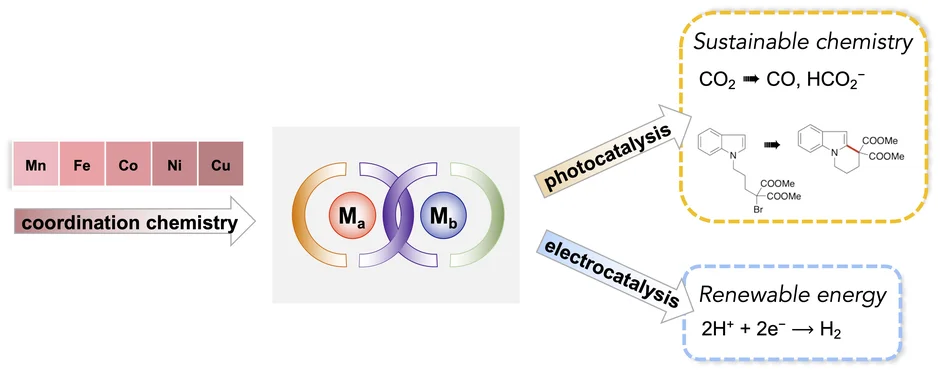
Our research spans areas of inorganic, bioinorganic and organometallic chemistry. We are developing photo- and electrocatalysts relevant to renewable energy and sustainable chemistry. We design molecular inorganic complexes based on first row transition metals, that can serve as catalysts for small molecule reactions (e.g. H2 evolution, CO2 reduction), as well as for the functionalization of organic compounds. We are particularly interested in how the electronic structure and redox properties of our complexes affect catalysis, and how to harness metal-metal interactions to enhance catalytic efficiency.
Our work involves synthesis, reactivity studies, electrochemistry and a wide range of inorganic spectroscopic methods. We welcome new members to join our team to design and study new efficient transition metal catalysts.
Molecular catalysts for small molecule activation

A major research area centers on the development of catalysts for multi-electron reactions, particularly H2 evolution and CO2 reduction. We are interested in how the involvement of redox active ligands, the extended coordination environment, and metal-metal interactions can foster activity and selectivity. Our complexes consist of earth-abundant, first-row transition metals and have unique photochemical properties, offering a wide range of photo-accessible redox states. A key aim is to develop self-sensitized photocatalysts for the small molecule reactions. An example of our recent work in this area can be found here:
M. Huber, C. R. Hess "Lewis acid-promoted self-sensitized photocatalytic CO2 reduction by a bimetallic Fe complex" J. Inorg. Biochem. 2026, 277, 113230. DOI:10.1016/j.jinorgbio.2026.113230
Photocatalysis
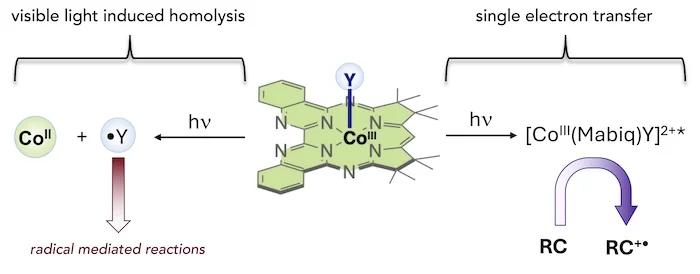
Another area of research involves the application of our complexes to organic functionalization reactions. Our transition metal photocatalysts are particularly well suited for such reactions, since they can engage in photo-induced single electron transfer as well as visible light induced homolysis. Thus, the metal center acts as both the photosensitizer and organometallic catalyst. In this program, we are likewise examining second coordination sphere effects on selectivity, and the use of bimetallic complexes for co-catalytic processes. The research is an integral aspect of the CRC 325 on “Assembly Controlled Chemical Photocatalysis (externer Link, öffnet neues Fenster)”. For a recent publication in this area see:
- O. Z. Esezobor, W. Zeng, L. Niederegger, M. Grübel, C. R. Hess "Co–Mabiq Flies Solo: Light-Driven Markovnikov-Selective C- and N-Alkylation of Indoles and Indazoles without a Cocatalyst", J. Am. Chem. Soc., 2022, 144, 2994. DOI:10.1021/jacs.1c10930
Artificial Metalloenzymes
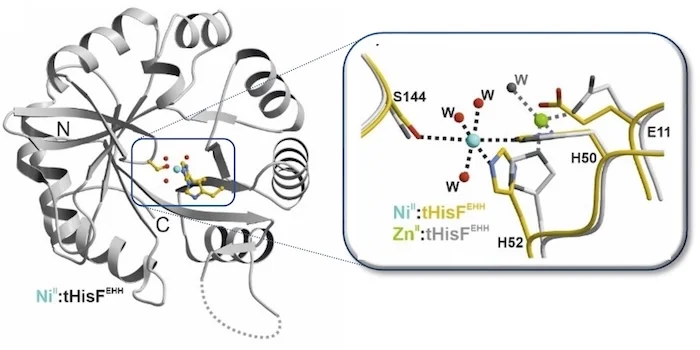
Finally, we also have research projects concerning the design of artificial enzymes. These projects lie at the interface of chemistry and biology. Projects center on the incorporation of transition metal complexes within protein scaffolds, where the molecular complexes serve as catalytic sites or redox partners. For more info, see:
- A. E. Wertz, I. Rosenkampff, P. Ibouanga, M. Huber, C. R. Hess, O. Rüdiger, H. S. Shafaat "A semisynthetic, multicofactor artificial metalloenzyme retains independent site activity" J. Biol. Inorg. Chem. 2025, 30, 13. DOI:10.1007/s00775-025-02095-z
M. Beaumet, A. Dose, A. Bräuer, J.-P. Mahy, W. Ghattas, M. Groll, C. R. Hess "An artificial metalloprotein with metal-adaptive coordination sites and Ni-dependent quercetinase activity" J. Inorg. Biochem., 2022, DOI: 10.1016/j.jinorgbio.2022.111914