

In an institution such as the seed bank Regensburg, plant seed material is stored in such a way that it remains viable for a long time (years to decades). To achieve this goal, the seed must go through a number of steps:
Collection
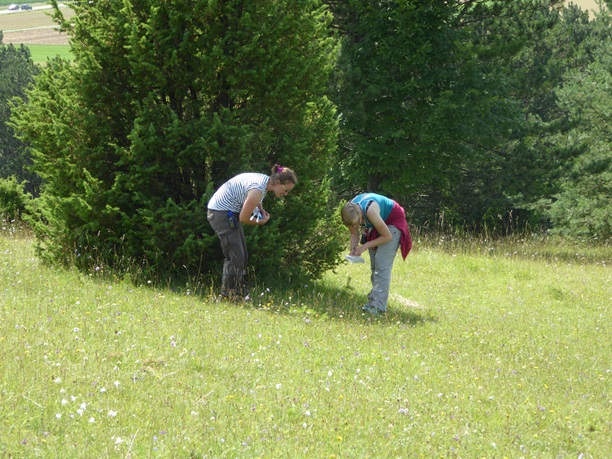
Before seeds can be stored in the seed bank, they have to be collected. Although this process sounds quite simple, it is comparatively complicated, as international standards must be complied with. Before collection begins, any necessary authorisations are obtained in consultation with the relevant authorities and information on the location is obtained by contacting local experts. Only then are the seeds collected. The primary aim of the collection is to map the genetic variation of a species or its populations. To achieve this, as many representative populations as possible across the species’ range and as many individuals as possible within a population, must be sampled. However, at most 20% of the available seeds are sampled, in order not to jeopardise the population in situ. The seeds must be collected at optimum maturity to maximise longevity and germination capacity, which often requires multiple trips to the growth sites. Information on the collection and the conditions at the site are documented in a collection sheet.
 1
1
Purification and portioning
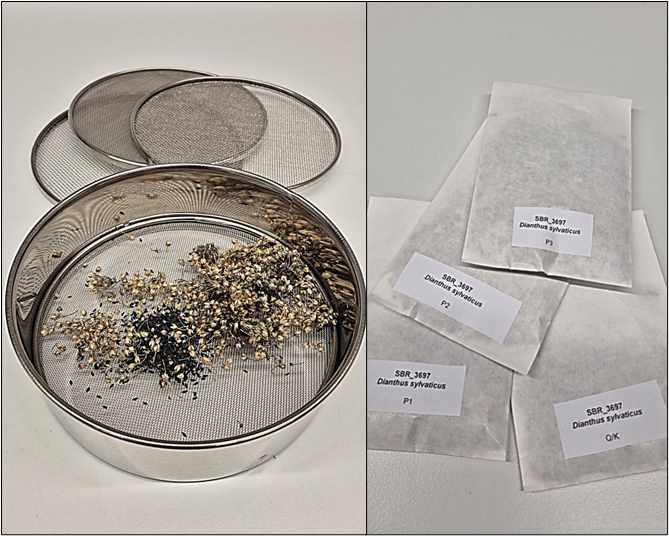
Before being stored in the seed bank, the collected seed must first be cleaned. This means that surrounding plant material, empty seeds, impurities and insect infestation are removed. The large variety of different seed shapes makes automated processes difficult, so the seeds are usually cleaned manually using dissecting instruments, stereo magnifying glasses, cleaning sieves and airflow. The number of seeds is then determined (this is done manually or with the help of a seed counting machine) and the thousand-grain weight is calculated. The seed material is then divided into three portions. One portion is used for long-term storage, a second as a safety duplicate for separate storage and a third portion is used for short-term storage for regular viability checks and for distribution to potential conservationists.
 2
2
Determination of viability
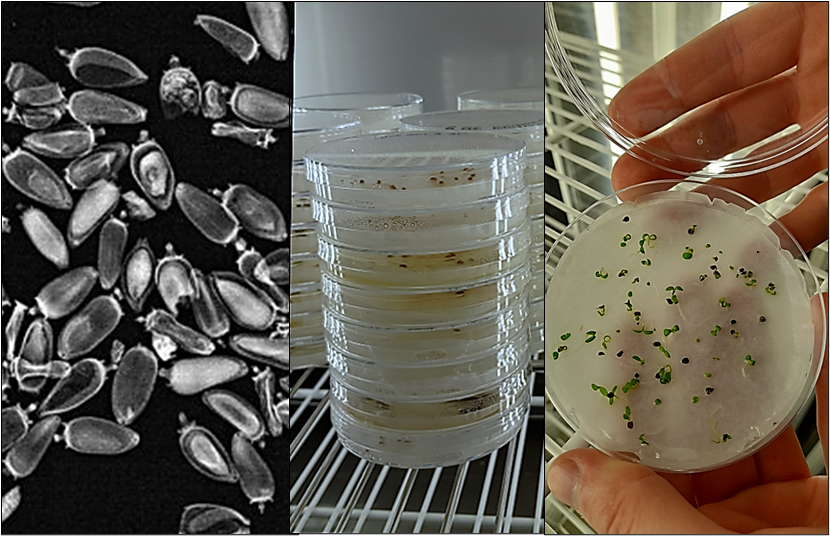
Seed quality is first analysed using a seed X-ray machine, which can be used to determine the proportion of unfilled seeds. Germination experiments and tetrazolium tests are then carried out to determine the viability of the filled seeds. Species-specific conditions are selected for the germination experiments in order to find out under which conditions the maximum germination capacity is achieved. Climatic chambers with different temperature and light regimes are used for this purpose. Depending on the species, the seeds are also prepared mechanically or chemically for the germination experiment.
 3
3
Drying, packaging and storage
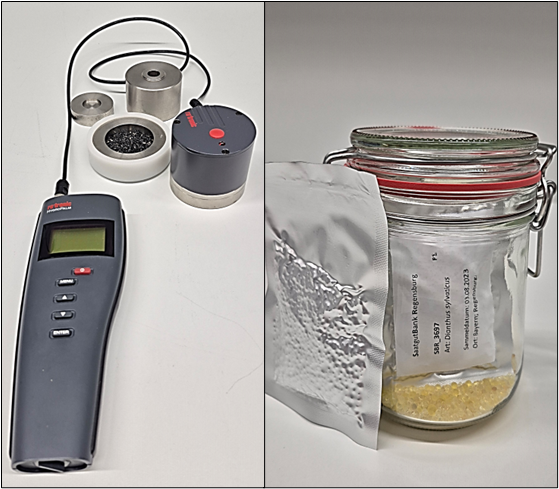
The seeds are then dried in preparation for storage. Around 92% of Central European species produce desiccation-tolerant seeds, whereas tropical plants predominantly have desiccation-sensitive seeds. Seeds of Central European species can therefore be stored well in seed banks. For effective and safe storage, the seeds should have a water content of about 5 %, which corresponds to an equilibrium moisture content of the environment of 15 %. In the Regensburg seed bank, the seeds are therefore dried in a special seed drying chamber at 15 °C and an ambient humidity of 15 % before they are stored. The seed portions are packed in paper bags for storage in the seed bank. The bags are then packed separately per portion in light-, water- and airtight aluminium composite bags, which are then sealed in a vacuum chamber sealer in the absence of air. The aluminium bags are labelled accordingly and provided with information on the type, collection location and date, as well as a unique accession designation. The aluminium bags are then placed together with silica gel in airtight glass containers and frozen at -18°C in freezers.
 4
4


Photos: 1, Theresa Lehmair; 2, Lina Begemann; 3, Judith Lang/Lina Begemann/Lina Begemann; 4, Lina Begemann