

All six subjects (German, English, Protestant Religion, Latin, Mathematics, Music) involved in FALKO-PV share a uniform theoretical background on which the interdisciplinary framework conceptualisation is based. On the one hand, this ties in with research into the professional competence of teachers and, in particular, their domain-specific professional knowledge, which is regarded as guiding their actions. On the other hand, it is based on the extensive research discourse on teaching quality in the context of the process-mediation-product paradigm and on instructional interdependencies, as summarised in the cascade model by Krauss and colleagues (2020). Other important points of reference are the didactics discourses on these topics in the respective disciplines.
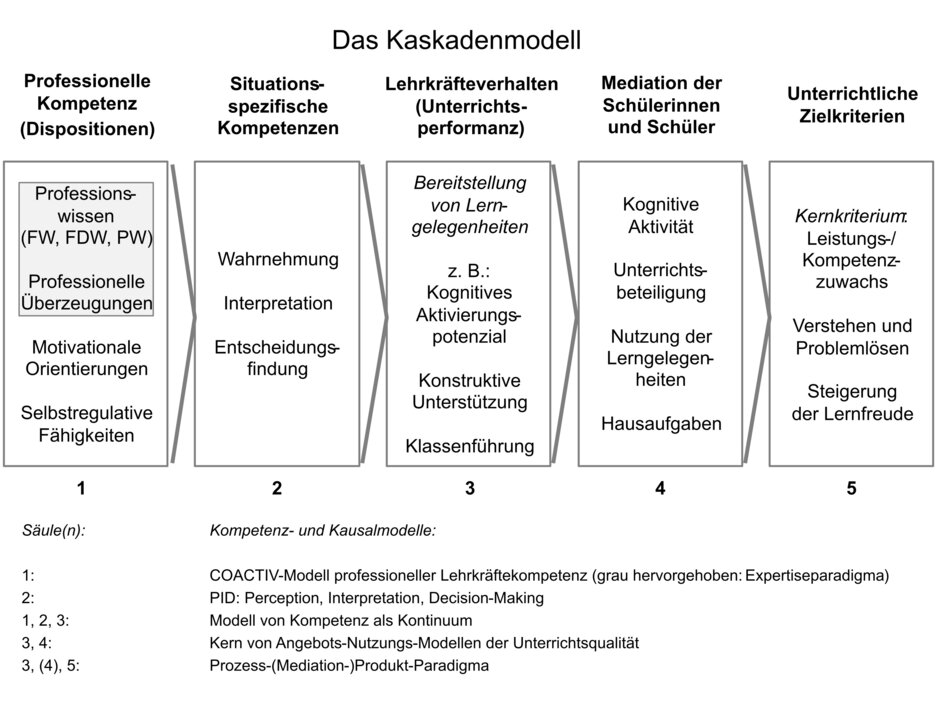
The central hypotheses that the junior research group aims to empirically test can be illustrated well using the cascade model by Krauss and colleagues (2020). To simplify the illustration, this model depicts an idealised chain of effects from teacher competence to teaching performance to pupils' performance. The mutual relationship between the individual pillars has not yet been conclusively clarified and interactions between them cannot be ruled out. However, it can be assumed that the professional competence of teachers (pillar 1) significantly influences their perception, interpretation and decision-making (pillar 2) and thus also their behaviour in specific teaching situations (pillar 3). Their performance creates learning opportunities, the quality of which can be described using the three generic basic dimensions of good teaching - classroom management, constructive support and cognitive activation. Whether pupils actually make use of these opportunities (pillar 4) can depend on a wide range of factors at an institutional, contextual or individual level and can only be guaranteed to a limited extent by the teacher. Ideally, it leads to performance-related, affective or socio-emotional learning success on the part of the pupils (pillar 5). The cascade model thus combines different theoretical approaches in educational research such as the COACTIV model of professional teacher competence, which is inherent to the expertise paradigm, the model of competence as a continuum, the supply-use model of teaching quality and the process-mediation-product paradigm.
Further information and descriptions of the individual elements in the pillars can be found below.
Literature mentioned
Krauss, S., Bruckmaier, G., Lindl, A., Hilbert, S., Binder, K., Steib, N. & Blum, W. (2020). Competence as a continuum in the COACTIV study: the “cascade model”. ZDM Mathematics Education, 52, 311-327.
Lindl, A., Krauss, S. & Buchholtz, N. (2023). Professionswissen von Mathematiklehrkräften – eine einleitende Übersicht. In S. Krauss & A. Lindl (Hrsg.), Professionswissen von Mathematiklehrkräften - Implikationen aus der Forschung für die Praxis (S. 1-35). Berlin: Springer.