

Our introductory video with key information on the study provides a quick overview of the core questions of FALKO-PV and how you as a teacher can support our project.
As the diversity and complexity of teaching cannot be simulated in a laboratory, in order to gain new insights into this, we have to go to where it takes place on a daily basis - in the classroom.
To this end, we looked for and found teachers who were willing to be scientifically accompanied in their teaching in a specific grade in the two school years 2023/2024 and 2024/2025. This included data acquisition on them as teachers, on their lessons and on the pupils, whereby certain elements were only optional and could also be omitted.
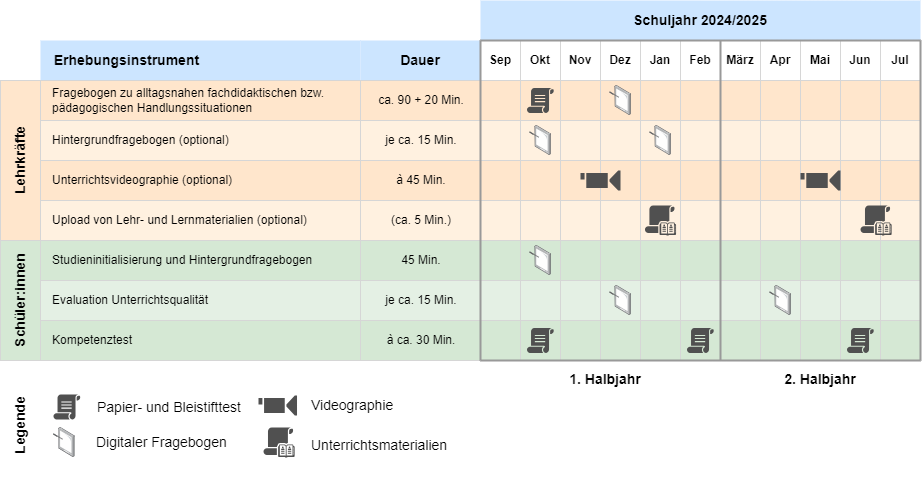
Test instruments
At the centre are two tests on the subject-specific and pedagogical professional knowledge of teachers (approx. 90 + 20 minutes), which were carried out at two points in time as paper and pencil tests.
These were flanked by a two-part online questionnaire (approx. 15 minutes) at two points during the first half of the school year, which took into account important influencing variables such as educational biographical background, beliefs about teaching and learning processes or the experience of professional stress.
We also wanted to find out more about the lessons: If all participants agreed, up to two lessons (45 minutes each, max. one hour per school term) were videotaped and selected teaching materials such as written performance records, worksheets or blackboard pictures were made available to us.
In order to track the average performance development of pupils over an entire school year, they were given subject-specific, curriculum-valid competence tests at three points in time (approx. 30 minutes each; at the beginning and end of the first and at the end of the second half-year). This was accompanied by a survey of their socio-demographic background using a digital questionnaire at one point in time (approx. 18 minutes) and a digital evaluation of teaching quality using the project's own web app AMADEUS at two points in time (approx. 2 x 15 minutes each).
Participating subjects
For pragmatic research reasons, a specific grade was focussed on for each subject in which the main study was conducted. The surveys of pupils are curricularly valid and aligned with the content and competences of the curriculum for this grade.
| Realschule | Gymnasium | |
|---|---|---|
| German | 6th grade | 6th grade |
| English | 9th grade | 10th grade |
| Protestant religious education | 9th grade | 10th grade |
| Latin | 9th/10th grade | |
| Mathematics | 6th grade | 8th grade |
| Music | 6th grade | 6th grade |
The survey materials for pupils were curricularly validated in line with the content and competence requirements of Bavarian secondary school and grammar school curricula and optimised for this purpose.
Time frame of the study realisation
In all measures of the study, we always endeavoured to keep any effort to a minimum and to use our participants' time as economically as possible. As part of the study participation, neither the creation or duplication of survey material nor the correction or evaluation of survey material was expected. All necessary preparation, correction or evaluation measures were carried out by the project.
The teachers were only responsible for conducting the study and forwarding the materials on site.
As can be seen from the description of the course of the study (see above), we accompanied the teachers for an entire school year. All data therefore relates to a complete school year. The amount of work required to participate in the skin study was approximately 150 minutes outside of regular lesson time - based on an entire school year. In addition, there was the optional videography of two lessons (45 minutes each, max. one hour per school term), which, however, took place during regular lesson time and should not be "specially" prepared from a research perspective.
Approximately 140 minutes were estimated for conducting the data acquisition with pupils - also in relation to an entire school year. The competency tests used were designed in such a way that they can be understood as subject-specific learning and feedback opportunities and can possibly also be used for performance evaluation. In addition, all survey elements could in principle also be carried out in (non-subject) substitute lessons.
Legal basis
The research project of FALKO-PV is supported by the Bavarian State Ministry of Education and Cultural Affairs, has been reviewed in terms of content and data privacy law and approved under file number IV.10-BO4106.2024/29/10 of 23 July 2024 for secondary schools and IV.7-BO5106/248/29 of 10 May 2023 for grammar schools. The data acquisition is based on your consent in accordance with Art. 6 para. 1 sentence 1 lit. a) in conjunction with Art. 9 para. 2 lit. a) of the European General Data Protection Regulation (GDPR).
For the sake of good order, we would also like to point out that the participating school must be informed by submitting a copy of this letter of authorisation. The headteacher ultimately decides on the implementation of an authorised survey in consultation with the parents' council or - if no such council has been established at schools - the pupils' committee (Section 24 (1) sentence 4 Bavarian School Regulations - BaySchO).