
Van der Waals heterostructures with magnetic components
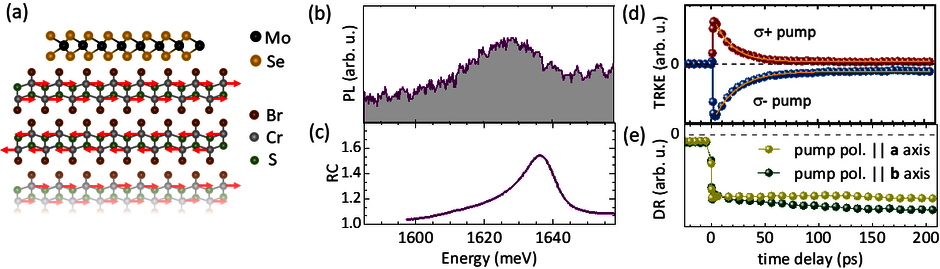
Our goal is to achieve improved control over excitons and other electronic quasiparticles in van der Waals heterostructures by integrating additional functional layers. These heterostructures are based on monolayers of semiconducting transition metal dichalcogenides such as MoSe₂ or WSe₂, combined with functional materials such as the layered antiferromagnet CrSBr (Fig. 1a).
Time-resolved experiments are performed using a tunable two-color pump–probe setup based on a mode-locked Ti:sapphire laser and a glass fiber for white-light continuum generation. This configuration enables four complementary measurements within a single experimental run: time-resolved Kerr ellipticity (TRKE), transient differential reflectivity (DR), white-light reflection contrast (RC), and photoluminescence (PL).
The emission and absorption properties of quasiparticles are investigated using PL (Fig. 1b) and RC (Fig. 1c), while TRKE (Fig. 1d) and DR (Fig. 1e) provide insights into their spin and population dynamics.