Semiconductor moiré materials with strong spin-orbit coupling
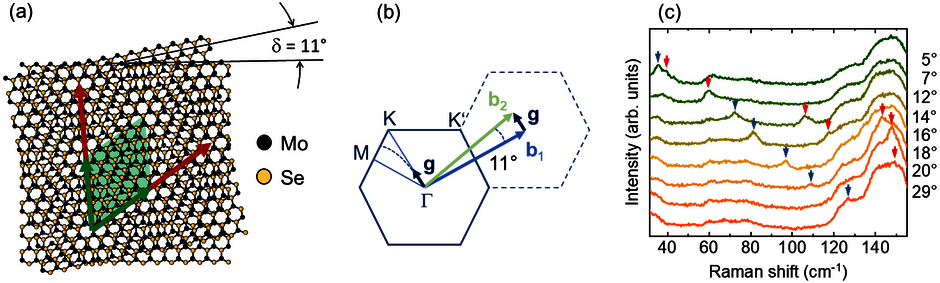
This project investigates the effects of moiré superlattices (Fig. 1a and 1b) in van der Waals homo- and heterobilayers based on semiconducting transition metal dichalcogenides, in particular MoSe₂, WSe₂, and WS₂. Moiré superlattices arise in these structures due to differences in the lattice constants of the individual layers and/or a non-zero twist angle between them (Fig. 1a).
In selenide-based heterostructures (e.g., MoSe₂/WSe₂), atomic reconstruction occurs in both untwisted and small-angle twisted configurations. In contrast, sulfide–selenide heterobilayers (e.g., MoSe₂/WS₂) exhibit moiré superlattices even without twisting due to their larger lattice mismatch.
To experimentally investigate these systems, we employ low-frequency resonant Raman spectroscopy (e.g., Fig. 1c), continuous-wave and time-resolved photoluminescence, as well as time-resolved pump-probe spectroscopy.