

Teacher Training Programs
Navigation
Here you can find the first-semester introductory presentation (opens in a new window). (This PDF is not accessible) (October 5, 2026).
Students of English as “Didaktikfach” will find their presentations at “Didaktikfach Englisch Grundschullehramt (opens in a new window). (This PDF is not accessible)” and “Didaktikfach Englisch Mittelschullehramt (opens in a new window). (This PDF is not accessible)” (both October 6, 2026).
At the Department of English and American Studies, you can study English for the following school types:
- Grundschule: English as major subject (Unterrichtsfach) or as a minor subject (Didaktikfach) (only in the winter term)
- Mittelschule: English as major subject (Unterrichtsfach) or as a minor subject (Didaktikfach), including as a minor subject for the program in Special Needs Education (Sonderpädagogik)
- Realschule: English as one of two major subjects (Unterrichtsfach)
- Gymnasium: English as one of two major subjects (vertieft studiertes Fach)
Please note:
Due to the very high number of students in the B.A. and teacher training programs at the Department of English and American Studies, students may not be able to complete their studies within the standard period of study (Regelstudienzeit)! Waiting times for the admission to many classes are to be expected.
A very good knowledge of English (see below) is essential to actively and successfully participate in all courses in the required manner.
Gallery


First-Semester Students
Introductory Meetings
First-semester students (incl. students coming from other universities and students changing their study programs):
All relevant information for beginning your studies will be provided on the website of the Central Department for Course Counseling (external link, opens in a new window).
There are introductory information meetings for all majors during the week before classes start (to find the rooms, please use --> UR walking (external link, opens in a new window), maps --> campus map and room finder).
Lehramt Englisch Unterrichtsfach Grundschule, Mittelschule, Realschule, Lehramt Gymnasium (two sessions):
- Monday, October 5, 2026: 2:00–3:30 p.m. (H2)
- Monday, October 5, 2026: 3:30–5:00 p.m. (H2)
Didaktikfach Englisch Grundschule (Grundschule allgemein):
- Tuesday, October 6, 2026: 8:15 a.m. – 12:30 p.m. (H20)
Englisch: 10:20–10:30 a.m.
Didaktikfach Englisch Mittelschule (Mittelschule allgemein):
- Tuesday, October 6, 2026: 8:45 a.m. – 12:30 p.m. (H4)
Englisch: 11:00–11:15 a.m.
Please contact the degree program coordinators if you have any questions.
Recommended Courses for Your First Semester
You will find an overview of all compulsory courses in the teacher training programs, according to the currently valid examination regulations (LPO) and study recommendations below (--> “Which Courses Am I Supposed to Take?”). These lists show the basic structure of your studies in linguistics, literary and cultural studies, language, and teaching English, which you should supplement with non-mandatory courses according to your interests and needs (e. g. with regard to exam/thesis preparation). Generally, we recommend taking some of the following courses in the first semester:
- English as a major subject (vertieft studiertes Fach/Unterrichtsfach)
- 35865 General Language Course 1
- 35701 Theory and Structure
- 35752 Culture & Society: UK
- 35801 American Literary History
- 35752 British Literary History
- 35760 Introduction to Literary and Cultural Studies
- English as a minor subject (Didaktikfach einer Fächergruppe der Grund-/Mittelschule):
- 35865 General Language Course 1
Other combinations are possible. However, students should try to successfully complete the core modules Linguistics, Language, Literary Studies, and Cultural Studies within approximately three to four semesters. The dates of the courses offered each semester can be found in the detailed course catalog on SPUR.
At the university, there are a number of other course types (such as lectures, seminars, and advanced seminars). The following list provides you with a brief overview (opens in a new window). (This PDF is not accessible) of these.
Organizing Your Studies
Program Structure and Subject Combinations
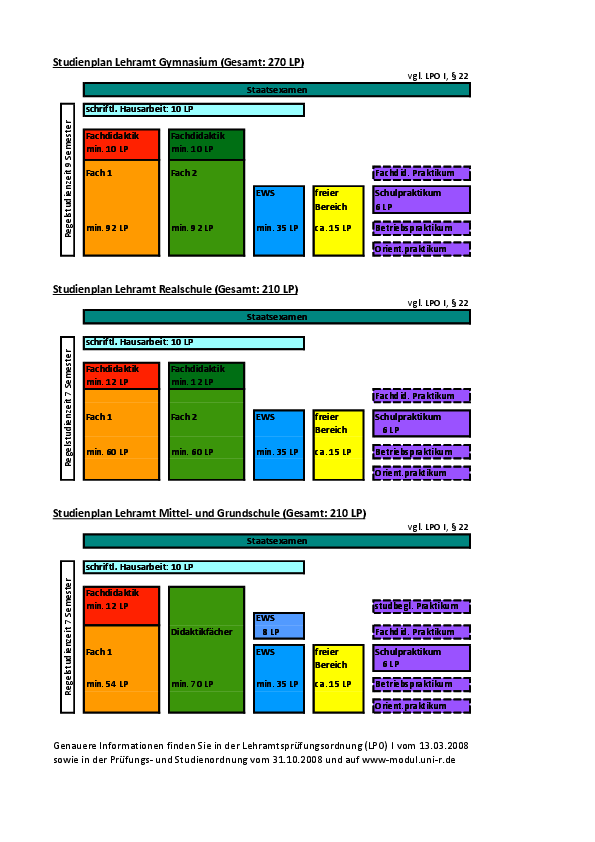
This diagram shows the program structure of the Teacher Training Programs.
By clicking on the school type of your choice, you will be directed to the page of the University Regensburg Teaching Education Center (Regensburger Universitätszentrum für Lehrerbildung (RUL)), where you can find comprehensive overviews of possible subject combinations:
Which Courses Am I Supposed to Take?
There is a number of compulsory classes that you have to take in the course of your studies. These classes vary depending on your study program. Which compulsory courses you have to attend is precisely stated in the module descriptions for your study program.
To view all compulsory courses on one page, please have a look at these overview tables:
1. Start of studies in or after summer semester 2026
- Teacher Training English: Gymnasium
- Teacher Training English: Realschule
- Teacher Training English: Mittelschule and Grundschule
- Teacher Training English: Mittelschule and Sonderpädagogik–Didaktikfach
- Teacher Training English: Minor for Grundschule–Didaktikfach
2. Start of studies in or after summers semester 2025
- Teacher Training English (start of studies in or after summer semester 2025) (changes to the core module cultural studies M14)
- Teacher Training English (start of studies in or after winter semester 2022/23)
(changes to the core module Linguistics M12) - Teacher Training English (start of studies in or after summer semester 2020)
(changes to the core module Linguistics M12) - Teacher Training English (start of studies between winter semester 2012/13 and winter semester 2019/20)
English as minor subject (Didaktikfach) in the Teacher Training Program for Grundschule or Mittelschule
Students who study English als one of their three minors for Grund- or Mittelschule will find the mandatory courses in the module descriptions (Modulkataloge).
Foreign Language Skills
Students who study English in the Teacher Training Programs will need to show some proof of foreign language skills in addition to English by the time they apply for admission to their state exams at the Examinations Office (as regulated by the respective examination regulations).
If these foreign language skills are not yet available at the time of enrollment, they can be acquired during the course of studies.
The required language skills vary depending on the course of study. You can find more information here:
- Bekanntmachung des Bayerischen Staatsministeriums für Unterricht und Kultus über den Nachweis der nach der Lehramtsprüfungsordnung I vorgeschriebenen Fremdsprachenkenntnisse
- Overview of the foreign language skill requirements for the different teacher training programs
Pronunciation Exam (Ausspracheprüfung)
General
All students (B.A. and Lehramt) are required to have their phonetic (pronunciation) skills tested to complete their core module language practice (Basismodul Sprachpraxis). This pronunciation test should usually be taken either after GLC A or after Composition or after GLC B at the very latest. Students may take the course "Exercises in English Pronunciation" to prepare for the pronunciation test. Those who do not pass the pronunciation test must enroll in the course "Exercises in English Pronunciation" and pass the test before they can proceed to GLC C and other courses in the intermediate module language practice (Vertiefungsmodul Sprachpraxis). Also, the course "Exercises in English Pronunciation" is a compulsory component for Lehramt Grundschule students who take English as a Didaktikfach.
Others are welcome to take the course on a voluntary basis to improve their spoken English!
You really should take every opportunity to speak and listen to English. Some suggestions include seeing a play performed by the English theater group, RUPs, watching movies and TV series at home, listening to audio books, podcasts, etc.
Registering for and taking the exam
The exams take place at the end of term, during the first lecture-free week.
Students must register for the exam both on SPUR and on FlexNow so that they can take part in the pronunciation exam! Taking the pronunciation exam is not possible if you register only on SPUR or only on FlexNow!
Registration runs until the end of the regular registration period in FlexNow. SPUR registration runs the week after FlexNow registration ends. Find both registration periods here.
When registering on SPUR, you can choose between different groups and thus
specify a preferred time slot (Monday/Tuesday, morning/afternoon) for the
examination.
a) Registration on SPUR:
*where: core module Language Practice (Basismodul Sprachpraxis): 35890
Pronunciation Exam.
*who: all B.A. and teacher training students except those studying English as
a “Didaktikfach” for “Lehramt Grundschule” (see above).
b) Registration on FlexNow:
*where: core module Language Practice (Basismodul Sprachpraxis) -->
Pronunciation exam
*who:
- ALL students in the B.A. study programs, students in the teacher training
programs with English as “Unterrichtsfach” (Grundschule, Mittelschule,
Realschule), students who study English as a “Didaktikfach” for “Lehramt
Mittelschule”, students who study English for “Lehramt Gymnasium”.
- exempt: students who study English as a “Didaktikfach” for “Lehramt
Grundschule” (see above).
Please make sure you are in a room with a stable internet connection for the exam!
Study and Examination Regulations
The above overviews have been compiled with great care; however, only the original wording of the respective examination regulations is legally binding. A thorough read of the examination regulations in the interest of a well-organized course of study is strongly recommended! You can find the study and examination regulations in the Teacher Training Programs here:
State Exam
The State Exam is an obligatory part of Teacher Education in Bavaria. As this only concerns students who speak German and contains several technical and legal terms, this section is only available in German.
Bitte beachten Sie:
Diese Übersicht wurde mit großer Sorgfalt zusammengestellt; rechtliche Verbindlichkeit hat jedoch lediglich der Originaltext der betreffenden Prüfungsordnung (hier: Lehramtsprüfungsordnung I (external link, opens in a new window) vom 13.3.2008).
Das genaue Studium der Prüfungsordnungen wird im Interesse eines geordneten Studienverlaufs dringend empfohlen!
Allgemeine Hinweise
Die Lehramtsstudiengänge enden mit der Ersten Staatsprüfung. Sie ist durch die Lehramtsprüfungsordnung I (external link, opens in a new window) vom 13.3.2008 geregelt.
Darin sind auch die allgemeinen und fachlichen Zulassungsvoraussetzungen, die Praktika und die Bestimmungen zur Bildung der Endnote geregelt.
- Fachliche Zulassungsvoraussetzungen: siehe §44 Abs. 1 für Grundschul-/Mittelschul-/Realschullehramt und §64 Abs. 1 für Gymnasiallehramt:
- Grundschul-/Mittelschul-/Realschullehramt: Bei der Anmeldung zum ersten Staatsexamen nachzuweisende Sprachkenntnisse nach § 44 LPO: Kenntnisse in Latein oder in einer romanischen Fremdsprache auf dem Niveau A2 des „Gemeinsamen europäischen Referenzrahmens für Sprachen“.
- Gymnasiallehramt: Bei der Anmeldung zum ersten Staatsexamen nachzuweisende Sprachkenntnisse nach § 64 LPO: Gesicherte Kenntnisse in Latein und Kenntnisse auf dem Niveau A2 des „Gemeinsamen europäischen Referenzrahmens für Sprachen“ in einer weiteren modernen Fremdsprache.
- Sprachkenntnisse siehe auch Informationen zu den Fremdsprachenkenntnissen auf unserer Homepage unter "Foreign Language Skills"
- Praktika: §34 => auf den Seiten des RUL gibt es Informationen zu den Praktika nach Schulart
- Schriftliche Hausarbeit ("Zulassungsarbeit"): siehe § 29 LPO sowie Homepage des Prüfungsamts. Betreuerin oder Betreuer in Englisch können sein:
- Fremdsprachendidaktik: Prof. Dr. Carola Surkamp, Sandra Binder, Dr. Max von Blanckenburg
- Amerikanistik: Prof. Dr. Volker Depkat, Dr. Birgit Hebel-Bauridl
- Anglistik: Prof. Dr. Anne-Julia Zwierlein, Prof. Dr. Benjamin Kohlmann, Prof. Dr. Jochen Petzold
- Englische Sprachwissenschaft: Prof. Dr. Jakob Leimgruber, Dr. Kerstin Richter, Dr. Thorsten Brato
- Notenbildung: §3 (Fachnote), §4 (Gesamtnote), sowie §44 Abs. 4 (Englisch Examensnote, Unterrichtsfach) und §64 Abs. 4 (Englisch Examensnote, vertieft)
Anmeldetermine:
- Im Prüfungsamt: Anmeldetermine siehe Prüfungsamt
- Unterlagen, die der Anmeldung beizufügen sind: siehe LPO I §§ 22 u. 24, sowie fachliche Zulassungsvoraussetzungen (s. o.)
- Prüferwünsche für die mündlichen Prüfungen: siehe GRIPS --> Sprach-, Literatur- und Kulturwissenschaften --> Anglistik und Amerikanistik --> Schleburg, Florian --> Prüferwunschverfahren Englisch
Prüfung Englisch Vertieft
(vgl. LPO I §64):
LITERATURWISSENSCHAFT (vert.) / LPO I §64 Abs. 3 nr. 1a:
- Prüfungsart: schriftliche Prüfung, 3 Stunden Bearbeitungszeit, in deutscher Sprache
- Inhalt: es werden mehrere Themen zur Wahl gestellt (Genaueres siehe hier unter "Information primarily for Students" --> "Information on the ‘Staatsexamen’ (in German)")
- geeignete Vorbereitungskurse: z. B. Vorlesungen, Pro- und Hauptseminare, Examensrepetitorien
SPRACHWISSENSCHAFT (vert.) / LPO I §64 Abs. 3 nr. 1b:
- Prüfungsart: schriftliche Prüfung, 3 Stunden Bearbeitungszeit, in deutscher Sprache
- Inhalt: es werden zur Wahl gestellt: zwei Aufgaben auf neuenglischer Textbasis und zwei Aufgaben auf historischer Textbasis; Genaueres: siehe Merkblatt (Orientierungshilfe siehe hier)
- geeignete Vorbereitungskurse: z. B. Vorlesungen, Pro- und Hauptseminare, Phonemic Transcription, Mittel-/Altenglisch Examenskurs
SPRACHPRAKTISCHE AUFGABE (vert.) / LPO I §64 Abs. 3 nr. 1c:
- Prüfungsart: schriftliche Prüfung (5 Std.)
- Inhalt:
1. Textproduktion (in englischer Sprache)
2. Sprachmittlung (Wiedergabe eines englischen Textes in deutscher Sprache)
- geeignete Vorbereitungskurse: z. B. GLCs, Academic Writing LA (Pflichtkurs im Profilmodul Skills), Sprachmittlung Examensrepetitorium, Cultural Studies Kurse
FACHDIDAKTIK (vert.) / LPO I, §64 Abs. 3 nr. 1d:
- Prüfungsart: schriftliche Prüfung, 3 Stunden Bearbeitungszeit, in deutscher Sprache
- Inhalt: drei Themen werden zur Wahl gestellt; jedes Thema gehört schwerpunktmäßig zu einem der in Abs. 2 Nr. 2a-d (§ 64 LPO) genannten Bereiche an
- geeignete Vorbereitungskurse: z. B. Examensvorbereitung Fremdsprachendidaktik Lehramt
SPRECHFERTIGKEIT U. LANDESKUNDE (vert.) / LPO I §64 Abs. 3 nr. 2:
- mündliche Prüfung (30 min), in der Fremdsprache
- es werden 2 Noten darauf erteilt: eine für Sprechfertigkeit, eine für Kenntnisse der Kulturwissenschaft
- geeignete Vorbereitungskurse: z. B. Culture & Society: UK / Introduction to American Studies, Cultural Studies Seminare, thematisch geeignete Vorlesungen
Prüfungsthemen
1) Überblickswissen British and Irish Cultural Studies
2) Überblickswissen USA
3) sowie ein Schwerpunktgebiet entweder aus der UK/Irland-Themenliste oder aus der USA-Themenliste- Themenliste
Prüfungen Englisch Unterrichtsfach
(siehe LPO I §44):
LITERATUR- oder SPRACHWISSENSCHAFT (Unterrichtsfach) / LPO I §44 Abs. 3 Nr. 1a:
- Schriftliche Prüfung, 3 Stunden Bearbeitungszeit, in deutscher Sprache
- es kann gewählt werden, ob die Prüfung in Literaturwissenschaft oder in Sprachwissenschaft abgelegt wird
- Inhalt: Sprachwissenschaft (Orientierungshilfe siehe hier); Literaturwissenschaft: 3 Themen werden zur Wahl gestellt (Genaueres siehe hier unter "Information primarily for Students" --> “Information on the ‘Staatsexamen’ (in German)”)
- geeignete Vorbereitungskurse: Vorlesungen, Proseminare, Text Analysis
SPRACHPRAKTISCHE AUFGABE (Unterrichtsfach) / LPO I §44 Abs. 3 nr. 1b:
- schriftliche Prüfung, Bearbeitungszeit 4 Stunden
- Inhalt:
1. Textproduktion (in englischer Sprache)
2. Sprachmittlung (Wiedergabe eines englischen Prosatextes in deutscher Sprache)
- geeignete Vorbereitungskurse: z. B. GLCs, Sprachmittlung Examensrepetitorium, Cultural Studies Kurse
FACHDIDAKTIK (Unterrichtsfach) / LPO I §44 Abs. 3 nr. 1c:
- Schriftliche Prüfung, Bearbeitungszeit 3 Stunden, in deutscher Sprache
- Inhalt: drei Themen werden zur Wahl gestellt
- geeignete Vorbereitungskurse: Examensrepetitorium Fachdidaktik (Zentrale Aspekte)
SPRECHFERTIGKEIT U. LANDESKUNDE (Unterrichtsfach) / LPO I §44 Abs. 3 nr. 2:
- mündliche Prüfung (30 min), in der Fremdsprache
- es werden 2 Noten darauf erteilt: eine für Sprechfertigkeit, eine für Kenntnisse der Kulturwissenschaft
- geeignete Vorbereitungskurse: z. B. Culture & Society: UK / Introduction to American Studies, Cultural Studies Seminare, thematisch geeignete Vorlesungen
Prüfungsthemen
1) Überblickswissen British and Irish Cultural Studies
2) Überblickswissen USA
3) sowie ein Schwerpunktgebiet entweder aus der UK/Irland-Themenliste oder aus der USA-Themenliste- Themenliste
Helpful Links
- University Regensburg Teaching Education Center: Regensburger Universitätszentrum für Lehrerbildung (RUL), including information regarding internships
- Information about the Educational Science component of your Teacher Training: EWS Info (in German) (external link, opens in a new window)
- University Library: tutorial (sub library for British Studies/American Studies) (external link, opens in a new window)
- Individual voice screening and other offers for teachers and students in the Teacher Training Programs at the Communication and Voice Center for Teachers
Contact
Degree Program Coordination
- E-mail address: studienorg.iaa(at)sprachlit.uni-regensburg.de (opens your email program)
- Tel: 0941 943-3667 (starts a telephone call, if your device allows this)
- Location: PT, 3.2.62
-
Important information:
Susanne Gürtner, M.A. (Tuesday–Friday)
Gabriele Mödl, M.A. (Monday–Thursday)
Melissa Deiß, M.A., student assistant
**************
We offer in-person office hours in PT 3.2.62. There is no need to make an appointment in advance.
Monday: 10 am–12 pm (no office hours on Monday, November 9)
Tuesday: 10 am–12 pm
Wednesday: 10:30 am–12:30 pm
Thursday: 10 am–12 pm
**************
For questions concerning your M.A. application, please contact Application.MasterDEAS@ur.de.